On renunciation…

On renunciation…

The weakness of samsara is impermanence. That is the key observation that allows us to cultivate renunciation. Everything flows; everything changes; nothing remains the same. Why be attached or averse?

Venerable Tashi Nyima

i. What does this mean to me?

I grew up in the Bronx in New York state. By the time I was in high school, I was going into ‘the city’ (Manhattan) on the subway by myself. When I was in the city, I was a total tourist. My favorite place to go was the touristy part of Times Square, especially at night.

At night Times Square came alive with marquees full of flashing lights. All the stores lit up. It was a little magical. There was always something bright and shiny and new going on. Not to mention the smell of street foods and the strains of music. There were people walking down the street offering cards or flyers for the latest Broadway show, or the newest place to buy some touristy “I Love New York” t-shirt.

Times Square is a microcosm of samsara. There’s always the next new thing. There are always shiny new houses, shiny new cars, shiny new jobs. All this glitter hides the truth of samsara. It’s like going to Times Square in the daytime. The streets are dirty and littered, and in the bright light of day, the shiny objects of the night are merely dull and uninteresting.

As the writer says, “The weakness of samsara is impermanence”. Nothing stays the same in samsara. The shiny new house comes with a thirty-year mortgage that will turn you gray eventually. The shiny new car comes with eye-watering payments, not to mention insurance.

The writer talks about cultivating renunciation. Renunciation of what? It’s not so much the bright shiny things, it’s how they enthrall us almost to the point of legitimate concerns fading away. The writer isn’t suggesting that we go around in hair shirts and ashes. That would serve no purpose. It would be just another form of attachment. Rather the writer is pointing out that all bright shiny things will one day turn to rust. And knowing this, “Why be attached or averse?” Instead, shouldn’t we renounce the enthrallments of samsara and turn our minds to the true bliss, true permanence, true being, true purity that is the Dharma?

ii. How would I explain this to someone else?

Renunciation comes with a negative connotation in our society. We think of hermits on mountaintops or out in the desert wearing rags, having ‘renounced’ the world. Our local friendly AI tells us that renunciation means, “the formal rejection of something, typically a belief, claim, or course of action.”

Renunciation is simply a rejection or a knowing choice to stop doing something or to stop believing something. In this case we’re talking about formally and consciously rejecting the idea that samsara has anything to offer. So many times, we make the mistake of believing what we experience in samsara and taking that for the truth of things.

This inevitably leads to unhappiness because, as the writer reminds us, “Everything flows; everything changes; nothing remains the same”. Whenever we accept anything in samsara at face value, we are placing causes for suffering into our lives. How many outfits do we have in our closets that are pushed all the way to the back, just a car ride away from Goodwill? Not only is everything we experience an internal mental representation, but “Everything changes; nothing remains the same”. What is it that remains the same with no retrogression? The Dharma. While in these limited bodies with our limited senses, the Dharma is the only reliable, unchanging thing we have.

Samsara, like Times Square at night, is very seductive. It appeals to the senses, attracts the mind, dominates our thoughts. It’s hard to remember that samsara is merely superimposed upon ultimate reality – the truth of how things are.

iii. How do I bring this into my life?

For me, the lure of samsara used to be nearly irresistible, like some powerful addiction. Like any addict, I was lost in the delusions of samsara, drowning in an ocean of misery. Now, after having had the good fortune to encounter and study the Dharma, I understand samsara for the illusion it is.

I won’t be running out and buying a hair shirt anytime soon though, but I will use the teachings of the Dharma, through wisdom and compassion, to help others. Helping others is the only true cause for happiness in samsara.

In my day-to-day life, what hooks me the most into being lured by samsara are my comforts. I like air conditioning. I like shopping for yarn, and knitting. I like, overall, being comfortable. I think we all do. But at what cost does our comfort come? Does it make us so indolent that we don’t ‘feel’ like studying the Dharma? Or acting compassionately? Or we feel like ignoring our own Buddha Nature when it becomes uncomfortable to help others?

As I study, meditate and practice, samsara becomes more and more transparent. The tricks of seduction become clear. Knowing these things, and having seen samsara for what it is, what is the best way to behave to bring me closer to expressing my Buddha Nature and recognizing it in others?

The writer reminds us that “The weakness of samsara is impermanence”. So, we know samsara is an illusion that will fade away like mist in the trained mind. Knowing this, we must turn to our conduct. We must move through samsara with wisdom and compassion for those caught up in the illusion. We must be patient and compassionate with our own progress on the path. We must cultivate renunciation and peace and renounce attachment and aversion. We must do these things because, as Shantideva reminds us, the Lord of Death is always at hand. We don’t know when his scythe will fall, only that it will inevitably fall. Knowing this, shouldn’t we do what we can for as long as we can?

On tomorrow’s laughter…

Currently I’m studying Heart Treasure of the Enlightened Ones with a Dharma friend, the Venerable Tashi Nyima.

This is my contemplation on the first line of verse 38 of the root text of Heart Treasure of the Enlightened Ones.

heart treasure

“Whatever appears is delusion and has no true existence;

Samsara and nirvana are just thoughts and nothing more.

If you can liberate thoughts as they arise, that includes all stages of the path;

Applying the essential instruction for liberating thoughts, recite the six-syllable mantra.”

 Full Disclosure:

It’s so easy to get taken in by ‘reality’ that it’s hard to write about the magic act without getting caught in it.

Written Tuesday, September 16th, 5 AM

Explain to someone else (making it my own)

When I was very young, I saw a movie called ‘Finian’s Rainbow’. It was about a leprechaun who’d come to this side of the rainbow chasing after the pot of gold someone had stolen from him on his side of the rainbow. That movie used to come on a lot. I’d watch it over and over. I think I was intrigued by the idea that a rainbow was something you could travel like a road and then end up on the other side in a whole new world.

As we go about our ordinary lives in samsara, we carry this same sense of child-like wonder. Is there, we ask ourselves again and rainbow potagain, that one act, or maybe that one job, or that one person that will give me a life on the other side of the rainbow? But time passes, we age, and we’re still on the wrong side of the rainbow, and the pot of gold doesn’t materialize. This makes us bitterly angry, frustrated. We become more desparately driven with each passing year to find that perfect life that always seems to lie just on the other side of whatever rainbow we’re chasing after.

This doesn’t work because there is no thing in samsara that is not a delusion generated by a deluded mind. The nature of samsara is that appearances arise when conditions are favorable, they last a few fleeting moments, then they pass away; just like rainbows. Yet we spend our entire lives chasing after delusional rainbows. Dilgo Khyentse says, “However much we might prefer to believe that things are permanent, they are not. Yesterday’s happiness turns into today’s sadness, today’s tears into tomorrow’s laughter.”

We live our lives in a kind of deluded madness. In our delusion, we are like dreamers in a dream looking for one thing—just one thing—that is real. In the dreamlike existence of samsara, it is only the deluded mind that makes it possible to create the illusion that any appearance is substantial, permanent, and independent of the deluded mind from which it arises.

We live like magicians who’ve forgotten that  magic is only a trick, slight of hand. We’ve become deluded to a point where we believe a woman can be sawed in half, then put back together. This is no less absurd than believing that money will bring us happiness, or that our One True Love will come and it will last forever, till every star falls from the sky.

***

 Apply to a past situation (how would it have been different?)

There are so many times in my past where I’ve been sucked in by the magic show of samsara. It’s hard to pick just one.

ladderThere was a time, about two and half decades ago, when I wanted to ‘make it’ in corporate America. I interviewed for an internal posting that I thought would be my dream job, and I got the position. It was everything I’d wanted. I was high profile in the marketing department of a managed dental care company. I managed my own projects. I had my own budget. I organized and put on meet and greets for clients from all over the country. I set my own hours.

I was miserable. I couldn’t bear all the pressure. I once missed a typo on a bulk mailing. It had already gone to the printer to be done on good paper in four color process—very expensive. It cost thousands to run new, corrected copies. I began to miss days at work. I couldn’t stand the thought of being there. My boss, who was totally caught up in the ‘climb the ladder and be a success’ delusion treated me with a mix of condescension and mild disgust. I was holding her back.

One day, something (I don’t remember exactly what) went horribly wrong. It was open enrollment and the pamphlets describing the different plans available had not been delivered to the client. This was in the days before the internet. No pamphlets meant that the entire open enrollment process came to a halt. I had the client calling and yelling at me. I had the client reps calling and yelling at me.

I had…the sudden urge to go shopping. I got my purse, went to Barnes & Noble, and went shopping for a couple of hours. This was in the days before cell phones. I was unreachable. After shopping, I went home. I went back to that job after this fiasco, but it was causing me terrible suffering. I felt like a sublime failure. I felt that I didn’t have it takes to be a ‘success’. I suffered for years after leaving that job, laboring under the delusion that I was just too stupid to ‘make it’.

Looking back on that time in my life, I can notice that all of my suffering came from attachment to a delusion. At that time in my life I imputed reality to the idea that becoming a corporate Vice President (the next step in that position) would make me happy. I also believed that not being alble to do that meant I was dumb or lazy or both.

If I’d been able to take a step back and breathe, and let some peace and clarity arise, I may have noticed that I couldn’t be a ‘success’ because a part of me simply didn’t believe the corporate myth of ‘making it’. That part was desperately trying to wake me up. If I’d been able to bring my attention to nurturing that part of myself, I may have ended my suffering that much sooner.

***

 Apply to an (ongoing) present situation (how does it matter today?)

Yesterday morning I sent the last bit of information needed to complete my background check. Yesterday afternoon the recruiter called to let me know that I’d be getting a ‘Final Offer’ via email in the next couple of days.

That’s it. One phone call that lasted maybe two minutes, and I was free of Interplanetary Title, Inc. I had the urge to go back to my desk and create an email with the subject line “Out of the Office…Forever!”, then send it to ‘All’. Thankfully, I resisted that urge. But it was tough.

An interesting thing has happened since the phone call. Nothing—and I do mean nothing at all—at Interplanetary Title has even a miniscule weight of reality in my mind. Being at work yesterday felt like being in a lucid dream. I took a look at my mind. I was really curious about how  my experience could suddenly be so different. After a bit, I realized that the three poisons (attachment, aversion, indifference) were nearly wholly absent from my experience of the workplace.

But this wonderful dreamlike experience would flip back and forth like an optical illusion…is it a wine glass or two faces? As soonwineglass as an afflicted emotion would arise, I’d be instantly sucked back into the ‘reality’ of Interplanetary Title. When I worked with letting the emotions pass, the dreamlike quality would return.

Wow. It amazed me that so-called ‘reality’ could flip from ‘real’ to ‘dream’ and back literally faster than you can snap your fingers. It was like a coin tossed high in the air and turning over and over—first heads, then tails, then heads. The day went on and I noticed that I was clinging to the dreamlike experience and not wanting it to change. I knew eventually this clinging would lead to attachment, so I worked with letting the dreamlike perception of reality rise and fall like waves on an ocean.

The sudden capacity to experience the dreamlike nature of work has made it so much easier to leave. I don’t feel like I’ll be giving up anything. That would be a little like being caught in a nightmare and saying…No, don’t wake me up. I’m enjoying my suffering.

Being able to experience the dreamlike quality of the workplace has been extraordinary. I always thought that experiencing waking reality as a dream would lead to a total lack of compassion, even though I’ve been told otherwise. Just the opposite is happening. Because I’m relatively free of my suffering under the terrible weight of that reality, I have more compassion for those still laboring under the full weight of the delusion. It’s not just an arising appearance to them, it’s ‘reality’. It’s ‘how things are’. And my real job there in these last few weeks will be to be an Agent of Compassion, to be the wakened dreamer helping those still caught in the nightmare.

***

 Apply to a potential situation (bringing it home to play)

Unless something goes horribly wrong with the new job offer, I have about twenty-five business days left at Interplanetary Title. I can use one of two exit strategies. I can show up each day with an ‘I don’t care because I’m leaving’ attitude, or I can go to work each day and look for ways to use to this new capacity to experience the workplace as dreamlike to help others.

This should be a no-brainer. It is, kind of, except for Salem, who is still unbelievably, and utterly incompetent. A part of me wants to have the ‘I don’t care’ attitude, just so her job gets harder. It’s scary that I still feel that way after all the work I’ve done with that situation…but…there it is.

But…and it’s a BIG but…every act becomes a seed, then a heavy seed, then an impression, then a karmic formation. To be honest, telling myself that including Salem in my compassion is the right thing to do doesn’t help. I know yaks don’t fly and ravens don’t till the earth…but good god almighty already.

All right. So the ‘I need to do the right thing’ approach won’t work to include Salem in my compassion. It’s time for a little enlightened self-interest to kick in. I’ve studied the Dharma long enough to know that the experience of work as illusory and dreamlike is like a pebble tossed into the waters of mind. Soon I’ll start experiencing the ripples. I’ll begin to notice the underlying dreamlike state of other aspects of my life.

Since the workplace is my first genunine experience of this, I have the chance to consciously shape the seed of behavior that will eventually become my karmic formation (my ‘default’) for directing my behavior when this experience arises again. Bearing in mind that I want to plant ‘good’ seeds of behavior in my mind stream, I will go to work today with the intent of bringing a measure of compassion to all of my interactions. After all, in most other areas of my life, I’m still nearly completely caught in the delusion of ‘reality’, just as the people at work are caught in the delusion of that reality.

When my Dharma friend Tashi talked about this verse, he said that it describes the origin of renunciation. At first, I didn’t really understand that. But after yesterday, I totally understand. All that arises in mind is a delusion, a distorted dream. Once we fully realize this, the natural response is to want to wake up from the nightmare world ruled by attachment, aversion, and indifference.

Renunciation is that all-important first step to coming awake to the deluded nature of samsara. Once we begin to awaken, we begin to see clearly that the true nature of samsara is ephemeral—a city of clouds in the mind of a dreamer who’s forgotten he’s asleep. This coming awake I regard as the root of renunciation, and I’m coming to believe that it’s the only way to free ourselves and others of the nightmare pangs of samsara’s thousand fold sufferings.

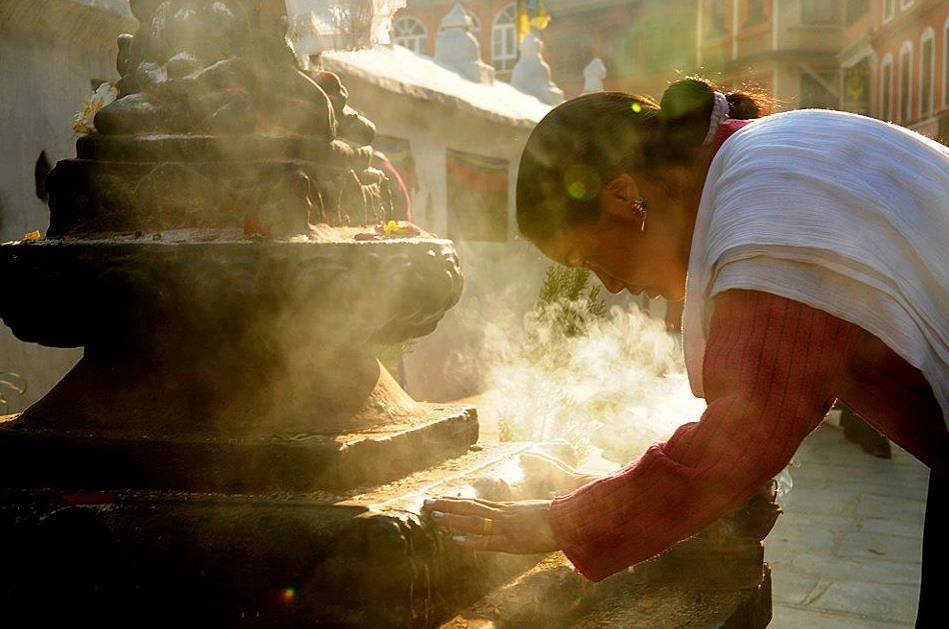
woman at shrine


On the birth of renunciation…

Currently I’m studying Heart Treasure of the Enlightened Ones with a Dharma friend, the Venerable Tashi Nyima.

This is my contemplation on the second line of verse 37 of the root text of Heart Treasure of the Enlightened Ones.

heart treasure

“Put your child, devotion, at the doorway of your practice;

Give your son, renunciation, mastery over the household;

Wed your daughter, compassion, to the bridegroom of the three worlds.

Consummating your duty to the living, recite the six-syllable mantra.”

 Full Disclosure:

I find renunciation much easier to do than to write about. My mind seems to shy away from renunciation as a concept, but cooperates relatively easily in acts of renunciation.

Written Saturday, September 13th, 7 AM

Explain to someone else (making it my own)

For a long time, I was the ultimate Ms. Fixit in my life. I’ve seen those ‘Fix It Yourself’ shows on TV. There are all these people working really hard to remodel a kitchen, a bathroom, a backyard—whatever. With the magic of television, a few weeks’ work is compressed into just a few minutes and –voila!  A House Beautiful magazine photo op has been created.

The other day I was at my dentist watching one of those shows while I waited for my appointment. And truly, those three men did some pretty amazing things to a dock behind a lake house. It was beautiful work. But ever since then, I’ve been wondering. What if, instead of packing up his camera when the job was done, the camera man left all his gear in place, and set it up for time lapse photography, and just…left it there for a few decades?

Thinking of it that way, I could see the homeowners come and go in just a few moments. Then perhaps their children would flash across the picture. Then maybe a restoration crew would fix up the sagging wood. But sooner or later, if the camera was there long enough, the house would first sag, then crumble into the ground. The grass would grow up higher and higher until finally the house would simply be gone, as though it had never been; as though it had been an illusion all along.

When I was Ms. Fixit, I could never, ever get my life right. Every time I fixed it, something else would go wrong. keystoneAnd there I’d go scurrying after the next problem to try and fix it. This went on for decades. For all I know, it went on for lifetimes. If my life could have been captured in time lapse, I would have looked like a Keystone cop, always madly chasing after the latest miscreant issue in my life.

It didn’t work. And now, having practiced the Dharma, I know why. Simply put, there is no solution to life in samsara. There just isn’t. Dilgo Khyentse says, “Renunciation is born when you know that there is ultimately no satisfaction in samsaric life.” Yes. Just so. After you’ve chased down enough rainbows, you must sooner or later come to the conclusion that there is simply no solution to be found. The sooner we realize this, the sooner we can begin a path of renunciation, and the sooner we can end our (entirely optional) suffering in samsara.

***

 Apply to a past situation (how would it have been different?)

In the Ms. Fixit stage of my life, no one could have possibly talked to me about renunciation. What? Stop trying to fix things?? I would have said, No! Not now. I’ve almost got everything right!

Mr FixitProbably the biggest Fixer Upper project in my life, up until a little more than a year ago was the relationship with my mother. My mother is not a bad person. On the contrary. She is a very, very scared person. She’s scared her chance to be rich and beautiful forever is long gone. She’s scared she’ll die without her dreams coming out exactly the way she wanted. She’s right. She will. Her fear makes her manipulative, selfish, and vindictive against those in her life who seem to have all that she so richly deserves and could never seem to get.

For decades I wanted to fix that relationship. Actually, if I’m honest, I wanted to fix her, and make her what I thought a ‘good mother’ should be. I fell out of touch with her for a long while, then a little more than a year ago, I re-established contact. To my horror, nothing had changed in her. She was still sly, manipulative, selfish, and vindictive. Her conversations were an outpouring of vitriol against those who had ‘wronged’ her. For a while, I dutifully made my weekly phone calls, listened, and ignored her attempts to bait me and manipulate me.

But one morning she called and did something that made me see with perfect clarity, detached from afflicted emotion, that the only way to successfully manage that relationship (which was draining me at that point) was to renounce any idea that things would change. That day on the phone, I knew it was the last time I would ever speak to her. I knew that the next time I saw her would be at her funeral. I knew I didn’t have the skillful means to handle things as they were, and things were not going to change. I knew that I couldn’t have her in my life. I thought this decision would lead to much suffering for me. It hasn’t. I didn’t do it in anger. I did it because I fully realized that the most compassionate thing I could do for both of us was to renounce my role in her suffering.

Looking back over the decades of the relationship with my mother, I see that if I could have taken a step back, I may have noticed that my intense suffering came from believing that I could fix that situation, that it was ‘wrong’ somehow. I suffered because I tried so hard to be a ‘good daughter’, but my mother didn’t change and become a ‘good mother’. If I had been able to take a step back, take a few breaths and allowed just a bit of peace and clarity to arise, I may have seen that the only ‘fix’ for that situation was to seek a path of renunciation with the intent of finding a compassionate (not satisfactory) solution.

***

 Apply to an (ongoing) present situation (how does it matter today?)

The biggest thing going on in my life right now is transitioning to a new job.

I’ve never jumped out of an airplane, never parachuted, but I think I can imagine fairly well what it’s like. There you are standing in the door of the plane. The air’s rushing past you at hundreds of miles per hour. You feel the weight of your parachute on your back and…you’re waiting. You know you’re going to jump. There’s no question about that. You’re just waiting for someone to signal that now’s the time, things are right, we’re where we need to be—jump.parachute

In those last few milliseconds when you take that first step off the plane and you’re caught, one foot in rushing air, the other solidly on the plane, there must be a moment when you think…please—let my parachute be packed right.

That’s where I am now in transitioning between jobs. I have to fax one last bit of information to complete the background check. The next step is to wait for the contingent job offer to morph into an actual job offer.

Strangely, now that I’m leaving work, it seems entirely more bearable there. It’s almost (but not quite) palatable. I’ve thought about this and wondered about it.

I’m pretty sure that work seems almost pleasant because I’ve renounced both the illusory gains and the illusory suffering that goes with that job. It’s a wonderful feeling of freedom. I’ve always had a hard time distinguishing (theoretically) between indifference and renunciation. Now I’m experiencing the difference. It’s not that I don’t care what happens at work. It’s just the opposite. I want to do a good job. But at the same time, there’s no sense of attachment to the job itself, or even to the outcome of what I do. On an everyday level, this means I do what has to be done, with as much compassion as I can, then I move on.

In this situation renunciation feels like a total lack of judgment about how things should be versus how they actually are. Each day when I go to work now, I’m fully aware of how miserable it is to be there. But somehow, that awareness doesn’t cause aversion to arise. I’m doing everything I can not to be there anymore. It’s an experience of my life as what happens…happens. There’s no struggle to stop things from being as they are. Renunciation feels like understanding that things are as they are and if I want them to change, I will have to figure out how to bring that change.

Far from giving up anything, renunciation feels like total power. It feels like stepping off the airplane into the screaming wind and thinking…If my parachute’s not packed right, I’ll die today. If it is, then I won’t die. Not today. Right now…I’m going to fly.

***

 Apply to a potential situation (bringing it home to play)

At my current job, the location being used has to be vacated in about a month. This past week there’s been much anxiety in the office about who will move where. There are two possible sites. One is about a ten minute drive for me. The other would be probably a little more than an hour…on a good day. I wasn’t actually all that concerned because I had absolutely no intention of driving an hour to get to work; not to that job. As it turned out, I’ve been assigned to the site that’s maybe a ten minute drive. I’ll have to be honest. I wish I’d been assigned to the farther site, because then the jump would be a complete no-brainer.

As it is, I’m starting to wonder. Twenty-two thousand dollars is an awful big drop in salary. As I prepare to take this jump off the familiar into the unknown, I see renunciation as my parachute.

How do I explain this? When you practice renunciation and make it part of your ordinary life, you’re no longer a victim of circumstances. You’re no longer a victim of anything. Changing jobs and moving to a new industry after nearly two decades in the same industry is just a little this side of terrifying. It is, really. I feel no less anticipation and fear than if I were standing in the door of a plane waiting to jump. But living my life with an attitude of renunciation makes the fear and anticipation and uncertainty all right. Once you realize that there isn’t that one special act or that one totally awesome person that’s going to make your corner of samsara comfortable, your only option is renunciation.

To me renunciation feels like stepping from the plane, relaxing into the pull of the air and thinking…I take refuge in the Buddha, the Dharma and the Sangha. This sounds trivial, but it absolutely works. When we let go, and let the Dharma support us, not only do we not fall, we fully come to realize that there’s nowhere to fall to.

These next few weeks, as I fall through the skies of transition, I will keep my heart in a place of renunciation. I will know that the Three Jewels never fail those they protect. I will know that I have set my feet firmly on a path of renunciation. I will know that I can float like a Bodhisattva and sting like a Buddha. In short, I will know that this precious human birth is given to us so that we may live in a way that makes our death an unequivoval doorway to enlightenment.

monk on brick road

On thinking about these times…

Currently I’m studying Heart Treasure of the Enlightened Ones with a Dharma friend, the Venerable Tashi Nyima.

This is my contemplation on the last  line of verse 11 of the root text of Heart Treasure of the Enlightened Ones.

This was my first time working with renunciation. It was interesting.

heart treasure

“Being learned these days doesn’t help the teachings—

 it just leads to more debate;

Being realized these days doesn’t help others—

it just leads to more criticism;

Being in a responsible position these days doesn’t help

govern the country well—it only spreads revolt.

Think about these times with sorrow and disgust. 


 Explain to someone else (making it my own)

When I was younger my two favorite cartoons were The Flintstones and The Jetsons. My two favorite ‘people’ shows were Star Trek and Lost in Space. I liked them because, even though I couldn’t articulate it as a child, I thought their problems were so much different than mine, so very removed. They had no constantly fighting parents, no homework, no bullies at school, no stupid dishes to wash.jetsons

The Jetsons had robots to do all the cleaning. Captain Kirk was out meeting aliens and having adventures on the edge of the universe, and even though he made trouble in every episode, things always worked out okay for Dr. Smith and the Robinsons. The Flintstones were so far back in time, they had a dinosaur for a pet and a bird with teeth for a can opener.

As an adult looking back on those stories, I can see the human drama being played out from the Stone Age all the way up to an idealized future where drudgery was wholly removed. Yet, there was still drama. How can that be? How could George Jetson fly to work in a hover craft and still have problems with his boss? Why didn’t Captain Kirk bring a message of everlasting peace to the aliens he met? After all, they were smart enough to build a star ship and beam people down to planets. Why didn’t the Robinson family become ambassadors of peace after spending all that time lost in space? And finally, how could a Stone Age man like Fred Flintstone have the same drama with his boss that a future man like George Jetson had?

The Dharma teaches us that, “Worldly pleasures are deceptive,/and bring no lasting joy, only suffering.” Even though this is our experience day in and day out, we live in a constant painful denial of this very basic truth of our lives. We reach for happiness in the material world constantly—a good meal, a good partner, a new pair of shoes—and are constantly disappointed to find that our happiness is at best, fleeting.

If we look upon these times with disgust and sorrow, and develop a mind of renunciation, then we will be ready to put our feet on a path that leads to permanent happiness.

***

Apply to a past situation (how would it have been different?)

There was a time when I believed with all my heart that Texas was Heaven, Nirvana, a place where no problem could stand in the face of such paradise. I believed that merely by being here, the problems I had outrun would simply dissipate, and I’d go on with life, reborn into a land of milk, honey, and cowboy hats. I was in the Promised Land.

The day I got here was one of the worst ice storms Dallas had seen up until then. I stood outside the Dallas airport shivering miserably in my Florida-weight clothes (because it never gets cold in Paradise) and was turned down by taxi drivers who didn’t want to risk crossing the icy bridges between Dallas and Plano. A driver finally took pity on me. By the time I go to the rental office (which was closing due to the storm) to claim my new apartment, I was grateful to be alive after slipping and sliding over very icy roads with a driver who apparently had a pressing appointment with Death. I had no food. The restaurants in the Downtown Plano area were closed due to the storm. My first meal in Texas was a giant Hershey bar and a bottle of water purchased in a gourmet candy store that hadn’t closed yet.paradise3

So began my sojourn in Paradise.

This was emblematic of what was to come. There seemed to be so many obstacles to the bliss I so richly deserved: no car, nightmares and insomnia, flashbacks, anxiety. What? I asked myself. I’m in Paradise. How can there be problems here?  I became angry, confused, disillusioned. Without the help of a very skilled therapist who explained the truth of things to me and helped me learn the skills I needed, I would have been lost in paradise.

Looking back on that time, I can notice that I behaved as though changing geographically would mean leaving my samskars behind. I believed that happiness (in the extreme) was to be found if I could only figure out the right thing to do with my life. I believed that happiness was out there somewhere for the taking. Having noticed this desperate brand of constant searching, I might have taken a step back and asked myself if I’d ever found lasting happiness in the material world. Once I’d had the courage to be honest with myself and admit that I never had, I would have been ready to begin developing a mind of renunciation.

***

Apply to an (ongoing) present situation (how does it matter today?)

monkWhen I first started learning about renunciation in the Dharma, if I’m honest, all I could think of was tonsured medieval monks wearing threadbare robes with hair shirts underneath, living in a monastery on some very cold, very isolated hill top in England. They never talk to each other. They have cold gruel for their one meal a day. They pray six times a day—including in the middle of the night! They live in little tiny rooms called cells where the only things on the dank stone walls are a miserably crucified Christ and a whip. The whip of course is for self-flagellation while penitently murmuring, ‘mea culpa’.

In a word, for me, renunciation was a synonym for denial and purification by suffering. I owe this gross misunderstanding partly to growing up Seventh Day Adventist and partly to Hollywood.

As it turned out, I came to do serious renunciation in my own life nearly by accident. After pursuing the craft of writing fiction for decades, I became so disillusioned with it that I couldn’t bear it anymore.

What’s interesting about this is I didn’t want to renounce writing. I wanted to renounce the way I was doing it, the way I was seeing it in my life. In doing this, working with it daily, I find the act of renunciation to be joyful and incredibly liberating. Now that I don’t write fiction anymore, I don’t have to read it anymore. I hadn’t even realized how unbelievably bored I was with fiction. I’ve been devouring non-fiction as fast as I can download it to my Kindle. My latest kick seems to be Tudor history. Now that I don’t write fiction anymore, I’m free to write what calls to me, rather than being caught up in deadlines, plot devices, character arcs, blah, blah, blah.

What I’ve learned is that fiction writing had become a prison. liberated2Renunciation was just setting myself free. In the same way, samsara is a prison. It is in fact inimical to who we truly are. It is utterly unnatural that we would live in a world of duality. When we begin to “Think of these times with sorrow and disgust”, we’re not giving up anything. Far from it. We are setting ourselves free of the illusions and delusions and pains of the prison of samsara and aligning ourselves with our innate perfection.

***

Apply to a potential situation (bringing it home to play)

Right now as I look for a job, my life is in transition. In this Jetson-like age, job applications are done online. There’s always a moment of anxiety before I click SUBMIT, when I say to myself, “Do I really want to do this?” Then I click the icon.

As I work with finding a new job, I haven’t thought of renunciation. I am thoroughly nauseated with my workplace, but not enough to actually want to leave. It’s more of an intellectual realization that I have to leave or burn out. I have not yet reached the level of disgust and sorrow that for me, seems to be required for renunciation.

renunciation2From this I’m learning that renunciation isn’t an act of turning away, or denying. My experience is that it’s just the opposite. It seems that renunciation is a whole-hearted embrace, an understanding of what is. And then the next step seems to be an understanding that if you continue with things as they are, it will lead to more and more suffering. Then finally, the last step seems to be renouncing the suffering.

As I go to work today, I can notice how much I suffer there. Yes. There are many good things there. There is the comfort of having a job and a steady income. There is the convenience of a ten minute drive. But the suffering of being there day in and day out has gone on for years. I’m not sure what it would take for me to renounce the suffering of the situation of my workplace.

I can breathe and look back at other times in my life when I renounced the suffering of a situation. By the time I did, things had reached a point of crisis. And when I finally did experience renunciation, it led to very positive changes. Oddly, knowing this doesn’t help.

I guess what I can take a look at is…haven’t I experienced enough sorrow and disgust with that situation to have the wisdom that renunciation of that particular suffering is the right choice? The best choice? Maybe the only choice?

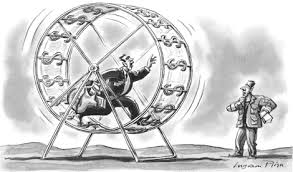
On quitting the rat race…

Currently I’m studying Heart Treasure of the Enlightened Ones with a Dharma friend, the Venerable Tashi Nyima.

Here is my contemplation on the last line of verse nine of the root text. As a committed rat racer for decades of my life, I couldn’t let this one go by!

heart treasure

“In this dark age, what people think and do is vile.

 None of them will help you, they’ll deceive and trick you;

And for you to be of any help to them will be hard;

Wouldn’t it be best to quit the whole rat race?


Explain to someone else (making it my own)

Every day when we wake up, we’ve got things to do. Ever notice how you never wake up and just lie there and say to yourself, “Someday I’m going to die. What can I do today that will further my spiritual journey so that I go to my death as prepared as I can be?”

No. Never.

We turn off the third snooze on the alarm, brush our teeth, take a shower, wash our hair, and of course the “Good Morning: Here’s All the Bad News You Missed Overnight” show is babbling on in the background. Then we get in a car (or on a subway or bus), go to work, and spend our entire day caught up in petty drama that feeds our anger, resentment, frustration, and fear. rat race2

Then we go home, say a few bare words to the people who share our living arrangement du jour, turn on the TV, mindlessly absorb the government propaganda marketed as Prime Time, then, in a state of physical and mental exhaustion, we take refuge in sleep. In our dreams, we are haunted by the fears, regrets, and longings that we repressed all day long while pursing things that didn’t matter.

This is how we live our lives, in a kind of chronic insanity. We are like rats in a stone maze that is set atop a simmering volcano. We run and run, hoping we’ll find some relief from our chronic suffering in the next marriage, the next job, the next raise, the next new house. But as soon as we get what we chase after, we can’t enjoy it because the moment we pause, we notice how the ground under our feet is too hot to bear. When we pause in our constant chase through life, we notice our own suffering and we believe the answer is to chase after something else and rely on that to bring us happiness and relief from our suffering.

Beneath all our suffering is one inescapable thought: one day, I’m going to die. If we treat death like an enemy to outrun, we will suffer all our lives and die in regret and anxiety. Yet our culture encourages us to do just that—outrun death with the latest anti-aging cream, the latest Mor-Energy drink.

This doesn’t work.

Wouldn’t it be better to quit the whole rat race and get out of the infernally hot maze before our suffering culminates in a death that will only land us back in samsara, trapped once again in the cycle of birth and death?

***

Apply to a past situation (how would it have been different?)

There was a time when I wanted to write a bestseller. It wasn’t so much that I wanted to make millions. The money was almost an aside. What I really wanted was to be happy. I believed that selling millions of books would make me happy because it would free me of the corporate world. Then, I told myself, all my problems would be solved. I’ll experience untold bliss.

Looking back on that time in my life, I can notice how my unhappiness had very little to do with the corporate world. Blaming my job for my suffering was a little like blaming a stage for a bad play. I could have noticed that the actual cause of my unhappiness was my own internal drama, and my job was just the stage where it was being played out.

drama4Having noticed this, I could have taken a step back from rabidly chasing after the goal of being a happy bestseller, and taken a look at the causes of my suffering. Had I done this, I might have noticed how Hope and Fear had starring roles in my personal drama. I might have noticed that everything I did was hooked into either desperate hope of success or desperate fear of failure.

In noticing this, I might have seen how my suffering was arising from a constant ping-pong back and forth between hoping for what I feared I wouldn’t get and fearing what I hoped wouldn’t happen.

Once I’d seen this, I could have taken a step back, breathed, and let a moment of peace and clarity arise in my confused mind. In that moment, I might have recognized that hope and fear were thoughts based on a fantasy future, an outcome I could never know. I might have noticed that even if I became a bestseller, I’d still be cruelly haunted by even bigger hopes and fears. I might have noticed that I could, at any time, choose to let go of both hope and fear, because my grip on them was all that gave them substance.

***

Apply to an (ongoing) present situation (how does it matter today?)

Here I find myself back with Salem. A funny thing’s happened with that particular mental representation. It’s no longer the biggest concern in my life.

As I deal with that particular drama in my life, my most helpful strategy has been to simply let go. And boy was that hard! In the beginning, I was determined to have things my way: I was sure that the only way was for her to smarten up.

As it turns out, I’m the one who smartened up. As I’ve dealt with this ongoing drama day in and day out, I’ve finally recognized that it was my own afflicted emotions that were drawing me in and hooking me. I recognized and experienced that I could make a choice not to go with those emotions. I began to see that the entire tempest in a teapot was being stirred by me chasing after one thing: wanting Salem to be different than what she is.

Yeah. Sure. One day she’ll wake up. But in the meantime, I’ve got work to do.

In the past couple of weeks, I’ve seen that the only way for me to work with that situation is to “quit the whole rat race”. I do this by recognizing my afflicted emotions when they arise, experiencing fully that incredibly powerful tug to act on them…and then refraining. This is the only thing that has worked.quit2

Sometimes I only have to do this once a day. Sometimes it’s moment to moment.  But whenever I do it, I recite a verse of Dharma from my stack of index cards on my desk (the Dharma Brigade), and this re-focuses my mind. I’m able to see the rat race for what it is: an invitation to deepen my suffering in samsara. Each time I turn down the invitation, it’s easier to do it next time.

Afflicted emotions still arise, but not nearly with the strength or urgency they once did. I have by no means become Mother Teresa in that situation. The urge to throttle Salem still comes up, but these days I’m aware it’s a thought, and I’m more and more willing to give impermanence a chance to prove itself.

***

Apply to a potential situation (bringing it home to play)

As I look for a new job, it’s hard to drop the ‘rat race’ point of view. Looking for a new job, there’s no way to avoid competition. Just in the act of applying, I’m already competing.

I think the biggest pitfall for me to work with in seeking a new job is the Panacea Outlook. It comes up again and again. I have constant thoughts that when I leave this job, I’ll escape Salem for good. I’ll be happier in my work day. But gradually, especially as I work with Heart Treasure of the Enlightened Ones, I’m coming to see that there’s only one way that any job (inside the corporate world or outside of it) will be the cause of happiness for me.

At this stage in my spiritual cultivation, a job will only be a cause of happiness if I can bring that job to the path. Sitting here in the early morning, in pre-dawn darkness, with city sounds outside and faraway, that seems very obvious. But when I’m caught up in the job-seeking drama, it’s easy to lose sight of that.

path3Little by little as I study the Dharma, contemplate, meditate, pray, and practice, I start to question my decision to leave my job at all. If I’m honest with myself, the driving reason behind leaving was to put Salem behind me. But not only do I now understand how impossible that is, I no longer have a need to do that.

I ask myself now, is it possible that I’m confusing quitting the whole rat race with leaving my job? And if what I really want to do is learn to rely on my own effort, isn’t the turbulence of my workplace the perfect training ground?

As I go to work tomorrow, I’ll take time to notice…where is the rat race happening? Is it happening in the building? The people I encounter? The emails I answer? If I left my job, aside from geography, what would change? Isn’t it all the path? Will my causes for happiness increase by exiting the situation of my job? Or is the thought of leaving a part of my rat race, my illusory pursuit of happiness?

Where is the rat race? It is, of course, an appearance in my confused mind. Tomorrow at work I can notice that when peace and clarity arises, the rat race dissolves, revealing its true illusory nature.