Currently I’m studying Heart Treasure of the Enlightened Ones with a Dharma friend, the Venerable Tashi Nyima.
This is my contemplation on the third line of verse 19 of the root text of Heart Treasure of the Enlightened Ones.

“There’s no time to be happy; happiness is over just like that;
You don’t want to suffer, so eradicate suffering with Dharma.
Whatever happiness or suffering comes, recognize it as the power of your past actions,
And from now on have no hopes or doubts regarding anyone at all.”
Explain to someone else (making it my own)
When I was a little kid, I thought things just kind of happened. Actually, what I thought was, things happen, but if I really want something, I mostly can’t make it happen. My world—full of the constant upheaval of bickering parents—seemed to be a stormy sea that tossed me to and fro like a rudderless, leaky boat.
My parents mercifully got a divorce, and of course went right on being miserable with two other unfortunates.
I grew up.
For many decades I still believed things just sort of happened randomly. I made absolutely no connection between what came into my life and what I’d done.
Well, sometimes I did.
When I was in school, I understood that if I studied, I’d get a good grade. Later, when I entered the corporate scheme of things, I understood that if I did my job, got to work on time, and met deadlines, I’d get the (dubious) privilege of keeping my job.
But in my personal life, I kept engaging in the same negative acts again and again. Then I’d cry and wonder…why does this keep happening to me?
I’ve told my mother to stay out of my life, but there she is—interfering. Again.
I’ve told my boyfriend (du jour) to stop pissing me off, but there he goes. Again.
It was a very bewildering and frightening world in which I was agent of absolutely nothing. Suffering came at me constantly. It was everyone else’s fault. My mantra in those years was…if he (or she) would just [fill in the blank], then everything would be okay.
It never occurred to me, even as a passing thought, that I was the agent of my own suffering. I never paused to look at my own actions and how they were clearly linked to the consequences I experienced. My mind was a constant whirlwind of afflicted emotions—anger, frustration, resentment, aggression. There was no end to it.
 Without pausing to look at how we cause all the suffering in our lives, we are doomed to wander samsara lifetime after lifetime, suffering terribly.
***
Apply to a past situation (how would it have been different?)
Where do I start?
There have been so many times in my life when, if I’d just paused and noticed the connection between the causes of suffering I was putting in place and the consequences that were manifesting, I could have freed myself of that particular suffering.
I guess the time in my life just before I came to Texas is a place to look at.
I was about two weeks from leaving (fleeing, actually) a scarily bad relationship. It was a kind of caesura in my life. Everything was on hold. I was simply counting down the clock to my booked airplane flight to Dallas. I was participating in the relationship only in the most superficial ways. In my mind, it was over, like a corpse ready for burial.
This meant I was no longer caught up in the emotional dynamics such a relationship exhaustingly demands. I really didn’t care what the other person said or what they did, because I was on a countdown to freedom.
In those two weeks, I unintentionally gained an analytical distance from a very entangled situation. I was able to see with almost perfect clarity how my own actions had led to exactly where I was. It was like seeing a map that I had drawn and then navigated with precision. At the time, this insight came with a lot of shame and blame and guilt and feelings of worthlessness.
Looking back on those two weeks, I might have noticed how the connections I’d seen weren’t just true of the last ten years. It was true of my entire life. Having noticed this, I might have breathed, and taken another small step back. Had I taken a step back from the afflicted emotions that arose, I may have noticed that I’d just discovered the key to my true freedom. I may have noticed that since my actions had brought me to the misery I was experiencing, I could choose different acts that would lead to different consequences. 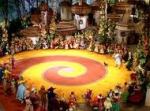
I might have noticed that I wasn’t Dorothy helplessly caught up in the tornado of my life. Rather, I was a pilgrim setting out on a brand new road.
***
Apply to an (ongoing) present situation (how does it matter today?)
The ongoing situation in my life right now is the Pilgrimage of 62. Wow. It’s nothing like I thought it would be. I had so many doubts when I started with this idea. The biggest (and perhaps silliest) was…what if I’m not holy enough? Now, on day four of the pilgrimage, that makes me laugh. How could I not be holy enough (and what I really meant was good enough) to take time twice a day to touch in with my true nature?
When I began this a scant three days ago, I was focused on my twice daily mediation and prayer activities—the 62. In the beginning, a couple of weeks ago, I had to readjust my schedule and condition my life to the pilgrimage. What I’m finding now is that the pilgrimage is conditioning my life to it. It is in fact becoming the action of my ordinary life. I didn’t foresee that.
As I go about my ordinary life, there is so much clarity about what will put in place causes for suffering, and what will put in place causes for happiness. And it’s nothing like I thought. I can’t say that enough.
Last night I was very tired so I decided not to do the dishes. Now, there’s nothing that bothers me more than walking into the kitchen in the morning and seeing even one dish in the sink, let alone the mess that’s in there now. In choosing to leave the dishes in the sink last night, I knew I was putting in place a cause for suffering this morning.
In seeing that, I was able to go back to the choices that had led to so many dishes in the sink so late. I was able to clearly see how I’d started baking late, then chosen to do other things instead of cleaning up as I went along.
 This is a very mundane example of how our choices bring suffering into our lives. But I think suffering is always mundane. No choice is made in a vacuum. We are surrounded by conditions at every moment. And those conditions are a culmination of our smallest choices. From this, I am absolutely coming to see that whatever happiness or suffering comes, it is the power of my past actions bringing it to manifest. We all have an incredible power for happiness or suffering. The choice is always ours.
Isn’t that awesome?
***
Apply to a potential situation (bringing it home to play)
A funny thing’s happening on the pilgrimage. I’m getting to know my ego very well. The catalyst for this is none other than my cubicle-mate Salem. She knows how to push all my buttons, even the ones I didn’t know I had. At the end of the pilgrimage, I should really get her a gift because she is turning out to be an invaluable traveling companion.
At least once a day, Salem will do or say something that ticks me off. Well, that’s what used to happen. These days, I can usually the catch the afflicted emotion before it’s full blown and giving rise to discursive thoughts.
Yesterday was my first day at work and on the pilgrimage. The day before, on Sunday, I took Bodhisattva vows for the first time. The two together are very powerful agents in my ordinary life.
At work yesterday, Salem did her usual awesome job of pushing my “Are you ever going to take responsibility for what you do?” button. I was almost off and running. The fuse was lit and sizzling, burning its way toward a tightly packed bundle of Self Righteousness TNT. But these days it’s a pretty long, pretty slow-burning fuse with Salem. She’s given me so much practice that I was able to pause and ask myself—did I really want to plant seeds of frustration and resentment with my thoughts? Did I want to put in place causes of my own suffering? Did I have so little suffering in my life that I wanted to add to it? And finally, did I want to add to Salem’s suffering? [that was a first]
There was a moment when ego flashed a thought, “Damn right I do! She deserves it.” Ouch.
Then I remembered the pilgrimage, my Bodhisattva vows, and I realized that no, she didn’t deserve it. None of us do. Even ego piped up (grudgingly) with, “I guess not”.
Today as I go to work, I will work with having gratitude for Salem. Without her presence in my life, I wouldn’t have learned nearly so quickly the intimate connection between the causes I put in place in my life, and the consequences that manifest.
I know there’ll be moments like what happened yesterday, but when they arise, it is my intent to use those moments to train my mind to make choices that lead to peace and clarity rather than to suffering and confusion.
Can I actually do that?
We’ll see.







 dharma pen