
Currently I’m studying Heart Treasure of the Enlightened Ones with a Dharma friend, the Venerable Tashi Nyima.
This is my contemplation on the first two lines of verse 28 of the root text of Heart Treasure of the Enlightened Ones.

“The noble teacher has the nature of all Buddhas,
And of all Buddhas, it is he who is the kindest.
Seeing the teacher as inseparable from Chenrezi,
With fervent devotion, recite the six-syllable mantra.”
Explain to someone else (making it my own)
I work with a teacher who’s more than five thousand years old. Well, I haven’t actually met him, but I’m pretty sure about the five thousand years. We’ve been making bread, as a source of food, for at least that long. Although he’s new to me, Ken Forkish, the author of Flour, Water, Salt, Yeast: The Fundamentals of Artisan Bread and Pizza, is part of the lineage of baking that stretches way back to when bread was unleavened flour and water.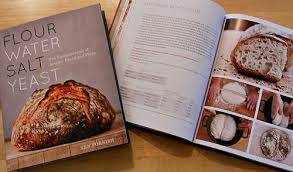
The wonderful thing about studying with someone who’s part of a disciplic succession is that, once you begin learning from them, you’re now practicing a technique that’s a few thousand years old. Now, you’re part of the lineage, and it will pass through you to others. For me right now, being part of the lineage means folks I know get homemade bread, and muffins, and the occasional scone.
When it comes to baking, it’s easy to realize that there’s no way you’re going to buy a book and invest in tools and equipment if the author’s introduction says something like, “I’ve never studied with anyone. I baked my first loaf yesterday. It came out good, and now I’m writing a book.” In our ordinary life we recognize the need for a lineage. Madison Avenue uses this in advertising with catch phrases like, “Trusted to Deliver Since 1919”. In the west, time equals lineage, which equals trust, which equals consuming whatever is being delivered.
Yet there is a part of our lives where we rarely think of lineage or its importance. When it comes to spirituality, we give our afflicted emotions credence and go with “what feels good”. Well gosh, isn’t that how we ended up in samsara, lifetime after lifetime—by going with what feels good? Wouldn’t it be better to rely on and become part of a lineage whose foundation is primordial?
Patrul Rinpoche tells us we can do this by devoting ourselves to the noble teacher. The noble teacher is one through whom the unbroken disciplic succession of the teachings of the Buddhas flows. When we devote ourselves to such a teacher, we are becoming part of that lineage, and it will eventually flow through us to others.
In my mind, the noble teacher is a necessary companion on the path to becoming a bodhisattva. If it’s my aspiration to bake the perfect artisan bread, then I rely on a teacher who’s part of a lineage that goes back five thousand years. If it’s my aspiration to become a bodhisattva, then doesn’t it make sense to rely on a teacher whose lineage goes back to the primordial Buddhas who exist before beginningless time?
Dilgo Khyentse says of the noble teacher, “Practice in accordance with his instructions, and, as all the clouds of doubt and hesitation are cleared away, the sun of his compassion will shine through, warming you with happiness.” When we rely on a noble teacher as a companion on our path, we are relying on a lineage, on all the Buddhas who came before him, and ultimately, we are relying on our own Buddha Nature, of which the noble teacher is a reflection.
***
Apply to a past situation (how would it have been different?)
I began baking bread sometime in the nineties. I think the first Breadman bread machine had just come out. A bread machine can make either bread or dough. On the dough cycle, you take out the dough, and finish baking it in the oven. When I got my first bread machine all those years ago, I wouldn’t even look at the dough cycle recipes that came with the recipe booklet.
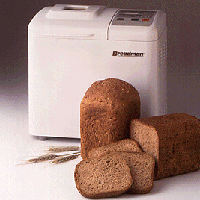 But the funny thing was, I’d look at the pictures of breads made outside the machine all the time. I had lots of reasons for sticking with my bullet-shaped, soft-crust bread. It was easy: measure carefully, press a couple buttons, come back four hours later and voila! Bread. I didn’t need special equipment to bake in the machine. It even came with its own measuring cup. The biggest reason though, was fear. If I used the dough cycle, what the heck would I do with that glob of flour, water, salt, and yeast? It would NEVER come out looking like the pretty pictures. I baked for years in that machine, never venturing beyond the constricting boundaries of the machine’s pan, and always mildly dissatisfied with even the most perfect loaf.
Looking back on that time in my life, I can notice that the source of my fear was that I’d have to venture beyond the boundaries of the Breadman alone. That was terrifying. It was pretty much this thought that kept me locked in my Breadman prison.
Had I been able to take a step back from my fear, I may have noticed that the library had a plethora of books on baking. I could have noticed that rather than venturing out into the dark unknown alone and unprepared, I had the opportunity to get to know a lineage that went back thousands of years. Had I been able to notice this, it may have taken me less than two decades to begin the adventure of baking outside my machine.
***
Apply to an (ongoing) present situation (how does it matter today?)
I took about fifteen years off from baking bread. Then, I bought a Cuisinart bread machine. Then, about six months ago, I took my first steps outside my Cuisinart. They were tottering, uncertain steps, but by then, I’d become part of a lineage. I had a wonderful bread machine cookbook that included recipes for dough to be baked outside the machine, and which I dutifully ignored.
In the beginning, the bread machine recipes in that book were enough. But then I got tired of all my breads having the same uninteresting shape, and pretty much the same uninteresting crust. I wanted more control over how my bread looked and tasted. Gradually—and it was a very gradual process—I stepped outside of the constricting boundaries of the machine. I was only able to do that because the baking world has a wealth of teachers whose lineage goes back thousands of years, and who selflessly share what they know.
I think we come to the Dharma for pretty much the same reasons I started my journey toward baking artisan bread. We begin to become sick of the sameness of our suffering. We begin to chafe against the perceived boundaries of our lives. We begin to think…there’s got to be a better way.
Happily the Dharma offers a much better way than the constrictions of samsara, the infinitely churning machine of birth, age, disease, and death. We find this in a noble teacher through whom will flow the unbroken disciplic succession of the teachings of the Buddhas. When we find such a companion on the path, their kindness, their compassion will begin to resonate with our own compassion. Before studying the Dharma, I believed a ‘good teacher’ was someone with volumes of knowledge on their given subject—Shakespeare, quantum physics, artificial intelligence—whatever.
But now, studying the Dharma, I’m coming to see that the only kind of teacher worth studying with is the noble teacher. Pema Chodron says that the idea of a teacher isn’t that they’re a burning log, and you get really close so that you can get a little warmth. The idea is that the teacher’s flame will inspire you to burn as well. In my own experience, I find this to be true. The noble teacher will inspire those devoted to them. Inspiration isn’t imitation. Inspiration is awakening to the inherent wisdom we all have, finding your own fire, to use Pema Chodron’s metaphor. The noble teacher is able to inspire others with their teachings, their lives, and their incredible act of compassion in pointing you to your path to awakening.
***
Apply to a potential situation (bringing it home to play)
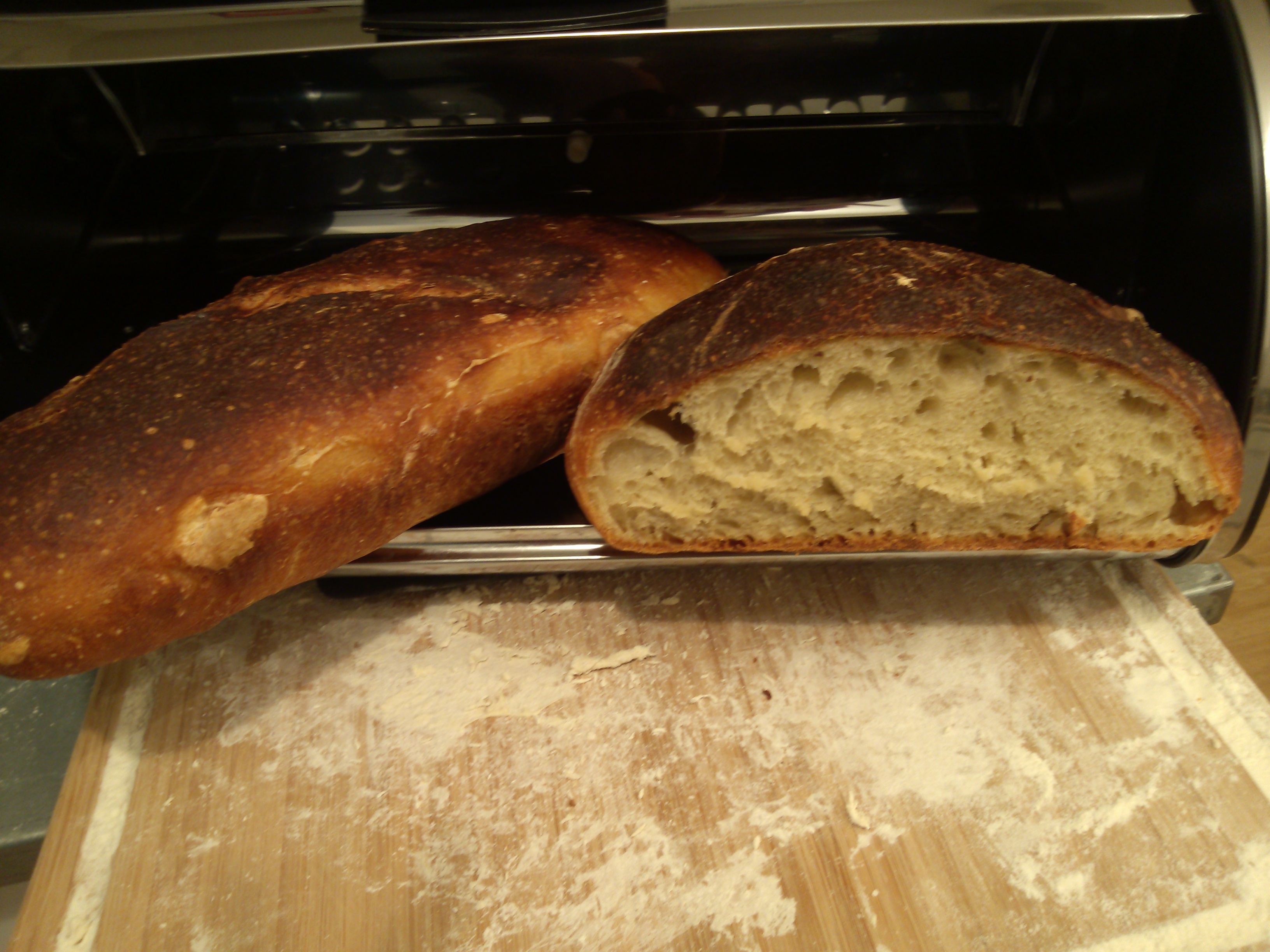 Last weekend I made my first Ken Forkish loaves. With his recipes you make a BIG dough, then bake two loaves. The recipe I chose went so wrong that I ended up with a splat of very sticky dough on my kitchen floor. When I was baking the loaves in the oven, I was so anxious I wanted to cry. The loaf was getting too dark! I never go that dark! That’s two days of work in there!
This weekend, I’ll be making the same loaf. I know I’ll have the same fears but they’ll be far less gripping this weekend. Why? Because I’ve tasted my ‘disaster’ bread. It sure is good bread, and its got those pretty holes I’ve always wanted in my bread.
Until now, my bread machine has been a part of my baking process. I’ve always let the machine make the dough. But now, that’s not enough. I don’t like the dough being locked away in that machine for two hours until it beeps, then I get what I get. In choosing Ken Forkish, I purposely chose a technique that lets me make the dough myself.
Making dough is messy. You get flour everywhere. You have to get your hands into that sticky mass and stretch and fold, and all the time you’re thinking…no way will this sticky gloopy mess ever be a loaf of bread. But I’ve chosen the Ken Forkish technique because I believe that after diligent practice, I will be free to use Baker’s Percentages to create my own formulae (recipes), and introduce the world to my interpretation of artisan bread. I can only do this because I am relying on a lineage of bakers who have shared their knowledge, their passion, and their mistakes.
The Dharma is no different. We come into this and we’re thinking…there’s no way I’ll ever get enlightened…not with the mess I’ve made of my life. We’re so very wrong about that. There are eighty four thousand gates to the Dharma. The Dharma is reality as it truly is, without elaboration. Sooner or later, our own Buddha Nature will grow tired of the illusions of samsara and we will be drawn to one of those gates. I used to think of the gates of the Dharma as entrances. But now I’m starting to see them as exits. In the same way that I left behind the confines of my Breadman, we can leave behind the confines of birth, disease, age, and death by stepping through a gate of the Dharma. I believe that when we do this wholeheartedly, there will always be a noble teacher there welcoming us, ready to shine the sun of their compassion on our path.










 precious human life to carry others across the ocean of samsara. I might get a little lost sometimes. Some really huge waves might come, but my Buddha Nature will be right there, keeping me on course for compassion one thought, one breath, one word, one act at a time.



 they were daisies), and everything in the house was exactly as I wanted it. Back then this meant my dolls were my blessedly silent and always smiling companions. We enjoyed tea from my tea set. Of course I didn’t go to work or pay bills. I had only the dimmest understanding of why my parents left me with a babysitter all day long except for two days a week. I had no concept of bills at all.








 dharma pen