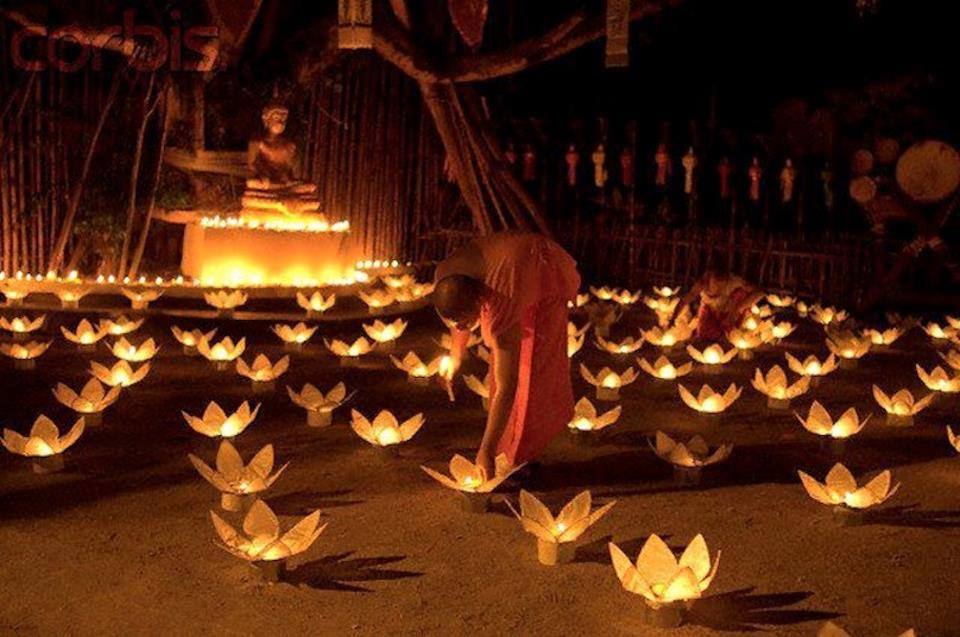
On tomorrow’s laughter…

Currently I’m studying Heart Treasure of the Enlightened Ones with a Dharma friend, the Venerable Tashi Nyima.

This is my contemplation on the first line of verse 38 of the root text of Heart Treasure of the Enlightened Ones.

heart treasure

“Whatever appears is delusion and has no true existence;

Samsara and nirvana are just thoughts and nothing more.

If you can liberate thoughts as they arise, that includes all stages of the path;

Applying the essential instruction for liberating thoughts, recite the six-syllable mantra.”

 Full Disclosure:

It’s so easy to get taken in by ‘reality’ that it’s hard to write about the magic act without getting caught in it.

Written Tuesday, September 16th, 5 AM

Explain to someone else (making it my own)

When I was very young, I saw a movie called ‘Finian’s Rainbow’. It was about a leprechaun who’d come to this side of the rainbow chasing after the pot of gold someone had stolen from him on his side of the rainbow. That movie used to come on a lot. I’d watch it over and over. I think I was intrigued by the idea that a rainbow was something you could travel like a road and then end up on the other side in a whole new world.

As we go about our ordinary lives in samsara, we carry this same sense of child-like wonder. Is there, we ask ourselves again and rainbow potagain, that one act, or maybe that one job, or that one person that will give me a life on the other side of the rainbow? But time passes, we age, and we’re still on the wrong side of the rainbow, and the pot of gold doesn’t materialize. This makes us bitterly angry, frustrated. We become more desparately driven with each passing year to find that perfect life that always seems to lie just on the other side of whatever rainbow we’re chasing after.

This doesn’t work because there is no thing in samsara that is not a delusion generated by a deluded mind. The nature of samsara is that appearances arise when conditions are favorable, they last a few fleeting moments, then they pass away; just like rainbows. Yet we spend our entire lives chasing after delusional rainbows. Dilgo Khyentse says, “However much we might prefer to believe that things are permanent, they are not. Yesterday’s happiness turns into today’s sadness, today’s tears into tomorrow’s laughter.”

We live our lives in a kind of deluded madness. In our delusion, we are like dreamers in a dream looking for one thing—just one thing—that is real. In the dreamlike existence of samsara, it is only the deluded mind that makes it possible to create the illusion that any appearance is substantial, permanent, and independent of the deluded mind from which it arises.

We live like magicians who’ve forgotten that  magic is only a trick, slight of hand. We’ve become deluded to a point where we believe a woman can be sawed in half, then put back together. This is no less absurd than believing that money will bring us happiness, or that our One True Love will come and it will last forever, till every star falls from the sky.

***

 Apply to a past situation (how would it have been different?)

There are so many times in my past where I’ve been sucked in by the magic show of samsara. It’s hard to pick just one.

ladderThere was a time, about two and half decades ago, when I wanted to ‘make it’ in corporate America. I interviewed for an internal posting that I thought would be my dream job, and I got the position. It was everything I’d wanted. I was high profile in the marketing department of a managed dental care company. I managed my own projects. I had my own budget. I organized and put on meet and greets for clients from all over the country. I set my own hours.

I was miserable. I couldn’t bear all the pressure. I once missed a typo on a bulk mailing. It had already gone to the printer to be done on good paper in four color process—very expensive. It cost thousands to run new, corrected copies. I began to miss days at work. I couldn’t stand the thought of being there. My boss, who was totally caught up in the ‘climb the ladder and be a success’ delusion treated me with a mix of condescension and mild disgust. I was holding her back.

One day, something (I don’t remember exactly what) went horribly wrong. It was open enrollment and the pamphlets describing the different plans available had not been delivered to the client. This was in the days before the internet. No pamphlets meant that the entire open enrollment process came to a halt. I had the client calling and yelling at me. I had the client reps calling and yelling at me.

I had…the sudden urge to go shopping. I got my purse, went to Barnes & Noble, and went shopping for a couple of hours. This was in the days before cell phones. I was unreachable. After shopping, I went home. I went back to that job after this fiasco, but it was causing me terrible suffering. I felt like a sublime failure. I felt that I didn’t have it takes to be a ‘success’. I suffered for years after leaving that job, laboring under the delusion that I was just too stupid to ‘make it’.

Looking back on that time in my life, I can notice that all of my suffering came from attachment to a delusion. At that time in my life I imputed reality to the idea that becoming a corporate Vice President (the next step in that position) would make me happy. I also believed that not being alble to do that meant I was dumb or lazy or both.

If I’d been able to take a step back and breathe, and let some peace and clarity arise, I may have noticed that I couldn’t be a ‘success’ because a part of me simply didn’t believe the corporate myth of ‘making it’. That part was desperately trying to wake me up. If I’d been able to bring my attention to nurturing that part of myself, I may have ended my suffering that much sooner.

***

 Apply to an (ongoing) present situation (how does it matter today?)

Yesterday morning I sent the last bit of information needed to complete my background check. Yesterday afternoon the recruiter called to let me know that I’d be getting a ‘Final Offer’ via email in the next couple of days.

That’s it. One phone call that lasted maybe two minutes, and I was free of Interplanetary Title, Inc. I had the urge to go back to my desk and create an email with the subject line “Out of the Office…Forever!”, then send it to ‘All’. Thankfully, I resisted that urge. But it was tough.

An interesting thing has happened since the phone call. Nothing—and I do mean nothing at all—at Interplanetary Title has even a miniscule weight of reality in my mind. Being at work yesterday felt like being in a lucid dream. I took a look at my mind. I was really curious about how  my experience could suddenly be so different. After a bit, I realized that the three poisons (attachment, aversion, indifference) were nearly wholly absent from my experience of the workplace.

But this wonderful dreamlike experience would flip back and forth like an optical illusion…is it a wine glass or two faces? As soonwineglass as an afflicted emotion would arise, I’d be instantly sucked back into the ‘reality’ of Interplanetary Title. When I worked with letting the emotions pass, the dreamlike quality would return.

Wow. It amazed me that so-called ‘reality’ could flip from ‘real’ to ‘dream’ and back literally faster than you can snap your fingers. It was like a coin tossed high in the air and turning over and over—first heads, then tails, then heads. The day went on and I noticed that I was clinging to the dreamlike experience and not wanting it to change. I knew eventually this clinging would lead to attachment, so I worked with letting the dreamlike perception of reality rise and fall like waves on an ocean.

The sudden capacity to experience the dreamlike nature of work has made it so much easier to leave. I don’t feel like I’ll be giving up anything. That would be a little like being caught in a nightmare and saying…No, don’t wake me up. I’m enjoying my suffering.

Being able to experience the dreamlike quality of the workplace has been extraordinary. I always thought that experiencing waking reality as a dream would lead to a total lack of compassion, even though I’ve been told otherwise. Just the opposite is happening. Because I’m relatively free of my suffering under the terrible weight of that reality, I have more compassion for those still laboring under the full weight of the delusion. It’s not just an arising appearance to them, it’s ‘reality’. It’s ‘how things are’. And my real job there in these last few weeks will be to be an Agent of Compassion, to be the wakened dreamer helping those still caught in the nightmare.

***

 Apply to a potential situation (bringing it home to play)

Unless something goes horribly wrong with the new job offer, I have about twenty-five business days left at Interplanetary Title. I can use one of two exit strategies. I can show up each day with an ‘I don’t care because I’m leaving’ attitude, or I can go to work each day and look for ways to use to this new capacity to experience the workplace as dreamlike to help others.

This should be a no-brainer. It is, kind of, except for Salem, who is still unbelievably, and utterly incompetent. A part of me wants to have the ‘I don’t care’ attitude, just so her job gets harder. It’s scary that I still feel that way after all the work I’ve done with that situation…but…there it is.

But…and it’s a BIG but…every act becomes a seed, then a heavy seed, then an impression, then a karmic formation. To be honest, telling myself that including Salem in my compassion is the right thing to do doesn’t help. I know yaks don’t fly and ravens don’t till the earth…but good god almighty already.

All right. So the ‘I need to do the right thing’ approach won’t work to include Salem in my compassion. It’s time for a little enlightened self-interest to kick in. I’ve studied the Dharma long enough to know that the experience of work as illusory and dreamlike is like a pebble tossed into the waters of mind. Soon I’ll start experiencing the ripples. I’ll begin to notice the underlying dreamlike state of other aspects of my life.

Since the workplace is my first genunine experience of this, I have the chance to consciously shape the seed of behavior that will eventually become my karmic formation (my ‘default’) for directing my behavior when this experience arises again. Bearing in mind that I want to plant ‘good’ seeds of behavior in my mind stream, I will go to work today with the intent of bringing a measure of compassion to all of my interactions. After all, in most other areas of my life, I’m still nearly completely caught in the delusion of ‘reality’, just as the people at work are caught in the delusion of that reality.

When my Dharma friend Tashi talked about this verse, he said that it describes the origin of renunciation. At first, I didn’t really understand that. But after yesterday, I totally understand. All that arises in mind is a delusion, a distorted dream. Once we fully realize this, the natural response is to want to wake up from the nightmare world ruled by attachment, aversion, and indifference.

Renunciation is that all-important first step to coming awake to the deluded nature of samsara. Once we begin to awaken, we begin to see clearly that the true nature of samsara is ephemeral—a city of clouds in the mind of a dreamer who’s forgotten he’s asleep. This coming awake I regard as the root of renunciation, and I’m coming to believe that it’s the only way to free ourselves and others of the nightmare pangs of samsara’s thousand fold sufferings.
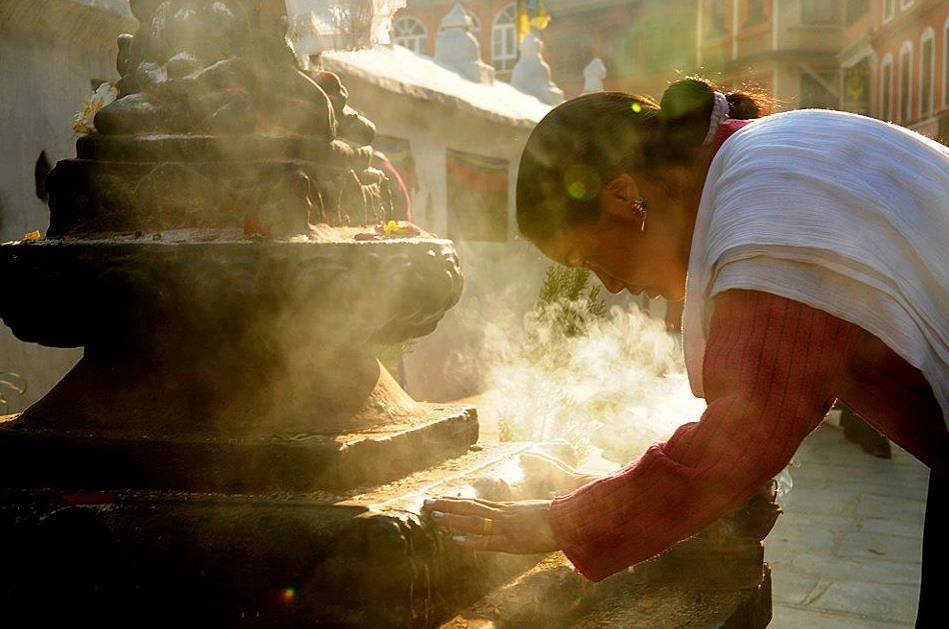
woman at shrine


On the birth of renunciation…

Currently I’m studying Heart Treasure of the Enlightened Ones with a Dharma friend, the Venerable Tashi Nyima.

This is my contemplation on the second line of verse 37 of the root text of Heart Treasure of the Enlightened Ones.

heart treasure

“Put your child, devotion, at the doorway of your practice;

Give your son, renunciation, mastery over the household;

Wed your daughter, compassion, to the bridegroom of the three worlds.

Consummating your duty to the living, recite the six-syllable mantra.”

 Full Disclosure:

I find renunciation much easier to do than to write about. My mind seems to shy away from renunciation as a concept, but cooperates relatively easily in acts of renunciation.

Written Saturday, September 13th, 7 AM

Explain to someone else (making it my own)

For a long time, I was the ultimate Ms. Fixit in my life. I’ve seen those ‘Fix It Yourself’ shows on TV. There are all these people working really hard to remodel a kitchen, a bathroom, a backyard—whatever. With the magic of television, a few weeks’ work is compressed into just a few minutes and –voila!  A House Beautiful magazine photo op has been created.

The other day I was at my dentist watching one of those shows while I waited for my appointment. And truly, those three men did some pretty amazing things to a dock behind a lake house. It was beautiful work. But ever since then, I’ve been wondering. What if, instead of packing up his camera when the job was done, the camera man left all his gear in place, and set it up for time lapse photography, and just…left it there for a few decades?

Thinking of it that way, I could see the homeowners come and go in just a few moments. Then perhaps their children would flash across the picture. Then maybe a restoration crew would fix up the sagging wood. But sooner or later, if the camera was there long enough, the house would first sag, then crumble into the ground. The grass would grow up higher and higher until finally the house would simply be gone, as though it had never been; as though it had been an illusion all along.

When I was Ms. Fixit, I could never, ever get my life right. Every time I fixed it, something else would go wrong. keystoneAnd there I’d go scurrying after the next problem to try and fix it. This went on for decades. For all I know, it went on for lifetimes. If my life could have been captured in time lapse, I would have looked like a Keystone cop, always madly chasing after the latest miscreant issue in my life.

It didn’t work. And now, having practiced the Dharma, I know why. Simply put, there is no solution to life in samsara. There just isn’t. Dilgo Khyentse says, “Renunciation is born when you know that there is ultimately no satisfaction in samsaric life.” Yes. Just so. After you’ve chased down enough rainbows, you must sooner or later come to the conclusion that there is simply no solution to be found. The sooner we realize this, the sooner we can begin a path of renunciation, and the sooner we can end our (entirely optional) suffering in samsara.

***

 Apply to a past situation (how would it have been different?)

In the Ms. Fixit stage of my life, no one could have possibly talked to me about renunciation. What? Stop trying to fix things?? I would have said, No! Not now. I’ve almost got everything right!

Mr FixitProbably the biggest Fixer Upper project in my life, up until a little more than a year ago was the relationship with my mother. My mother is not a bad person. On the contrary. She is a very, very scared person. She’s scared her chance to be rich and beautiful forever is long gone. She’s scared she’ll die without her dreams coming out exactly the way she wanted. She’s right. She will. Her fear makes her manipulative, selfish, and vindictive against those in her life who seem to have all that she so richly deserves and could never seem to get.

For decades I wanted to fix that relationship. Actually, if I’m honest, I wanted to fix her, and make her what I thought a ‘good mother’ should be. I fell out of touch with her for a long while, then a little more than a year ago, I re-established contact. To my horror, nothing had changed in her. She was still sly, manipulative, selfish, and vindictive. Her conversations were an outpouring of vitriol against those who had ‘wronged’ her. For a while, I dutifully made my weekly phone calls, listened, and ignored her attempts to bait me and manipulate me.

But one morning she called and did something that made me see with perfect clarity, detached from afflicted emotion, that the only way to successfully manage that relationship (which was draining me at that point) was to renounce any idea that things would change. That day on the phone, I knew it was the last time I would ever speak to her. I knew that the next time I saw her would be at her funeral. I knew I didn’t have the skillful means to handle things as they were, and things were not going to change. I knew that I couldn’t have her in my life. I thought this decision would lead to much suffering for me. It hasn’t. I didn’t do it in anger. I did it because I fully realized that the most compassionate thing I could do for both of us was to renounce my role in her suffering.

Looking back over the decades of the relationship with my mother, I see that if I could have taken a step back, I may have noticed that my intense suffering came from believing that I could fix that situation, that it was ‘wrong’ somehow. I suffered because I tried so hard to be a ‘good daughter’, but my mother didn’t change and become a ‘good mother’. If I had been able to take a step back, take a few breaths and allowed just a bit of peace and clarity to arise, I may have seen that the only ‘fix’ for that situation was to seek a path of renunciation with the intent of finding a compassionate (not satisfactory) solution.

***

 Apply to an (ongoing) present situation (how does it matter today?)

The biggest thing going on in my life right now is transitioning to a new job.

I’ve never jumped out of an airplane, never parachuted, but I think I can imagine fairly well what it’s like. There you are standing in the door of the plane. The air’s rushing past you at hundreds of miles per hour. You feel the weight of your parachute on your back and…you’re waiting. You know you’re going to jump. There’s no question about that. You’re just waiting for someone to signal that now’s the time, things are right, we’re where we need to be—jump.parachute

In those last few milliseconds when you take that first step off the plane and you’re caught, one foot in rushing air, the other solidly on the plane, there must be a moment when you think…please—let my parachute be packed right.

That’s where I am now in transitioning between jobs. I have to fax one last bit of information to complete the background check. The next step is to wait for the contingent job offer to morph into an actual job offer.

Strangely, now that I’m leaving work, it seems entirely more bearable there. It’s almost (but not quite) palatable. I’ve thought about this and wondered about it.

I’m pretty sure that work seems almost pleasant because I’ve renounced both the illusory gains and the illusory suffering that goes with that job. It’s a wonderful feeling of freedom. I’ve always had a hard time distinguishing (theoretically) between indifference and renunciation. Now I’m experiencing the difference. It’s not that I don’t care what happens at work. It’s just the opposite. I want to do a good job. But at the same time, there’s no sense of attachment to the job itself, or even to the outcome of what I do. On an everyday level, this means I do what has to be done, with as much compassion as I can, then I move on.

In this situation renunciation feels like a total lack of judgment about how things should be versus how they actually are. Each day when I go to work now, I’m fully aware of how miserable it is to be there. But somehow, that awareness doesn’t cause aversion to arise. I’m doing everything I can not to be there anymore. It’s an experience of my life as what happens…happens. There’s no struggle to stop things from being as they are. Renunciation feels like understanding that things are as they are and if I want them to change, I will have to figure out how to bring that change.

Far from giving up anything, renunciation feels like total power. It feels like stepping off the airplane into the screaming wind and thinking…If my parachute’s not packed right, I’ll die today. If it is, then I won’t die. Not today. Right now…I’m going to fly.

***

 Apply to a potential situation (bringing it home to play)

At my current job, the location being used has to be vacated in about a month. This past week there’s been much anxiety in the office about who will move where. There are two possible sites. One is about a ten minute drive for me. The other would be probably a little more than an hour…on a good day. I wasn’t actually all that concerned because I had absolutely no intention of driving an hour to get to work; not to that job. As it turned out, I’ve been assigned to the site that’s maybe a ten minute drive. I’ll have to be honest. I wish I’d been assigned to the farther site, because then the jump would be a complete no-brainer.

As it is, I’m starting to wonder. Twenty-two thousand dollars is an awful big drop in salary. As I prepare to take this jump off the familiar into the unknown, I see renunciation as my parachute.

How do I explain this? When you practice renunciation and make it part of your ordinary life, you’re no longer a victim of circumstances. You’re no longer a victim of anything. Changing jobs and moving to a new industry after nearly two decades in the same industry is just a little this side of terrifying. It is, really. I feel no less anticipation and fear than if I were standing in the door of a plane waiting to jump. But living my life with an attitude of renunciation makes the fear and anticipation and uncertainty all right. Once you realize that there isn’t that one special act or that one totally awesome person that’s going to make your corner of samsara comfortable, your only option is renunciation.

To me renunciation feels like stepping from the plane, relaxing into the pull of the air and thinking…I take refuge in the Buddha, the Dharma and the Sangha. This sounds trivial, but it absolutely works. When we let go, and let the Dharma support us, not only do we not fall, we fully come to realize that there’s nowhere to fall to.

These next few weeks, as I fall through the skies of transition, I will keep my heart in a place of renunciation. I will know that the Three Jewels never fail those they protect. I will know that I have set my feet firmly on a path of renunciation. I will know that I can float like a Bodhisattva and sting like a Buddha. In short, I will know that this precious human birth is given to us so that we may live in a way that makes our death an unequivoval doorway to enlightenment.

monk on brick road

On ending well…

Currently I’m studying Heart Treasure of the Enlightened Ones with a Dharma friend, the Venerable Tashi Nyima.

This is my contemplation on the first line of verse 36 of the root text of Heart Treasure of the Enlightened Ones.

heart treasure

“Cremate that old corpse of clinging to things as real in the fire of nonattachment;

Conduct the weekly funeral ceremonies of ordinary life by practicing the essence of Dharma;

As the smoke-offering to provide for the departed, dedicate your accumulated merit for all their future lives.

Consummating all positive actions done for the sake of the dead, recite the six-syllable mantra.”

 Full Disclosure:

Really? I couldn’t resist a chance to write on a verse that talks about cremating old corpses!

Written Thursday, August 28th, 7 AM

Explain to someone else (making it my own)

Ever watch a disaster movie? If you’re old enough, you remember the airport movies and the earthquake movies. If you’re not, they were actually billed as exactly that, “disaster movie”. Believe me, when you walked into the theater, bought your popcorn, and settled down in the dark, you did not expect a happy ending. You knew that right after the opening credits, everyone onscreen was about to have a very, very bad day; a day so bad in fact, they’d wish they could crawl back between the sheets and take refuge in their worst nightmare.

When I was younger, maybe in about sixth or seventh grade, I used to love those movies. I’d sit in front of the screen spellbound, watching strangers work through disasters born in some (very warped) writer’s mind. Then I grew up. And honestly, I think for a while, my life outdid even the most warped among Hollywood’s writers.

Unfortunately for all of us in samsara, we’re living the ultimate disaster movie. If I had to give it a title, I’d borrow from my Dharma friend Tashi and call it, It Doesn’t End Well. Pessimistic? No. Realistic? Yes. alienThink about it. At least in Earthquake, or Towering Inferno, or The Titanic someone gets out alive. Not so in samsara. This realm is the perfect storm. Remember how the tag line for the movie Alien was ‘in space, no one can hear you scream’?  Well, the tag line for It Doesn’t End Well would be, ‘no one gets out alive’.

This realm has a one hundred percent mortality rate. The moment of your birth inevitably and relentlessly leads to the hour of your death. Isn’t that great news? Now that you know how the movie ends, no need to stress over it or obsess about it. In the end, you’re going to die. That’s a certainty. Knowing that, we can get on with the business of living a life that will lead to enlightenment, and the end of our encore performances on the stage of samsara.

Think of it. Here we are, caught in the ultimate disaster movie, and we’ve been in reruns for eons. Talk about your long lasting shows! But in this very lifetime we have a chance to escape the beginningless cycle of birth and death. How do we do that? It’s one of those things that’s hard and easy at the same time. Dilgo Khyentse puts it like this, “The tree of samsara is rooted in the belief that there is a self, in clinging to things as real, in ego-clinging; once this clinging is consumed by the fire of wisdom, the whole tree and all its branches of delusion, luxuriant with the foliage of attachment and hatred, are bound to be burned up too.”

In other words, the only way out of samsara is to give up or ‘renounce’ our habit of clinging to phenomena as though it were substantial, permanent, and independent. It is not. The sooner we can bring ourselves to this path of renunciation, the sooner we can cremate the old corpses of our attachment to samsara’s delusions, the sooner we will stop suffering, the sooner we will bring down the final curtain.

***

 Apply to a past situation (how would it have been different?)

About three years ago, I really wanted to quit my job. I mean really. I would come home some days and cry. Weekends were nightmarish because I knew that, come Monday, I’d have
to go back to the deepest circle of Hell, and I’d be trapped there for hour upon hour. It felt no different than a gulag to me: imprisoned, tortured, longing for freedom. Every time I thought of leaving, there were a thousand reasons I couldn’t. I needed the money. I didn’t want a long commute. What if I couldn’t do the new job?

in prisonThis cycle stretched into my personal life, leading me to unwholesome pursuits and the cultivation of unskillful habits of over spending, overeating, and other ways of overindulging; anyting to try and escape the dismal suffering of life as a prisoner in the Bank of America gulag. No nightmare was ever so unrelievedly full of dismay, melancholy, or despair. It was a very dark , very bleak time in my life. It was then that I ‘accidentally’ heard the Dharma for the first time: Pema Chodron’s “Getting Unstuck”. The Dharma showed me the path (which had been there all along) out of Hell.

Looking back on that time in my life, I could have taken a step back from my constantly overwrought emotions. I could have breathed. I could have done mantra. If I had been able to do that, I may have noticed that all of my suffering, every single moment, came from one thing: attachment. I was attached to ‘my’ job. I was attached to ‘my’ lifestyle. I was attached to ‘my’ reputation for being good at what I did. I was attached to ‘my’ short commute. I was even attached to hating ‘my’ boss and being right about him being a bully.

Had I been able to notice that all of my suffering had just one cause, I may have been able to work with a remedy to ease my extreme attachment. I believe if I had been able to work with my attachment, I would have decreased my suffering much sooner.

***

 Apply to an (ongoing) present situation (how does it matter today?)

Fast forward about four years, five or six layoffs (I’ve lost count), and the sale of the company I formerly worked for to Interplanetary Title, Inc. During that time, I was desperate to hold on to my job. Then, with each layoff, when I wasn’t the one being walked out, I was ‘happy’, or least not morose.

With the shrinking of the department I work in from sixteen people to just two people, things changed. I had to train Salem, possibly the most untrainable sentient being on the face of the world. She is for certain (in my most humble opinion) the most self-pitying sentient being on the face of the world.

Here’s a funny thing about this job. Ever since I began studying the Dharma, I could feel more and more acutely the suffering of the work situation. I don’t know enough about
the Dharma to know if karma actually works like this, but since the beginning of this year in particular, it feels like karma is a strong wind at my back, blowing me out of this job, urging me on. I have been staunchly resisting. I’ve turned down three job offers since January. And with each offer that I turned down, the situation at work grew worse and worse. The suffering kicked up just enough to go from tenable to just shy of unbearable. I’ve had to hang on more and more grimly simply to have the patience to walk in there each day and avoid harm, do good, and purify my mind. That last bit has been quite the challenge just lately.girl on rope underwater

Now, today, I fully realize that the true source of my suffering isn’t Salem. Sure. She’s an irritant. If she were inside an oyster, it could make a pearl the size of Jupiter. The actual source of my suffering is my attachment. I’m attached to being right. I’m attached to the idea that someone (please god, anyone) will realize how incredibly incompetent Salem is and replace her with someone who (a) has critical thinking skills, (b) has written communication skills, and (c) actually does their job instead of coming up with wholly implausible excuses for not doing it. I’m attached to my ten minute commute. I’m attached to going on the King Arthur website and buying something just because I want it. I’m attached to the idea that I am right, Salem is wrong, and she needs to go.

No. Working with this verse the last few days has shown me beyond a doubt that I need to go. I have seen my attachment these last couple of days. My attachment is like a parasite, feeding on my afflicted emotions, paralyzing me with the delusions of fear and impotence. It’s time to purge these delusions and . . . let go.

***

 Apply to a potential situation (bringing it home to play)

This morning, in about an hour, I have a telephone interview with Big Sky, Inc. It’s a HUGE company. It’s building new national headquarters about five minutes from where I live. It’s a telephone representative position. Far from being a Mickey Mouse Wannabe, their benefits package is absolutely stellar. All I would have to give up to work there is twenty-two thousand dollars’ worth of attachment. My salary would drop by that much.

Even knowing this, that wind of karma blows warmly and insistently at my back. At this point, I would say that the urge to move on from where I am now has become an irresistible compulsion. I’ve done the math. I can do it financially, but my lifestyle will be totally different—to the tune of twenty-two thousand dollars different.

I’ve known about this morning’s upcoming phone call since Sunday afternoon. All week I’ve worked with looking at Mara, at my attachment. Each day, as I’ve gone to work, I’ve observed my attachment in action. It’s a feeling of desperate clinging, as though I’d jumped off the sinking Titanic into icy waters and I were clinging to drifting debris, madly treading water just to stay afloat.

These past few days I’ve realized something that really hit me hard. That desperate feeling of clinging isn’t going to go away until I leave that job. I’ve made so many accommodations, worked with so much of the Dharma, but it’s as though the flames of a burning house were licking at me hotter and hotter. It’s literally become impossible to stay there. The very last straw was my manager’s decision to make me wait more than three weeks to go to the dentist for an ‘emergency’ appointment. I can’t bear anymore.

Today, when I have the phone interview, I will accept the job if it’s offered. I won’t do this because I think a job at Big Sky, Inc. will land me in nirvana. I’ll do it because the only thing keeping me at my current job is my attachment. Nothing—absolutely nothing—else keeps me there. With that being the only reason to stay, it surely cannot end well.

I will accept any offer made by Big Sky, Inc. because it’s my fervent desire that in moving my life toward nonattachment, toward renunciation, I will begin to truly see that only one thing keeps us on the “It Doesn’t End Well” movie set: attachment. In seeing this, and acting on it, my feet will be more firmly set on the path of renouncing suffering.

It doesn’t end well. No, not at all. We can’t get out alive. But what we can do, without a doubt, in this very lifetime is stop the reruns.

grace in sunlight

Postscript:

When I shared this contemplation with my Dharma friend Tashi, he called the situation at work, “the unbearable comfort of the known”. This is brilliant…yes…that’s exactly what it feels like.

 I’ve had the phone call. I’ve accepted a provisional job offer. After that, I had to find a way to pay bills on twenty-two thousand dollars less a year than I make now. I went to my bank, and it took me a little more than an hour to get a loan that will consolidate my bills into one low monthly payment. This will let me barely squeeze by on my new salary. As an aside, the loan officer who assisted me ‘just happened’ to be a home baker. We exchanged baking stories. It’s incredible how easy karma makes things when you sail with the wind, instead of trying to go against it. As my Dharma friend Tashi says quite a bit, if you support the Dharma, it will support you.

On a bountiful harvest…

Currently I’m studying Heart Treasure of the Enlightened Ones with a Dharma friend, the Venerable Tashi Nyima.

This is my contemplation on the third line of verse 35 of the root text of Heart Treasure of the Enlightened Ones.

heart treasure

“Overcome your enemy, hatred, with the weapon of love;

Protect your family, the beings of the six realms, with

the skillful means of compassion;

Harvest from the field of devotion the crop of experience

and realization.

Consummating your life’s work, recite the six-syllable mantra.”

 Full Disclosure:

Mind has been extremely agitated these last few days. Doing this contemplation felt like trying to see through mud smeared two-inch thick glasses. 

Written Thursday, August 21st, 5 AM

Explain to someone else (making it my own)

I grew up a city girl. When I was very young, I didn’t know grass had to be planted. I thought it was just the green stuff that grew where there was no sidewalk or road. Then my aunt moved to upstate New York, and I went to spend summers with her.

She had a little garden in back of her house. There were tomatoes, peas, and other stuff I can’t remember anymore. Each morning I’d see my aunt out there watering, picking off leaves, and doing weird stuff like making the little sticks stand up straight for the tomatoes. After work she’d be out there again doing the same routine. I didn’t get it. Did the vegetables need help to grow?

One day I asked her what she was doing out there and why didn’t she pick them if they were ready. She told me if she didn’t do that each day, they’d never be ready. She said if they were ever going to be ready, she had to take care of them. After that, I’d sort of sit and look at the growing tomatoes (the easiest to see) and watch…to see if I could spot them growing. Of course, I couldn’t.

Then came the day they were ready to harvest. My aunt let me help pick them, and then I got to shell the peas. Was I surprised or what to find out that peas grew inside something, not just in the ground by themselves in the dirt. That night when we had dinner, those were the sweetest peas I’d ever had.

tending fieldsAs we go through our lives and practice the Dharma, we are constantly tending the fields of our devotion. There is not a word, or an act, or a thought that is not planted in the vastly infinite fields of our experience. At every moment, we have a choice of what seeds of word, thought, or deed to drop into the fallow soil of our lives. It’s easy to forget that whatever seed we drop, that is what we shall harvest. Dilgo Khyentse puts it this way, “There is no better or more bountiful harvest than the one you sow in the soil of your faith and endeavor so that it ripens into the richness of merit and wisdom.”

Knowing that we will reap what we sow, knowing that Dharma is a practice not a theoretical debate, knowing that we must free ourselves of the cycle of birth and death or be doomed to repeat it, what must we do? We must live our lives in the knowledge that with each precious human birth, we are given all that we need for a bountiful harvest. When our harvest is complete, and we break open the pods of our experience, if we are able to see past the obscurations of wrong view and afflicted emotion, we will see that we have harvested our own enlightenment.

***

 Apply to a past situation (how would it have been different?)

Sometimes we can have the biggest realizations about the Dharma while we’re doing the most mundane things. I do a lot of baking. I have a lot of tools for baking: cast iron pots, an enamel pot, a clay baker, a Kitchen Aid, a baking stone, a scale, measuring spoons, knives, thermometers—a whole gaggle of stuff. So when I started learning a new technique for baking bread, I thought I was totally ready.

I’m learning how to make bread in a new way, using a stretch and fold technique that lets you work with a wetter dough, so you can get nice big holes in your finished loaf. When I began this technique, I made a sort of mini-vow that I would do fifty-two bakes before I decided if I liked the technique or not.

So off I went. Ken Forkish, the author of the book I’m learning from, suggests starting with a low hydration (73%) bread recipe. But no. I skipped ahead to a 78% hydration recipe. When I mixed my dough, it was a watery soup of flour and water that I couldn’t handle or manage. I certainly couldn’t shape loaves out of it. I had to add more flour, which defeated the whole purpose of learning to make ‘artisan’ bread. I almost put the book away and went back to my old ways. But…there was the 52 bakes mini-vow, so I kept at it.

When I was reading Ken Forkish’s book and I wasn’t actually in the kitchen, I thought all my tools and all my experience doughwere enough. Seventy-eight percent? Sure. Why not?

In practicing the Ken Forkish method of baking bread, I learned almost overnight that a recipe is just a theory until you’re in the kitchen and wrist-deep in a mixture of flour and water that sticks to you like Crazy Glue. At that point, you have to let go theory, and start practicing. In other words, you have to do it.

The practice of the Dharma is so much like this. We read a prayer or we read about harvesting from “the field of devotion the crop of experience and realization” and we think…yeah, okay. I’ve got that.

No. We don’t have it. Until we bring the Dharma into our everyday mundane experience (like baking bread), we think we have all the tools and we think we’re understanding, but all we’re really doing is reading theory.

If I could have done this Ken Forkish experience differently, I would have started with the ‘beginner’ bread. I would have reminded myself that reading a recipe is worlds apart from doing a recipe. Had I done this sooner, I may have noticed that reading a recipe, even in a well-equipped kitchen, only gives you a starting point. I may have noticed that the baking didn’t actually begin until I felt the warm mix of flour, water, salt, and yeast squeezing between my fingers.

***

 Apply to an (ongoing) present situation (how does it matter today?)

If I had to pick one thing in my life going on right now, it would be working with giving up a harmful habit. I’ve had this particular habit for about twenty years. As I study the Dharma, the habit becomes more and more distasteful, but I still want to do it. It’s a form of intoxication that poisons the mind but not the body. In the last ten days, I’ve really taken the approach that I want to be free of this habit in this very lifetime. Believe me, this habit is far too ingrained to be only from this lifetime. The biggest help has been to cultivate a higher taste, something I learned about in one of Tashi’s Dharma talks.

devotionIn working with this habit (which feels so much like an addiction), I am very much working with paying attention to what I devote my time to. I’ve also begun to pay very close attention to what devotion means. I’m finding that we can be devoted to absolutely anything. Although this sounds self-evident, I am coming to see very clearly that devotion is simply a matter of attention. Where your attention is–that’s what you’re devoted to. From this follows that whatever you are devoted to, you will harvest experience and have realizations in line with your devotion.

Here’s the trick. If you devote yourself to something that habitually agitates the mind, then your realizations will be distorted by afflicted emotion and wrong view. After just ten days of working with this habit, I already feel more peace and clarity arising in the mind. But the habitual tug to return to the habit is quite strong.

Working with this line has helped tremendously because I am able to see clearly the crop I harvest when I cultivate a higher taste.

From this I’ve observed the following sequence. When we are devoted to something, we give it our attention. The more of our attention we give, the more our experience will show us the world in terms of our object of devotion. When we shift our devotion to the Dharma, our experience shifts, and our realizations become clearer and clearer as peace and clarity arise in the mind.

***

 Apply to a potential situation (bringing it home to play)

Tonight when I get home, I will want to indulge in my habit. That’s a given. I keep waiting for that desire to pass. It has subsided, but it doesn’t feel like it will ever pass. I have quit this habit in the past, when I first started studying the Dharma. But back then I was holding my breath, struggling with it…and it lasted only eight months.

Vows don’t work. Struggle doesn’t work. Holding my breath doesn’t work.

Tonight after work, when the habitual desire arises, I will look at Mara, as I have been doing. I will recognize that I have a choice about where I put my attention, my devotion.

Tonight I can do a devotion to Mara. She’s very welcoming, but it’s the strangling, poisonous embrace of a viper. I will recognize that if I choose to devote my evening to Mara, the experience I harvest will be one of fleeting happiness, followed by a happiness hangover of feeling defeated and impotent.

If I choose to devote my evening to the Dharma, the Buddhas will welcome me, as they always do. The experience I will harvest from my devotion to the Buddhas will be permanent happiness, a glimpse of my Buddha Nature. I will also experience far more peace and clarity in an evening spent in the presence of the Buddhas and Bodhisattvas.

Sitting here writing this in the pre-dawn stillness of my little neighborhood, the choice seems self-evident. Of course the choice to make is not to embrace the viper, right? But…didn’t Alice drink from the bottle marked ‘Poison’?

After work tonight, when I’m exhausted from anxiety running through me all day like high voltage current, the choice won’t be so clear. Mara will look awfully good, scales, fangs and all.

Knowing that is a great advantage. Knowing that my mind will be presenting a very distorted view to me as to what will lead to happiness will help me not to get caught up in the delusion.

I harvestwill remember, even in that state of mind, that wherever I put my devotion, that is the crop I will harvest.


As we go about our lives, let us remember this; let us remember that our bountiful harvest is always our choice in every moment, with every heartbeat, with every breath.


On molding the clay…

Currently I’m studying Heart Treasure of the Enlightened Ones with a Dharma friend, the Venerable Tashi Nyima.

This is my contemplation on the second line of verse 34 of the root text of Heart Treasure of the Enlightened Ones.

heart treasure

“Offer the torma of whatever arises to the guests of immediate liberations;

Mold the clay of whatever appears into the tsa-tsa of void appearance;

Offer the prostration of nonduality to the Lord of Mind Nature.

Consummating these Dharma activities, recite the six syllable.”

 Full Disclosure:

In writing this contemplation, and working with this verse this week, I had an odd feeling of eavesdropping on my own mind, as though I’d ventured into a basement work room marked PRIVATE: DO NOT ENTER. I’m glad I ignored the sign.

Explain to someone else (making it my own)

There’s a lot of talk these days about unemployment rates and how the economy’s recovering. Honestly, who cares? Unless there’s a job that gets you out of the burning house of samsara, every job is the same job. Wanna see a politician’s perfectly coifed hair stand on end? Tell them this: At this time (Madam Prime Minister, Mr. President…whoever), there is 99.99% unemployment, worldwide. After he or she runs screaming into the night in search of their spin doctor cavalry, think about this.

We are here in samsara to do one job and one job only: recover our Buddha Nature. Everything else is just, as my Dharma friend Tashi likes to say, entertainment. Patrul Rinpoche puts it like this: “Between meditation periods, make sure that everything you do is in harmony with the Dharma….whenever you have the free time…do only what is truly meaningful.” How many of us do that? Right, about .01%, which is why the worldwide unemployment rate is 99.99%.

Now, honestly, I don’t carry Play Dough around in my purse. Everything else it seems, but not that. I don’t have time in my life to mold little clay statues (tsa-tsas) as offerings. But there’s no need for that. We all have the ultimate clay molding mega machine with us wherever we go. We could go into the bowels of the earth or way out past where the Hubble telescope can see, and we’d still have that amazing fantastic mega molding machine right there with us. And it travels light, very light.

Our experience of reality is an internal representation created by the mega molding machine of the mind. All that we see, all that we experience is the “clay of whatever appears”. Given this, we could spend our entire lifetime molding whatever arises in our lives along the elegantly shaped lines of the Dharma. How do we do this? It’s simple, really. As we go through our experience, we remind ourselves that all is impermanent, insubstantial, and completely dependent on our karmic formations.

Lest we think this is too difficult asculptor task, let us remember that at each and every moment we are master sculptors who shape into being a delusional reality that is convincingly permanent, substantial, and independent.

Isn’t it time we employed that incredible talent for molding the clay of whatever arises to work for us instead of against us?

***

 Apply to a past situation (how would it have been different?)

Tsa-tsas are traditionally made of clay, usually mixed with the relics (ashes) of a Buddha who’s left their body. When I first heard that this past Sunday, I thought—how brilliant is that? In creating an offering, the thing we fear most—death—is actually made part of the offering itself.

I’ve thought about that all week and how, growing up Christian, offerings were made on pretty white cloths on beautifully pristine altars. It wouldn’t have occurred to anyone to put a dead saint’s ashes on all that pretty white cloth. Particulary since Seventh Day Adventists don’t hold with all that ‘Saint’ stuff. This goes with the Christian theme of sin being something to apologize to God for and to make every effort to scrub it away from your filthy, undeserving soul.

Imagine offering sin to the Christian God? He’d probably smite you into the middle of next week.

So this way of seeing offering was totally different to me. Looking back over my life, I think the situation that I could have molded into void appearance was the relationship with my mother. That caused me no end of heartache from about the time I was five years old until a little more than a year ago. I wanted desperately to be the perfect daughter. I wanted her to love me as I was—not the perfect daughter she wanted to make me into. I wanted to stop being the fat, stupid little girl (to use her well-turned Patois phrase: you no have no sense!) she always saw me as and treated me as.

If I look back on my life at that time, I can notice that both my mother and myself were caught up, embroiled igladiatorn afflicted emotions. We were like flint rocks that struck sparks of pain and anger off each other on contact. If I could have taken a step back, breathed, done a quick mantra, I might have noticed how I had nothing to do with how my mother was. It wasn’t personal. She resented having children. Any child could have stood in my place and would have been subject to the same treatment.


Having noticed this, I could have taken yet another step back and noticed that all that was arising in my experience with the woman I called ‘mother’ was insubstantial, impermanent, and wholly dependent on my karmic formations that went back for eons.

Once I’d noticed that, I may have sensed the ancient feel of the conflict, and instead of seeing it as a battle to be won over an external entity, I might have seen my afflicted emotions as markers showing me what karmic formations I need to work with to recover my Buddha Nature.

Having realized the emptiness nature of the ‘external’ conflict, I would have been free to mold each encounter into a welcome chance to work with dissolving the underlying karmic formation that all the conflict was pointing to.

***

 Apply to an (ongoing) present situation (how does it matter today?)

The biggest ongoing situation in my life right now is my missing dental bridge. This week the dentist’s office called me with the cost. I promise you, here in Texas, I could make a down payment on a really nice house for the cost to replace this bridge. In the meantime, there’s lots of discomfort, especially when I talk. There’s the risk I could accidentally rip out the little filed down stub of tooth that was anchoring the bridge. Then I’d need an implant. And that would probably cost the down payment on a McMansion—in Frisco.

As this week has progressed, I’ve really worked with this whole bridge thing, and wondered what the heck kind of tsa-tsa this would make. At one point when the little stub was really hurting, I thought—hey, if it falls out, all I need is some clay to  mold around it and I’m good to go!

In my more serious moments, I watched mind at work. Mind was playing the blame game. The truth is the dentist told me a year ago that this bridge would have to come out. I had really good dental insurance. He had a treatment plan. I didn’t go.

This year before the company I work for was sold and I got moved to this Mickey Mouse Wannabe dental insurance, Interplanetary Title, in an uncharacteristic moment of candor, warned that we should get any procedures that we needed done before we moved to the new insurance. I didn’t go to the dentist.

blame 2After all that, mind has the unmitigated gall to blame my pain and discomfort on my manager (who won’t give me time off) and Salem (who’s the reason I can’t have time off until Sept. 4). This has been an amazing opportunity to watch my mind at work. Because it hurts to talk, I spend ninety percent of my time at work in silence. And in this silence I am able to observe mind hard at work molding and assigning blame. But never to me; no, never that.

Using this stanza, this line in particular, when those thought of assigning blame arise, I repeatedly ask myself: Is this substantial? Is this permanent? Is this independent? Is this the right view? What am I missing in this picture? (Thank you to Tashi for these questions)

At first mind was stubbornly silent. Then, grudgingly, like a sulky child, I’d get answers: no, no, no, no, and “missing lots”. After repeatedly asking the same questions for days, I’m not really sure what happened. I didn’t have a feeling of molding anything, but there’s far more distance between me and those thoughts of blame now than there was last week. When the thoughts of blame arise now, I don’t get caught up in them. I don’t buy into them. They are exactly like clouds passing in a vast sky.

I’m not sure, but I think the questions allowed me to recognize the “void appearance” of those emotionally charged thoughts. Once that happened, I was able to see through them, past them, and back to the causes of suffering that I put in place for myself.

As I write this, I realize that when we acknowledge illusion as our parents, and realize we are a child of illusion, the experience of our perceptions becomes very much like soft clay. We can’t mold a masterpiece out of our lives, not here in samsara. But we are after all master sculptors with eons of experience and skill. We can certainly mold whatever arises into a shape that acknowledges and bows to the emptiness nature of all experience. In this way, we begin to free ourselves of our delusions.

***

 Apply to a potential situation (bringing it home to play)

It’s twenty days until I go to the dentist. Twenty days of sore gums. Twenty days of living in fear that I’ll break off that little stub of a tooth. Twenty days of eating foods I don’t like but am forced to eat because they’re soft.

Of course, it’s also twenty days to work with mind, but more importantly, to watch mind at work. I have pinking shears. They’re a special kind of scissors with curved teeth instead of straight blades. No matter what kind of paper you cut, you get pretty sculpted edges.

In these twenty days, it’s my intent to use this line as pinking shears for the mind. In just the last four days, I’ve made tremendous headway in working with blame, aggression, resentment, and frustration just by asking myself a few simple questions.

Even more unbelievably, instead of dreading going to the dentist I’m counting the days until I can lie back in that chair,dentist under that super-bright light, and have a very nice man insert an overabundance of needles, drills and all manner of sharp metal objects into my mouth. If that isn’t molding my experience, I don’t know what is.

As I go through these twenty days, it’s my intent to notice how incredibly malleable our experience really is. If anyone had ever told me that I would one day look forward to a dentist’s appointment, I’d honestly have thought them quite mad. But going through this experience, I see how all that arises in our lives is like clay that can be molded, is in fact molded at every moment, with every heartbeat, with every breath.

As I wait out these twenty days, it feels that I’ve discovered some wonderful new talent that I never knew I had. I will move through these twenty days with keen attention to what arises and view my experience with a sculptor’s eye, an eye that sees past the illusions of substantial, permanent, independent existence. With that sharp finely tuned view, I will move through these days with the intent to sculpt whatever arises into an offering to my parents, an acknowledgement that I am a child of illusion.

I will labor as hard as any artist ever has to call forth the essence of the Buddha I truly am, the Buddha we all truly are.

monks with lying down Buddha


On the turbulent vortex…

Currently I’m studying Heart Treasure of the Enlightened Ones with a Dharma friend, the Venerable Tashi Nyima.

This is my contemplation on the second line of verse 33 of the root text of Heart Treasure of the Enlightened Ones.

heart treasure

As thoughts and the two obscurations are pacified,

Experience and realization increase;

As your perceptions come under control, enemies and

Obstructing influences are subjugated.

It is Chenrezi who bestows in this very life the supreme

And common siddhis;

As the four activities are accomplished by themselves,

Recite the six-syllable mantra.”


 Full Disclosure:

I found it hard to contemplate something that doesn’t actually exist without slipping into treating it and speaking of it as though it does exist.

Explain to someone else (making it my own)

mad scientistWhen I think of controlling the mind, the first thought that comes up is a man strapped into a chair wearing a metal helmet with lots of wires coming out of it going to huge machines with blinking lights on them, like in a 1950’s sci-fi movie complete with spooky music, and a Vincent Price mad scientist type saying, “…I now control your mind, Mr. Smith, your very mind! You will do as I command…”

In real life, it’s not that easy. The ‘machine’ we have for controlling our minds is Mind Training. No blinking lights. No mad scientist. But you can supply your own spooky music if you want. When I first started mind training, I thought…how hard can this be? Memorize a few prayers, learn a few remedies and—voila!—a well-trained mind. Now, some two years into it, I’m starting to realize a few hard truths.

First among them and perhaps most startling is that the ‘mind’ as such doesn’t exist. Except that it does. But it doesn’t. And once you realize space and time are merely concepts made up by the mind, which itself doesn’t exist, you come to see that the ‘mind’ can both exist and not exist in the same moment. At first, this confused the heck out of me. I mean, come on, we live in a world of zeroes and ones, don’t we? The question is always is you is, or is you ain’t, isn’t it? It’s either a zero or a one, right? It’s got to be negative or positive, doesn’t it? It can’t be both, can it?

The answer is yes…and no. Dilgo Khyentse describes mind like this, “What we normally call the mind is the deluded mind, a turbulent vortex of thoughts whipped up by attachment, anger, and ignorance.” Well, that made me feel all kinds of better. When I think my mind exists, I’m deluded. But then I thought about it. That’s how things really are, isn’t it? Our eyes merely transmit information. They don’t ‘see’ anything. We see the world through our mind. And our mind is a little bit like that hundred years storm on Jupiter. Myriads of thoughts spin through our mind all the time, and anything we ‘see’ or perceive is being seen through the distorting and constant storm of afflicted emotions.

For something that doesn’t exist, the mind is pretty powerful, isn’t it? Or is it? What if we could calm that storm? What if we could recognize the absolute emptiness of all thought? Where would that leave us? I think it would leave us completely awakened, like a sleeper who wakes from a nightmare.

***

 Apply to a past situation (how would it have been different?)

Is romance an emotion? I don’t think so. I think it’s a whole lot of emotions packaged into a single concept, and attachment is the glue that holds it all together. After all, who wants a thirty day romance? How about ninety days? No. It’s more like my sister used to say, “I mate for life. His or mine. He leaves me, he’s a dead man.” She was only half-joking.

vampireAs I went about life in my past, I was constantly seeking that ‘Forever Romance’. Of course, it never even occurred to me to question what kind of person would offer a guarantee of forever. I wanted that Forever Romance because I labored under the delusion that having it would make me ‘happy’. By happiness, I meant I wanted to stop the constant spinning tornadoes of thought that whirled ceaselessly through my mind. What ended up happening was the tornadoes I’d carried around up until then were absolutely blown away by the hurricane of emotions that comes with living with a sociopath.

Boy, howdy. It wasn’t no joke.

Looking back on that time in my life, I can notice that I had so little control over my perceptions, I didn’t even realize they were perceptions. I wholly believed whatever my mind spewed out. Whatever the delusion, I bought into it. And all the time, I was miserable because happiness constantly eluded me.

If I could have stopped for just a moment, and breathed, and had just a moment of peace and clarity, I would have seen that I was on the Titanic and the iceberg was dead ahead. If I could have noticed that much, even for just a moment, I might have been able to change the course of my life. Or at the very least, I may have noticed that I was the only one who could change the course of my life. I might have noticed that there were lifeboats all around. All I had to do was jump.

***

 Apply to an (ongoing) present situation (how does it matter today?)

The biggest thing going on in my life right now is anxiety.

Our lives go through cycles. There are good times and…not so good times, right? The cycles in my life are very pronounced. I’m not sure why that is. It could be because I’ve always been an introspective, introverted person. Most of the time, my anxiety is there and I don’t really care that much. It’s like an annoying, buzzing fluorescent light—just loud enough to hear, but not loud enough to really bother about. With pharmaceutical assistance, the buzz has gotten even softer.

But then there are times like the past couple of weeks. How to explain anxiety at this level?

Okay. Imagine this.

You’re a time traveler. You know exactly what’s going to happen on the Titanic. And in some magical way you time travel back to the Titanic’s last night on the sea. You’re on board, and you know that in five minutes, the ship is going to hit the iceberg. Five minutes. There’s nothing you can do. You may survive the icy water, you may not. How would you know? You’re a time traveler, not a fortune teller. Five minutes to a watery death in frigid waters. Would you be anxious, or what?

That’s what it’s like for me to live with anxiety when it cycles up, like it is now. There’s this constant feeling of OH MY GOD! DOOM! DOOM! Imagine those last five minutes on the Titanic stretched out over days and days on end. Welcome to my world.

In dealing with anxiety at this heightened level, my practice is invaluable. It is such a tremendous sense of power to realize that just because it took me four hours to get out of bed (talk about not being a morning person!), the thought that I’m going to have a disaster of a day is exactly that—a thought.

In working with the latest cycle of anxiety, it’s a great relief to remind myself over and over of the emptiness of thoughts. In fact, the thoughts are so outrageously exaggerated, that it’s easy to see their emptiness. When I get caught up in the storms of anxiety, it’s easy to use mind training to clearly see that the obscurations arising are coming from my own mind.

In a sense, heightened levels of anxiety make it easy to experience perceptions as perceptions because my world becomes sofunhouse mirror distorted. Before I began studying the Dharma, the distortions were frightening. With the help of mind training and practice, I see the distortions as manifestations of what I’m learning about the mind. It’s kind of cool, because sometimes I feel like…will you look at that crazy thought? At those moments, I am entirely aware of the emptiness nature of thoughts in a way that’s impossible when my thoughts are more ‘normal’.

In a very real way, the anxiety-fueled storms that rage through my mind make the workings of mind nearly transparent to me. That transparency makes it easy to remember that I’m a child of illusion. It makes it easy to watch Tsunamis of emotion rise and fall, and feel them crash down around me. Does it still feel like I get knocked over and drown in all that emotion? You bet. But there’s something very powerful in being knocked over by a make-believe Tsunami. When you know it’s make-believe, you can’t drown in it. Once you’ve seen the transparency of thought, you can bring your perceptions under control and ride waves of anxiety on the surf board of the Dharma. And if you wipe out, so what? You’re not gonna drown. You just get right back on and ride the waves.

***

 Apply to a potential situation (bringing it home to play)

Yesterday, one of my dental bridges came out. If you’ve never had a bridge, imagine removing a Band Aid from a deep cut that’s almost healed. The skin’s real tender to the touch. My mouth feels like that where the bridge was. It’s not horrific pain, but it’s uncomfortable.

I made an appointment with the dentist, who can’t see me for another week and half. Don’t chew on that side, the dentist’s office told me, you could crack off the tooth that’s left, then you’d need an implant. Imagine hearing that in my Five Minutes on the Titanic state of mind.

I emailed my manager and let her know what day I needed to go to the dentist and why. She emails back and asks if I can push the appointment out further past September 2 because she’s going to be out, and Salem’s going to be out.

I read that and I wanted to throttle her. Seriously. I really did. Before I could stop myself, I emailed an unskillful response about it being an emergency appointment. Then I sent a second (more skillful) email saying that I’d check with the dentist for a new appointment.

I’ve already called and pushed the appointment back to early September. But this whole thing pissed me off. Staffing issues are not my problem. They made a decision to have a department with two people in it, but they don’t want to live with the consequences of a very unskillful decision.

I was able to get enough distance between me and my afflicted emotions to realize that what’s manifesting as irritation and resentment has nothing to do with Salem, the manager of that department, or my too-soon departed dental bridge. It has to do with me, and how much I truly, truly suffer each and every day at work.

So, having realized that, I know what to expect when I go to work in just a little bit. As soon as I pull into the garage I’ll experience aggression, resentment, and frustration. I’ll more likely than not feel like spitting on the manager if she gets within spitting distance.

When these afflicted emotions arise, I will remind myself that I am perceiving the world through the distorted lens of my afflicted emotions. I will make every effort to be aware of the afflicted emotions arising, instead of just getting caught up in them. I will be aware that what I’m experiencing is agitation in the mind. I will be aware that the ‘enemies’ I perceive are my own thoughts.

I will also be very quiet. Being in silence brings a tremendous amount of clarity. And since it’s quite uncomfortable to talk (cool air on exposed gum—not good), I’ll have the perfect reason to withdraw into silence. I will own my perceptions without buying into them.

As always with any mind training technique, I can’t know if this will work. But I do know that the Dharma is ever-constant and never-failing…even on the Titanic.

boy monk jumping


On a path of separation…

Currently I’m studying Heart Treasure of the Enlightened Ones with a Dharma friend, the Venerable Tashi Nyima.

This is my contemplation on the first two lines of verse 32 of the root text of Heart Treasure of the Enlightened Ones.

heart treasure

“Recitations, sadhanas, and powerful spells are just complications;

The all-inclusive six-syllable mantra is the very sound of the Dharma.

All sounds have never been other than the speech of Sublime Chenrezi;

Recognizing them as mantra, resounding yet void, recite the six-syllable mantra.”


 Full Disclosure:

This was a hard one! I’ve never thought of separation this way.

When I was a little girl, one of my favorite TV shows was Bewitched. I was intrigued by the idea of spells and witchcraft, and that just one twitch of the nose could get you what you wanted. Or for the really big jobs, you could cast a spell.

BewitchedWhat I didn’t notice back then is that instantaneous satisfaction of desires only led to more and more complications. In fact, there were a few seasons’ worth of problems that instant gratification and long range spells couldn’t solve. These problems kept screenplay writers in jobs for years.

In going about our lives, we treat spirituality the same way, I think. Since I’ve come to Buddhism, my thinking has shifted from, ‘If I act right, God will be pleased and I’ll get what I want’ to a subtle form of, ‘If I meditate and practice and do recitations, then my karma will be purified, and I’ll get what I want.’

As an embodied being, as a former Christian in recovery, it’s extremely difficult to resist seeing spirituality as a kind of Super Discount Mall. Although it’s subtle, I sometimes catch myself thinking things along the lines of, When my karma’s purified, I’ll…Essentially, I’m thinking that when I get to the stage of being “Good”, then I’ll go shopping at the Super Discount Mall of spirituality and see what all that credit (merit) I’ve accumulated will get me.

However, as I work on my path, I’m beginning to learn the value of separation. I am beginning to think of a spiritual path less as something I find with Buddha-GPS and then follow to the very end to some ultimate goal of ecstatic enlightenment, complete with levitation and rays of light emanating from my widely opened, All Seeing Third Eye. Now I’m beginning to see the path more as a recovery of what already is.

When I lived in Fort Lauderdale, I saw the aftermath of many hurricanes. Sometimes there was so much debris, the roads were indistinguishable beneath the fallen trees, the shattered homes, the overturned cars. It was just one epic landscape of confusion, a massively entangled pile of wreckage that completely denied the very existence of a road of any kind. But little by little, crews would come by and drag things away, and then it would seem miraculous that under all that debris, the road was still there, unchanged. hurricane

I’m beginning to see the spiritual path this way, as a clearing away, a separation from debris left from lifetimes of storms of afflicted emotions and wrong views that have left the path utterly obscured. I no longer feel that I’m looking uncertainly for a path that may possibly be there and may possibly lead in the right direction. Rather, I feel more and more that the only spiritual path that will lead to enlightenment is the one which we diligently recover by patiently removing lifetimes worth of debris left behind by afflicted emotions and wrong views. As we do this, the path, which has been there all along, and whose very existence we have forgotten, will gradually reveal itself. I think the experience of recovering our Buddha Nature is an experience of separation.

***

 Apply to a past situation (how would it have been different?)

clayWhen I first came to Texas, I was intent on ‘rebuilding my life’. Very well-meaning therapists kept telling me that I needed to ‘reclaim my life’. To my credit (and theirs), after much hard work, I did indeed rebuild and reclaim my life. Unfortunately, I built an exact replica of the life that had led to an unskillful relationship. And so my newly reclaimed, rebuilt life came complete with an extraordinarily unskillful relationship that nearly culminated in suicide.

From my perspective now, I can look back and notice that what I did when I moved to Texas was rebuild an exact replica of my life right up to the point where I met my previous Dr. Jekyll/Mr. Hyde partner. Naturally, when I built my replica life—complete with unskillful habits and tendencies—Dr. Jekyll/Mr. Hyde dutifully came onto the stage of my life.

Had I been able to take a step back from my desperate need to have a ‘normal’ life, I might have noticed that I was cultivating the exact habits that had previously led to unspeakable misery. Rather than separating myself from my past, I was building a monument to it, preserving it. Having noticed this, I may have noticed that what I needed to do was work with my mind.

I may have noticed that rather than a job of rebuilding a fiction that had proven itself useless, I had a job of recovering who I truly was. Under all the debris of my past, there was something that called to me even then. Had I been able to pay more attention to that, I might have been able to begin working with the fossilized wreckage of my wrong views and afflicted emotions. I might have noticed that even though it felt good to rebuild on what was familiar, sooner or later the stench of building on rotting refuse would begin to permeate anything I built on such a foundation, and eventually it would sink under its own weight of illusion.

***

 Apply to an (ongoing) present situation (how does it matter today?)

My work with silence in my life continues. In working with silence, it occurred to me this week after listening to my Dharma friend Tashi’s Dharma talk that what I’m working with doing is separating myself from random sounds coming into the mind. This separation has been very difficult. I feel like an addict in recovery. This past weekend, I put in a movie I’ve seen at least a thousand times, just to hear something.

But a funny thing happened. After the movie was over, I realized I liked the silence better. That realization has made me disneytake a look at this path of separation that I’ve stumbled across. The mind is a very noisy place. I mean really noisy. Think Disney World at peak season, or around Christmas: rides wooshing along, people talking, kids laughing and screaming, music, parades, fireworks, arguing parents. And that’s on a calm day.

Once you actually hear your own mind, you sort of wonder that it doesn’t drive us insane to live with that noise day in and day out.

What I’m learning on this path of separation from unnecessary noise is that most of what we say or hear are complications, unnecessary elaborations. I’m beginning to experience what’s always said—emptiness isn’t nothing. Silence isn’t the absence of sound. I’m beginning to experience silence as the possibility, the potential for all sounds to arise. In the silence I’ve found some very good habits arising, and some very unskillful ones are being revealed.

But gradually, I believe I’m beginning to hear the sound of the Dharma. I experience it as moments when there is no sound at all, inside or ‘outside’, but simultaneously there are all sounds. I don’t know how this paradox can be, but I think this experience may describe undistorted reality.

***

 Apply to a potential situation (bringing it home to play)

Tonight when I get home, I will want to do a thousand things.  This is one of the effects of being able to hear my mind more clearly in the silence. Believe me, my mind’s got plans. Tonight, I will want to: mix up a cookie recipe so the dough can rest until Thursday night; meditate & journal; do my blog; pay bills online; catch up on reading; do some prep reading for a Dharma writing project; review notes and a draft for a John Rain novella I’m working on, and oh—start thinking about weekend baking. Time for a new muffin recipe? Maybe.

To be clear about this, because of what time I get home, and how early I choose to wake up, I have a little less than two hours after work to eat, do whatever, then go to sleep. This week in working with this verse, I can see how these plans are elaborations, complications that needlessly arise from an agitated mind. I think in some way ruminating on the Crazy List is my personal mantra I use to escape the suffering of being at work.

If I pursue a path of separation today, it will be relatively easy to whittle down the list. I’m thinking that separation always begins with a question. Even in our ordinary lives, we have to ask ourselves, do I want to turn left and get greasy fries for dinner or do I want to turn right and go home and make a healthy salad?

I think on the spiritual path, the question is relatively easy. There are things I believe I want to do. Which of these things will be a step on my path to enlightenment? As soon as I shift my perspective with this question, the complications fall away. I am able to see with clarity the best way to spend the limited time I have after work. I’ve never done this before. The question I usually ask is…what activity will benefit the most people? Then I prioritize my list that way.

But I like better slimming down the list by focusing on separating myself (and my activities) from that which will not lead to my own enlightenment with the intent of liberating limitless sentient beings.

I don’t know what will happen tonight when I try this. But, just thinking of doing it this way gives rise to some clarity in the mind.
monk lighting candlesA little separation goes a long way.


On meditating on one…

Currently I’m studying Heart Treasure of the Enlightened Ones with a Dharma friend, the Venerable Tashi Nyima.

This is my contemplation on the second line of verse 31 of the root text of Heart Treasure of the Enlightened Ones.

heart treasure

“The mind cannot cope with all the many visualization practices;

To meditate on one Sugata is to meditate on them all.

Whatever appears, appearances are the form of the Great Compassionate One;

In the realm of the deity’s body, apparent yet void, recite the six-syllable mantra.”

 Full Disclosure:

I found this verse very obscure to work with. Typically in my contemplations, the line or lines I want to write about will become apparent to me after I read over my notes from Tashi’s Dharma talk and then read Patrul Rinpoche’s commentary. But today was a little different. None of the lines spoke to me, so I started writing until one of them did. Watch out ahead for flying mind debris!

Explain to someone else (making it my own)

Sometimes when I study the Dharma, I feel like a girl exploring her grandmother’s attic, stuffed to the walls with really atticcool-looking stuff and I can’t imagine what it all used to be for. Then I take my newly discovered Alien Artifact downstairs only to have my grandmother tell me it’s an old-fashioned waffle iron, and it makes far better waffles than that wretched Martha Stewart junk pile fodder you can order off the TV. And then I start remembering those amazing waffles grandma used to make when I was a kid.

Studying the Dharma is like that for me sometimes. When I learn a new teaching, there’s a feeling of rediscovering something wonderful that I knew a long time ago, but I’ve since forgotten. Today’s line, “To meditate on one Sugata is to meditate on them all” is like that.

We spend so much time and energy trying to solve all our problems, running from one problem to the next like actors in some never ending melodrama. In truth, we have only two problems: afflicted emotions and wrong views. If we would stop chasing after the shadow puppets the mind throws up against the seemingly solid walls of our delusions, we would see this clearly.

When we think of the Buddhas, our wrong view of duality makes us see many Buddhas. But this is not so. It’s more like there’s Buddha-ment (to coin a word) emanating through samsara at every moment. No matter which emanation we meditate on, we are meditating on all of them. The fragmentation is an illusion.

***

 Apply to a past situation (how would it have been different?)

When I was in college, I wanted to be out, done. When I was done, I wanted to run my own business. When I started my own business, I wanted to be a court reporter. When I was a year into being a court reporter, I wanted to be a writer. When I couldn’t write the next Great American Novel in a couple of months, I wanted to get married.

For years, my life went on and on like that: always being dissatisfied with what I had, then being even more dissatisfied with what I’d get. In a sense, the Relationship From Hell helped with this issue because I eventually became so focused on my own survival that there wasn’t room for much else in my mind.

wrecking ballHad I been able to take a step back from the mad dash through my life that eventually culminated in smashing into the shatteringly tough wall of surviving nearly ten years of a sociopath’s tender embrace, I may have noticed a few things.

What I thought I wanted was something I could settle into, something that would quell my restlessness. But what I actually needed to do was to spend some time working with my afflicted emotions and wrong views. They emanated through every imaginable aspect of my life. Had I been able to take a step back and just work with one (probably my afflicted emotions), I would have been able to make more skillful decisions about who to spend my life with. If I had been able to realize that the restless bustling of mind was like cloud cover against a clear blue sky, I may have begun to recover my Buddha Nature that much sooner.

***

 Apply to an (ongoing) present situation (how does it matter today?)

When you first sit down to meditate, especially if the mind is agitated, the first thing you hear is noise. It’s a rush of thoughts that makes me think of New York’s Penn Station at 5:10 PM on a Friday afternoon: frantic, echoing chaos. In the new silence that I’m bringing into my life, mind seems suddenly very loud. By comparison, those first few minutes of meditation actually feel quieter.penn station

I never realized how much I relied on noise to mask whatever unpleasantness was going on in my mind. After an agitated day at work, I’d come home and turn on tinkling “meditation bells” or ocean sounds. That doesn’t sound like much, but it was enough to draw attention away from mind’s discomfort and complaining after work.

Now, in the new silence that I’m cultivating, mind is much more apparent to me. I am beginning to see that, far from ‘complaining’ after work, mind is more like a freely flowing river that’s been dammed for most of the day. After that initial rush of thoughts and emotions (which I never used to allow), mind begins to settle into its own natural rhythms, which I find quite soothing. As a matter of fact, I’m starting to wonder if that rhythm isn’t just mind making its own white noise ‘music’. But that’s for another time.

Before I began cultivating silence in my life, it didn’t occur to me that by working with one thing in our lives, we are working with all things our lives. Maybe that’s why this line really resonates with me this morning. I’m beginning to understand that if we truly meditate on—I actually prefer the word ‘cultivate’ here—any one aspect of the Dharma, we are cultivating all of the Dharma and bringing all of it into our lives.

Since separation is a wrong view, any attempt we make, no matter how small is a little bit like looking at the sun through a prism. Even if you only see a single ray of light, it doesn’t matter because you’re getting to know the idea of ‘light’. Sooner or later you’ll realize the prism is just a skillful means to make sunlight visible. Once you know that, you’ll be able to perceive the incredible brilliance of the sun. Just so with our Buddha Nature. Even if we think we’re only cultivating one aspect of our Buddha Nature, to work with one aspect is to work with the entirety of the empty luminosity of who we truly are.

***

 Apply to a potential situation (bringing it home to play)

As I work with cultivating silence in my life, there suddenly seems to be more space. I mean literally. Not only does my mind feel more spacious, but physical spaces feel bigger too. When I bake, my kitchen feels bigger. When I’m reading or writing, my living room or bedroom feels bigger somehow. It’s as though all the noise I was adding (to an already noisy world) was actually making my world smaller. Is that possible? I don’t know. I can only go by my experience.

I am beginning to notice, in this new cultivation of silence, a feeling of less separation in my world, less fragmentation. In my afflicted emotions this means that the sharply edged divide between “good” and “bad” emotions is wearing away. In the way I see people, this means I’m somehow able to see their suffering with more precision. In response compassion spontaneously arises and many times it leads to a precise kind of wisdom of how to best relieve the suffering I see, or at the very least, how to not add to it.

Cultivating silence has led to so much unexpected light in previously dark corners of my mind and of my life. Honestly, I don’t know what to expect next, or even what to plan on working with next in all the new space. But I do know one thing for certain. It has been absolutely true in my experience with silence that “To meditate on one sugata is to meditate on them all.”

monk with candlesI thought I was taking silence for a test drive. But the experience is turning out to be that my Buddha Nature, through the vehicle of silence, is taking me for a test drive through my life. And what a ride it’s been so far. It’s like an all-inclusive tour through a life I’ve never taken the time to explore and now there are vistas of unknown hinterlands laid out before me.

So I think when I go to work today, I want to take this day to pay attention to how silence manifests in the workplace. Is the mind’s tendency to wander the known (and unknown) universe impacted? How? Am I able to see my Buddha Nature more clearly? What does that look like? And most importantly, I think, what is arising in all that new space, and what does it tell me about what my afflicted emotions and wrong views have been obscuring all this time?


Post Script:

I wrote this contemplation this morning, roughly twelve hours ago. During my day, I paid attention to the silence. What I noticed is something I’ve studied in the Dharma and heard about in teachings, but never really paid close attention to.

Yes. The world we experience is an internal representation. I thought I understood that. But I always thought this meant our world was defined by action, by what we do and what the perceived ‘other’ does. Today, for the first time, I was able to see that simply being still (silence) is the biggest ‘engine’ of making our world. This engine is infinite, unfathomable, and underlies every heartbeat, every breath, every moment. 

When I shared my contemplation with my Dharma friend Tashi, he put it much more simply: “Silence = Emptiness = Space = All possibilities.”

Yes, indeed.


On a single atom…

Currently I’m studying Heart Treasure of the Enlightened Ones with a Dharma friend, the Venerable Tashi Nyima.

This is my contemplation on the first line of verse 30 of the root text of Heart Treasure of the Enlightened Ones.

heart treasure

“Samsara is nothing other than how things appear to you;

If you recognize everything as the deity, the good of others is consummated.

Seeing the purity of everything confers the four empowerments on all beings at once;

Dredging the depths of samsara, recite the six-syllable mantra.”

 Full Disclosure:

When I began this contemplation, it was my intent to do the first two lines. But as I started writing, I realized how much of our lives is dominated by appearances, so the contemplation turned out to be only on the first line. 

Explain to someone else (making it my own)

When I was in my twenties, reality became wholly unconvincing. Something happened in my mind, some indefinable shift that made this world seem utterly insubstantial. It was an awareness that if I walked in front of a speeding car, it would surely hit me, but it shouldn’t because neither me nor the car were anything more than insubstantial ghosts.

morpheusBack then, living with this certainty day to day was pretty harrowing. I was afraid to tell anyone because it sounded so crazy. But crazy or not, I knew that the way I was perceiving things—insubstantial, ghostly apparitions—was how things truly were. After months of living with it, I finally had to ‘teach’ myself to believe and behave as though reality had a substantiality I knew it lacked. It didn’t really take. I never saw reality as completely solid ever again.

When I discovered (re-discovered?) Buddhism, it was a great relief. I didn’t have to pretend anymore. I’d been right all along. Samsara is a realm of continually generated reality that we have been generating for innumerable lifetimes. It may be the ultimate Dungeons and Dragons game. The only drawback is we’ve been playing the game for so many eons, we’ve forgotten it’s a game. We’ve forgotten we’re the Dungeon Masters.

Patrul Rinpoche puts it like this, “…not even a single atom has a verifiable existence….nothing that arises from causes and conditions has any true existence whatsoever….to see things otherwise, as truly existing, is the deluded perception underlying samsara…”. As we go through our ordinary lives, we accept reality without question. We accept that what we see is how things really are, and then we try to make things better. This is like a child building an elaborate sand castle on the sea shore. The tides are inevitable. They will come and wash away all that has been built. The tides of samsara—birth, age, disease, death—are no less inevitable. Anything we build here in samsara will soon be washed away by the unrelenting tides of this realm.

***

 Apply to a past situation (how would it have been different?)

I think I was born a perfectionist. It’s certainly a karmic formation I came into this lifetime with. Until very recently in my life, I always wanted things to be…just so. It encompassed everything in my life, from my body to academics to relationships.

It was in the area of relationships that my drive for perfection caused the most suffering for me and those around me. Simply put, I wanted the perfect mother. I wanted Caroline from Little House on the Prairie. I wanted the mom on the Waltons. I wanted the mom on the Hallmark greeting cards, the one in all those sentimental paintings with such a look of beatific compassion, a faint halo practically shined over her head.mother

To put it succinctly, I never quite found the perfect relationship with my mother. After all these years, I’m finally coming to see that what I wanted, the relationship I thought would be ‘perfect’ was only an appearance in my mind. And even worse, it was someone else’s appearance, absorbed from screenplay writers and Hallmark hacks.

If I could have taken a step back from my angsty emotions around my mother, taken a few breaths to let peace and clarity arise, I might have noticed a few things. I may have noticed that the woman I always thought of as ‘my mother’ wasn’t my anything. She was a woman who’d given birth to the body my karmic formations were drawn into for this lifetime. If I could have noticed just that much, then my suffering would have decreased by orders of magnitude. I would have been able to see that my mother’s actions (or lack thereof) had absolutely nothing to do with me. She was hopelessly caught in the bindings of her own karmic formations, struggling to free herself, but only managing to become more and more entangled.

Having noticed this, I may have seen that the best thing for both of us would be to let go the appearances of ‘mother’ and ‘daughter’, and let go the incredible suffering it brought to hold on to appearances with a death grip.

***

 Apply to an (ongoing) present situation (how does it matter today?)

The biggest ongoing situation in my life right now is silence. I know. Sounds funny, doesn’t it? A couple of weeks ago in his Dharma talk, my Dharma friend Tashi brought up silence and how we always have something on in the background. I immediately thought…yes, but it’s only Mozart or Beethoven. Someone else present brought up what I’d been thinking, and Tashi’s response really struck me. He said something like, “Yes. But silence is better.”

No, I thought to myself. That’s silly. That can’t be. But then I started really thinking about how little silence there was in my life. So I decided to take silence for a test drive through my life.
Wow! I lived in a noisy world. The first thing I used to do when I got home from work was turn on ocean sounds or tinkling silencebells or an audio book. At work, I’d listen to music with lyrics. At night while I slept, ocean sounds had to be playing. Although I hadn’t done it in a while, I used to like ‘immersion reading’, meaning I’d listen to an audio book and read along. When I’d bake all day on Saturday, there would be a movie playing or a book or a Dharma talk.

So, these last two weeks I’ve experimented with silence. In that short time I’ve noticed so much in my life that I was doing based on appearances from almost a decade ago when I first got to Texas. Back then, I couldn’t bear to hear my own thoughts. There always had to be something drowning them out. I used New Age music, ocean sounds—whatever—anything so that I didn’t have to pay attention to my thoughts.

Until a couple of weeks ago, I thought I dreaded cleaning. I’d always turn on music or a book, to make it go by fast. But these last two weeks, I’ve discovered that I enjoy cleaning. I enjoy bringing order to my apartment. I especially enjoy cleaning the kitchen, and getting ready for weekend baking. There have been so many things in my life like that.

What I’m finding is that in the silence, the appearances of samsara take on a certain transparence. It’s not that things appear ‘ghostly’ like what happened when I was in my twenties, it’s just that things don’t appear wholly, convincingly solid. In a sense, all this silence lets me hear the churning gears of the clockwork of mind as it busily generates the appearances of samsara.

This has led to tangible changes in my life. I ended my subscription to Rhapsody, a digital music service. I suspended my Audible account. I have, in short, eliminated the two biggest noise engines in my life. As I continue this journey into silence, it feels like a fog is lifting from my mind and continually revealing, little by little, a perfect clarity that’s been there all along.

***

 Apply to a potential situation (bringing it home to play)

Yesterday at work Interplanetary Title laid off three people. It turns out they have their own people who play with numbers, and so those three people had become suddenly expendable.

Ever since Interplanetary revealed their plan of conquest, their watchwords have been ‘growth’ and ‘expansion’. Without ever saying it, they implied that after years of surviving layoffs with the bank, our jobs were safe. Then this.

Yesterday at work there was a feeling of betrayal in the air. Although I didn’t hear anyone say it, I’m sure we were all, one way or another, thinking, “So…this is your idea of growth and expansion. Liars.” At work, as I thought about it back at my desk after the ‘re-organization meeting’, I experienced something that I’ve been taught again and again as I study the path. In samsara whenever you try to put your fears to rest based on phenomena, like a corporate takeover, you’re setting yourself up for suffering. It’s one thing to hear the teaching, but as always, another thing entirely to experience it in your life with clarity and attention.

I thought I had it all together with this whole transition thing. It’s samsara, I told myself, things won’t get better. They’ll for sure get worse. But ‘getting worse’ didn’t include not having a job. How could it after all that talk of growth and expansion? So, yesterday I experienced a sense of betrayal, of being lied to. I didn’t really start working with it until resentment began to creep in. I know how damaging that can be, so I started mantra, and I looked right at Mara until she slowly dissolved. It took hours of doing it again and again.

Today when I go to work, I will work with being a child of illusion. I will work with vigilantly reminding myself that whatever reality I encounter at work today is of my own making. Will there be desks and chairs and emails and a/c set to Arctic? Of course there will be. But more and more I’m coming to view those things as props on a stage. The play, the appearance that arises on the stage is entirely my choice. After all, it’s arising in my mind, created and given life by my karmic formations.

Today, I can choose to decrease my own suffering and that of others by not contributing to the fearful conversations that will come up. I can choose to act from a place of compassion rather than from a place of fear or resentment or anger.

boys on the stepsI’m not sure what that looks like exactly, but I know that, just like me, every single being I encounter today will have Buddha Nature. And just like me, when someone resonates with who they truly are, the suffering will fall away, if only for a moment. So today I’ll go to the workplace looking for the light that shines in all sentient beings. In most, I probably won’t find it. We’re so good at hiding it, aren’t we? But I’ll sure have some interesting times looking for it.

On a shimmer of water…

Currently I’m studying Heart Treasure of the Enlightened Ones with a Dharma friend, the Venerable Tashi Nyima.

This is my contemplation on verse 29 of the root text of Heart Treasure of the Enlightened Ones.

heart treasure

“Purifying the obscurations, initiating the practice

of the path and actualizing the four kayas,

The essence of the four empowerments is the

teacher Chenrezi;

If you recognize your own mind as the teacher,

all four empowerments are complete;

Receiving innate empowerment by yourself,

recite the six-syllable mantra.”


Full disclosure:

I found the whole idea of empowerment nearly impossible to work with. So today’s writing is about impressions I got from working with the verse as a whole, combined with Patrul Rinpoche’s commentary and Tashi’s Dharma talk. I invite you to think of this as a Monet Dharma painting.

Explain to someone else (making it my own)

monetMy mind gets in the way a lot. It really does. This morning for instance, my mind’s take on this stanza is…who needs all this empowerment stuff? That’s a Tibetan thing, isn’t it? How about that new chocolate chip cookie recipe? It’s just begging for some coconut and walnuts.


Mind is like that, isn’t it? You schedule time, you get all ready, get all the tools, and your mind decides it’s a good time to catalog all the stuff you put off doing over the weekend. Ninety-nine percent of the time, this frustrates us. The other one percent, we just give in and do what mind wants.

If we could take a step back from the afflicted emotions which cause us to so strongly identify with our mind, we would see the deluded nature of our lives. We are not our mind or our thoughts. If we are able to take that step back, we can begin to recognize the inherent quality of our mind as empty and luminous. How does this help us in samsara?

Patrul Rinpoche says, “Primordial purity really is the true state of all phenomena, and our usual impure perceptions are totally false, delusions without the slightest grain of truth—like mistaking a piece of rope for a snake or thinking a mirage is really a shimmer of water in the distance.”

Think about this: according to the latest studies, the average person has fifty thousand thoughts a day. Imagine having a teacher who was inseparable from you, and who had fifty thousand nuggets of wisdom to share with you each and every day of your life. Welcome to your mind without the obscurations of wrong view and afflicted emotions.

I think my mind has way too much of a western bent to completely understand the idea of receiving empowerments, but I understand this much. Our Buddha Nature is inherent in us. It is primordial, perfect, unchanging. Once we come to fully understand this, we will begin to see that our mind could not possibly be any other than the mind of the teacher Chenrezi. When we come to recognize this, can we merge our mind with that of the teacher? I don’t think so. Not right away. But we can begin to see with clarity that it can be done—one thought, one moment at a time.

***

 Apply to a past situation (how would it have been different?)

I like to read. A lot. A whole lot. I had an account on Goodreads and every year I’d take the Reading Challenge and my goal would be sixty books. That’s five books a month for a year. I’d hit my goal every year, but…I would read some real honest to god who-did-you-pay-to-publish-this trash. It was bad, but hey, it was number forty-seven in the challenge and I had to move on.library

This year, I’ve decided to do things differently. I have a brand new account. My challenge this year? One book. That’s right—one. I’m currently at 800%. I’ve read eight out of one books according to Goodreads. Whew! No more challenge. Now I’m exploring genres, meeting new authors, and reading for the sheer pleasure of it, not to ‘make the list’. I took this radical step because the whole sixty books a year thing made me take a look at my life.

I was kind of approaching spiritual cultivation the same way. Well, I’d think, I’ve done the Mind Training prayers—check it off the list. What’s next? If I’d been able to take a step back from my life sooner, I would have seen that I was like a farmer tossing seeds into dirt, then never coming back to the field. [I know it’s not really called ‘dirt’. Sorry. City girl thing.]

I may have noticed that rather than initiating any kind of practice or cultivation that might have made those seeds take root, I was simply leaving them on the surface of my mind, where they quickly blew away. Having noticed this, I may have thought about what it means to have a spiritual practice. I may have let go of the list of things to be learned and turned to my own mind. In doing this, I may have recognized my ordinary mind—everyone’s mind—for what it is: a set of patterns of habitual delusion. Having recognized this, I may have begun to seek a spiritual practice that would gradually dissolve the obscurations veiling the mind’s true luminous nature.

***

 Apply to an (ongoing) present situation (how does it matter today?)

The biggest thing going on in my life right now is learning a new method to bake bread. I noticed over the weekend that one of my bread machines is making a funny noise. A couple of weeks ago, I would have been cringing at the thought of investing in another machine. But when I heard that strange little noise, I thought…better learn this Ken Forkish thing faster.

With the Ken  Forkish method, I don’t need the bread machine. In fact, with that method, the baker is so in touch with the dough that the only machine that needs to be really fine-tuned is the mind. After baking just twice with this method, I’m coming to completely understand how important it is to get to know your dough.Saturday White Bread 06 21 14

In working with the spiritual path, I find that the ‘dough’ of spirituality is the mind. If we are to cultivate spirituality, we have to come to know the nature of our mind intimately. We have to recognize that our mind constantly creates a world of delusion which we accept without question. But, if you “recognize your own mind as the teacher”, then you realize that enlightenment isn’t some hidden treasure to be unearthed in some distant foreign place. No. It’s right here, right now. It’s what you truly are. Your mind is no different than that of Chenrezi or any of the Buddhas. You are working with the same primordial ‘dough’ so to speak.

A couple of times when I’ve been baking a Ken Forkish loaf, and working with the dough, I’ve thought to myself…he must be working with something different in those pictures. This dough is impossible to work with! Then I remind myself that I’m working with flour, water, salt, and yeast—just like Ken Forkish does. The only difference is he’s got decades of practice, and I’ve only put in two weeks’ worth so far.

Just so on the spiritual path. We all have Buddha Nature. We all have moments when our compassion shines through. In working with recognizing our mind as no different than that of the teacher, we are practicing to resonate with our inherent qualities of true purity, true bliss, true permanence, true self.

***

 Apply to a potential situation (bringing it home to play)

Sitting here, in the early dawn solitude of my air-conditioned apartment, birdsong and the mellow sounds of slow traffic just past my window, the possibilities for bringing this into my life seem endless. But soon, I’ll get up from here, I’ll take a shower, I’ll step out into the heat of late June in Dallas, and I’ll drive to work in my un-air conditioned car. Then I’ll get to work and…well…the possibilities won’t seem so endless.

One of the wonderful things about spiritual cultivation on the Buddhist path is that you can travel light. It’s even better than baking! The only tools you need are your mind and the Dharma. You know what’s really awesome about that? Wherever you are, they’re always with you. We can’t go anywhere without our mind tagging along. And since the Dharma is reality as it truly is without elaboration, we can never step beyond it or outside of it.

Lately at work, I’ve been extraordinarily…what? Restless, I think. The problem is it’s been very slow, so there’s been plenty of time for me to reflect on how many other things I want to do with my life, but how unwilling I am to risk being homeless and hungry.

Today will be no different. I can depend on mind to be restless and vaguely dissatisfied. Except…it will be different. Today, even though I’ll be starting out with the same ingredients of mind and Dharma, I’m going to try a new recipe. Today at work I will try seeing how all that arises in mind is inseparable from the empty luminosity of mind. I will try seeing that my suffering is my path to the union of wisdom and compassion, through compassion. I will try seeing that when we recognize our mind as the teacher, all the conflict and suffering and drama of mind becomes a beautiful frictionthat is constantly scrubbing away our obscurations.

monk and catI don’t know if I can do this, but just the thought that I could makes me feel one step closer to recovering the naturally splendid all-ground of who I truly am, who we all truly are.


* Thank you to my Dharma friend Rinchen for the idea of a beautiful friction.