On the presence of dew. . .

Written Saturday, October 31, 2015, 11:00 AM

Currently I’m studying The Supplication with a Dharma friend, the Venerable Tashi Nyima.

This is my contemplation on the third verse.

I bow at the feet of the masters who carefully teach that

All conditioned entities are impermanent, unstable, changeable

Phenomena—like a mountain waterfall, like a cloud, like

Lightning, and like dew on a blade of grass.”

Full Disclosure: This is my first contemplation on a whole verse!

Explain to someone else (making it my own)

When I knew I was going to write about this, the first thing I set out to do was to prove it wrong. But to do that, I had to understand it better. What’s this ‘conditioned entities’ thing all about? Well, it’s anything that arises from cause and effect. What? No. That definitely can’t be true because absolutely everything arises from cause and effect. If this is true, that would have to mean that every thing is impermanent, and unstable, and changeable.

I tried really hard (I had two weeks) to think of some ‘unconditioned entity’. But no go. I couldn’t think of one single thing. The moment when my mind was finally forced to that conclusion was pretty heavy duty. I think I was driving home from somewhere and I thought to myself…Yes, it’s true. And…wonderful!

 The tail end of that thought caught me by surprise. Wonderful? Yes! Imagine if the pyramids in Egypt were still sparkling brand new, fresh as the day the Pharaohs got buried there, wouldn’t that be weird? Worse yet, imagine if that really truly horrible meal you ate last year to be polite and not hurt any feelings were still there in your stomach undigested!

dandelion girlYes, I thought to myself, yes. This conditioned thing is good. Imagine a world where cause and effect had no…well…no effect. Ice would never melt, even in hot sun. Our bodies would never age. No. That’s not a good thing—you like having teeth don’t you? And worst of all, I think, karma would be carved in some kind of unforgiving, immutable stone.

This would mean that whatever direction we chose for our lives, we’d be stuck with it. Think about that. Do you really still want the things you wanted when you were sixteen?

In our existence here in samsara, our biggest tug of war with impermanence is that we want selective impermanence. You know, like—I want to age to 25, stop there, never grow older, but keep learning and becoming wiser. But that’s not how it is. We age, we grow, we learn, and if we’re very fortunate, we gain some wisdom along the way. It’s a package deal.

Conditioned existence itself, “like dew on a blade of grass” passes moment to moment without our ever seeing it. The great benefit, the great joy of this is that every moment that arises can become a cause of suffering or a cause of happiness. It’s our choice.

Every moment, it’s our choice.

***

 Apply to a past situation (how would it have been different?)
There’s a scene in an old movie called “The Time Machine”. In it the time traveler moves through hundreds of years in a matter of seconds. You see buildings melt into rubble, then brand new sparkling time machinebuildings rise, then crumble into rubble as he jets forward in time. I was fascinated by that. I wondered when my house would crumble like that, and what would rise in its place.

Decades later I got involved in a relationship. We both vowed that not only would we love each other forever, but we would love each other in EXACTLY the same way we loved each other that day at that moment.

Talk about naïve, right?

I spent a horribly tortuous decade of my life struggling to keep that vow. It was terrifying. As soon as something changed, I felt like—no. No! Things have to stay just like they are—forever. If I could have found Old Man Time, I would have done him in.pushback time
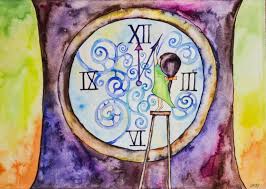
And change did of course come, but not in the way I feared it would. I changed. I wanted different things. I wasn’t in love. I grew tired of the struggle.

All of this struggle had a predictably disastrous outcome—what else could the ending have been but disastrous and painful, and heartbreaking?

If I could go back and whisper in the ear of my younger idealistic self, I would tell her that change is part of life. I would tell her that when we try to hold back the rhythms of cause and effect, we will bring upon ourselves a Tsunami of pain and suffering. I would tell her that in the end change will come, better to welcome it, no matter how frightening. I would whisper that anything permanent is a delusion, fueled by hope and fear. And I would certainly tell her that change, as fraught with danger as it may seem, is better than entombing yourself in a delusion of unchanging permanence.

***

 Apply to an (ongoing) present situation (how does it matter today?)

Since 2012 (maybe 2011), I have been through layoffs that included hundreds of people, other layoffs that came once a quarter, and finally the sale of the company I worked for. The very first layoff was terrifying. Even though I knew I’d get a good severance package—still—it was heart stopping and heartrending to see people be escorted out.

By the third or fourth layoff, I just kind of waited to see if my name was on The List. When the company got sold, I was furious! What? Getting sold to some rinky dink, nouveau riche, mom & pop family-owned operation whose true name should be Greedsters, Inc.? And who, I might add, was (and continues to be) very evasive about the whole idea of a severance package.

It took me a long time, a few months to realize the truth of the situation I’m in. I find myself at a point in my life where anything is possible. Of course, it’s always been that way. But now, I’m aware of it.

Aside from the overt acts of not showing up and/or not doing my work, whether or not I have a job is utterly beyond my control. Of course, it always has been. But awareness has a certain magic about it, or maybe I should say a certain grace. But more on that later.

The truth about my job is that the position I fill is on someone’s spreadsheet beside my Greedster, Inc. Employee ID Number. When the formulae in that spreadsheet indicate that my position can be filled for much cheaper in say. . . Mumbai or Puerto Rico. . .the Greedster, Inc. Employee ID Number will be changed and my steady paycheck will evaporate—kinda like dew on a blade of grass.

So each day, I work with what I have. This situation forces me to bow to impermanence and cause and effect.

balloongirlIn doing this, I am finding that when we bow to impermanence, our life takes on a certain grace, a certain lightness of being. Not to wax too poetic here, but we come to realize that we came to samsara with nothing, and we will leave with nothing. Rather than being depressing, as I thought that realization would be, it is in fact buoyant. I mean that literally. When we become aware of the true state of conditioned existence, then we can let of the terrible weight of hope and fear. Why? Because there’s no question: Yes. You are to lose absolutely everything you have acquired in samsara. No one gets out alive.

There. Now you know how the movie ends. The only question remaining is: do you want to struggle against impermanence until your last breath, or, do you want to live with the grace of impermanence and use your every moment to move toward true bliss, true permanence, true purity, true self.

***

 Apply to a potential situation (bringing it home to play)

Last year I took a vow to give 125 hats / scarves to the Jonang Monastery in Tibet. I took that vow in December, 2014. At the outset, I couldn’t turn the little wheel on my Addi knitting machine fast enough. Wow! I thought, at this rate, I’ll have 250 hats and scarves to give. In other words, I believed with a brand of blind faith, that things would remain exactly as they were.

As you may imagine, things changed. Depression snuck up on me. The slough of despondencymenopause baseball bat smacked me around. In short, I spent four months of my life in a quicksand morass of depression and despair.

With the help of a very good friend, I was able to make my way out of the deepest bits of the quicksand. As I lay panting on the shore, recovering, rediscovering my life—I panicked. Four months! And not one hat or scarf had rolled off my Addi. I was a long, long, way from 125. I wasn’t even in shouting distance.

I almost wanted to just let myself slide back into the quicksand. But before I did, I asked in desperation—how do I give back a vow? I tell you, that vow was wrecking my nerves.

The answer was so simple, I missed it. When my friend repeated it, I was just about bowled over. Change the vow. That was the answer. That’s it. Just change it. [Disclaimer: This is not true for all vows.]

Well, I tell you, that’s given me a world of relief. I feel the shore expanding, the quicksand drying on my legs and falling away as I pull myself free of the slough of despondency.

This seems like a small thing, but it made me think of all the other absolutes we have in our lives. We come up with all these “Have To” things in our lives, and somehow we come to have a faith in the imputed immutability we grant them. We will even change our lives to match the “Have To”. Wow. That’s a little bit crazy.

No. I say no to that. All that we see around us is, by its very nature, subject to cause and effect. All that we witness in samsara not only will pass away, but is passing away before our very eyes, with every breath.

Would we try to hold onto a wave in an ocean? Or a breeze rattling the leaves of a tree? These things and all that we see in samsara are ephemera. Their permanence arises from our deluded mind.

Once we understand this, we can appreciate the fleeting beauty of a waterfall, or a cloud, or a drop of dew on a blade of grass. We can appreciate each moment as it arises and falls away, and know that within each and every moment there exists a cause for our suffering or a cause for our enlightenment.

Which will we choose?

paths

On the next hour. . .

Currently I’m studying Heart Treasure of the Enlightened Ones with a Dharma friend, the Venerable Tashi Nyima.

This is my contemplation on the first two lines of verse 80 of the root text of Heart Treasure of the Enlightened Ones.

heart treasure

The third part, my exhortation to relinquish everything and practice;

Though you may well miss the point, just slipped out by itself.

Yet, since it in no way contradicts the words of the Buddhas and Boddhisattvas;

It would be truly kind of you to put it into practice.


Full Disclosure: This is my first contemplation in a long time. It was nerve wracking!

Written Saturday, September 23, 8:00 AM

Explain to someone else (making it my own)

The calendar has become such an icon of our culture. The sixties had Jimmy Hendrix. The seventies had disco. The eighties had unbridled greed. The nineties had all things New Age and crystal. Here we stand in the twenty-first century with the calendar. It’s not even a watch so you can see what time it is now, it’s a calendar so you can see where you will be.calendar

On top of this, a mere calendar isn’t enough. The true status symbol is a crowded calendar. One must have things to do at every waking moment of the day. This, samsara tells us, is success.

Is it? Is it really? Patrul Rinpoche asks us, “How many people in the world will die within the next hour? Can you be certain you won’t be one of them?” Where does the hour of our death go on our calendar? Which slot is that? Can we really afford a whole hour? I mean, you’re just lying there (if you’re fortunate) doing nothing, right?

Sadly, samsara buries us in things to be done, things to be acquired, things to be achieved. But not one of these myriad things will free us of the cycle of suffering. Not one of the things on our calendars will lead to the cessation of suffering.

Yes. Life comes with many things to be done. This cannot be denied. But I look at it this way. If I were in prison, and I wanted to get out, my mind would always be on escape. No matter what I was doing, who I was talking to, my mind would be on getting to freedom.

In the same way, here in the prison of samsara, shouldn’t our every thought be of freeing ourselves? Shouldn’t we live as though everything we did could be a step on our path to enlightenment?

I think the time has come to put “escape” on our calendars.

***

 Apply to a past situation (how would it have been different?)

A while back, when I was totally caught up in corporate culture, the company I worked for sent a group of us to a series of classes about how to organize our lives “for success” with a very famous brand of corporate calendars that I’ll call Cubby.

Cubby comes with a slot of everything, and by God, every slot had to be filled. This was long before the cell phone plague of constant, umbilical connection overtook us. Back then it was very prestigious to walk around with your Cubby calendar and whip it open if someone dared to interrupt your oh-so-carefully planned day. Under Cubby rules, they would have to be penciled in because. . . well…you were on the path to success.

This calendar “system” as it’s still called, was not merely a yearly calendar. No. Nothing so sFive Year Planimple. The Deluxe Cubby System (no, I’m not making that up) comes with a Five Year Plan. What am I doing here–taking over the world?? Oh my holy God! A what? Didn’t Russia have Five Year Plans? How did it work out for them? I heard they went all to pieces.

Anyway, at the end of each calendar week there was a space to summarize whether you were on target for your Five Year Plan, what progress you’d made, and what you needed to do better. This is one serious calendar system. It even comes with “Quadrants” to identify what matters, what really matters, and what really matters right now. I kid you not.

This happened sometime back in my late twenties, early thirties, and I bought into Cubby one hundred percent. I was never on target with my Five Year Plan because what I wanted kept changing.

Looking back on the whole Cubby episode in my life, I can notice that I truly believed that doing stuff—‘getting more done’ in the corporate parlance—would make me a better person, an absolute success. And one day, that would lead to happiness.

If I could go back and talk to my younger self, so full of hope and fear, I would ask her to think over one simple question. Where on the Cubby calendar is there a slot to reschedule aging, disease and death? Then I’d give her a book of matches and lighter fluid.

***

 Apply to an (ongoing) present situation (how does it matter today?)

Lo these many years later, I find myself still in the corporate world. Cubby, I’m sure has moved to tablets and iPhones and “Seminars for Success”. My job is pretty much dominated by the calendar because of my frequent interactions with attorneys and their deadlines. If you think someone can’t hyperventilate via email, spend a day at my desk.

I keep my calendar in Microsoft Outlook, and on my phone, of course. And I do things that must be done. I meet deadlines. I deliver products. I hold the hands of the nervous and fearful. I get to the doctor and the hairdresser reasonably on time.

But there’s something on my calendar at work that pops up every hour—breathe–it says. This is a reminder to either take a few seconds to silently recite mantra, or if it’s reasonable, to recite mantra and then silently read a prayer from the stack of “flashcard” prayers I keep on my desk.

path4For me, this is a constant reminder that I am here in samsara, caught in a cycle of suffering, and no matter what I’m doing at the moment, my life’s work is to achieve enlightenment, one step at a time, so that I may free myself and all sentient beings from suffering.

This sounds very high-minded, like. . .really? Every hour? Well, yes. It translates to taking an extra minute to reassure an attorney that yes, I understand their deadline, and yes, we’re doing all we can to meet it. It translates to saying a few light words to someone who looks sad, overburdened with samsara. It translates to remembering that no one gets out of samsara alone. There is no separation. Until we are all free of suffering, no one is free.

Like a prisoner, I’ve taken the instruments meant to imprison me, and used them to further my endeavor toward freedom. If we are to escape samsara, we must learn some way of using what lies in our lives to further our steps on the path.

***

 Apply to a potential situation (bringing it home to play)

These days, I’m almost tempted to buy a Cubby calendar just to luxuriate in the feel of all the empty space I would leave on it.

A Dharma friend of mine says…do less. At first, I thought—what? Have you seen my life? Mind you, I’m unmarried with no kids. But still, samsara sucks me in.

Ever notice how on Monday mornings at work, the question is—so what did you do this weekend? At times my jaw just about drops when I hear what people squeeze into forty-eight hours! People have stopped asking me this question because my answer is always the same. . . “not much”. They sort of give me a pitying look and move on. After all, there’s stuff to be done, right?

In truth, that’s a small white lie. I do quite a bit on weekends, but I try to make my activities as focused on my path as I can. For a long while, I did too much. That led to a mini-breakdown. But nowadays I choose three—maybe four things tops—to do on the weekend.

As time goes by and I feel more rested and more confident, I’m starting to want to do more. But then I think of my Dharma friend. . . do less. I’m finally beginning to see what that means. The less we do (that is unnecessary), the more chances we give the mind to turn to the Dharma.

The Winter season is approaching and I have a commitment to deliver 125 hats and scarves. I’m behind. My first instinct is to spend every waking moment knitting. This may work short term, but long term it will lead to exhaustion and disaster.

So, as I work on this wonderful project over the next couple of months, I will remind myself that every stitch can be a step out of samsara. What kind of future escapee would I be if I was too exhausted to escape when the time came to go?

Death is certain, but the time of death is unknown. There are countless ways to discard the body. There are eighty-four thousand gates to the Dharma. Shouldn’t our every step be urgently moving us toward one of those gates of freedom?

balloons

What came first? Are you sure?

Ramblings. . . March 29, 2015

Currently I’m studying the Dharma with a Dharma friend, Tashi Nyima.

One of the things Tashi shares with us quite a bit is that everything, absolutely everything we do begins in the mind.

Sometimes, I just want to say. . . no way. I just did that. . .ex nihilo…It came from nowhere. But if I follow the act back to its inception, sure enough, there’s a thought right there at the start of things.

reanimatorsSo, I’m reading this book written in the Lovecraft tradition, Reanimators. It’s a story written in the Lovecraft world, so of course there’s a mad scientist.

I’m up to the part where the mad scientist guy is thinking back on how he got himself into this mess. And how did it all start? Like this, “It was little more than a notion at first, but it then grew into a thought, and then an idea. Before long it was a plot and then a plan.”

Hmmm..sounds familiar.

This reminds me of one of my favorite mind training prayers:

As the wheel follows the ox that pulls the cart,

all my thoughts, words, and deeds have consequences.

Bless me to keep my view as high as a white-tailed eagle’s,

and my conduct as careful as a blind man’s on a steep mountain trail!

If only the mad scientist had caught those dastardly thoughts before they became deeds!

If only we could catch our mad scientist mind in the act, and see with perfect clarity that all our thoughts, words, and deeds have consequences!

The name of this mind training prayer is Life and Death. Really? Is it that serious? I believe it is. Every action matters; therefore, every thought matters.

My mind is still mostly mad scientist. . . I ain’t there yet!


Just Enjoy The Ride . . .

Currently I’m studying Heart Treasure of the Enlightened Ones with a Dharma friend, Tashi Nyima.

We are currently working with Verse 62:

heart treasureClinging to mind’s perceptions as true is the delusion that causes samsara;

If you leave the mind in its natural state, free from thoughts, it is Chenrezi—

It is none other than the Sublime Unwinding in Ultimate Mind.

In ultimate mind, the Dharmakaya, recite the six syllable mantra.

Note: When Tashi talked about this verse, he talked about emotions as being a ‘call to action’. That really resonated with me. Yes, I thought. It’s that almost irresistible feeling that you have got to do something. I think of it as the force sucking you from an airplane when the cabin’s depressurized, and there’s this pull just sucking you along and you feel absolutely helpless to stop it.

Ramblings . . . March 24, 2015

I’d never thought of emotions as a ‘call to action’ before.

This morning in sitting practice, my emotions were all over the place. That’s pretty ‘normal’ these days. I’m not sure if it’s menopause or just age. Or maybe I’m becoming sensitized to what’s been there all along.

Anyway.

This morning I was really angsting over all the emotions coming up, and I was sort of desperately thinking. . . oh no, not another day like this.

And then, mind came up with something that turned out to be totally true. . . Just enjoy the ride.

This is a reference to a really, really old Pepsi commercial that Britney Spears did way back in the dark ages of 2001. Part of the catchy pop tune lyric is ‘just enjoy the ride’.

This morning those words meant nothing to me.

But today, at work, something happened that triggered a response of extremely afflicted emotions. Oh man… my fingers were flying across my keyboard. I was like a race horse coming to the finish line. I was just about to hit SEND, when it hit me. . . I’m caught. I. Am. Totally. Caught.

My mouse was hovering over SEND. My heart was galloping along. I was literally a second away from answering that call to action. And I thought. . . what do I do?

Then I breathed. . . and recited mantra.

I did that for three breaths, a total of six mantras. And I have to be honest, the first two breaths, I was thinking. . . oh man…this isn’t gonna work. It’s not. . .

Those three breaths seemed like an eternity. I completely experienced the anger, the resentment, the . . .whatever. But most importantly, I experienced it as something that was rising and falling like waves in an ocean and simultaneously, I experienced myself holding onto (clinging) to the emotions arising. I could see myself “clinging to mind’s perceptions as true”. I couldn’t stop clinging, but I could see that I was doing it.

monks on rollercoasterThen suddenly my perspective shifted. For a split second (in those three breaths it seemed like forever), I experienced the emotions as undifferentiated energy. It was bliss! I could . . . just enjoy the ride.

After that, the emotions were very much in my face again, but the call to action had nowhere near the power I had imputed to it before I took those three breaths.

I opened my eyes (I often wonder what people think of me sitting there with my eyes closed), and I rewrote the email. Even better, the email resulted in the outcome I had actually wanted.

This sounds like a very small moment, but it was incredible. I think that’s because the emotions were so strong, and I was THIS close to blindly following that call to action.

Something similar happened yesterday, and I was able to catch myself again.

Wow. If this keeps up, I could actually begin to experience peace and clarity in my days at work!

These experiences have made me think of something I pulled from Tashi’s website, “Understand that pain is your spiritual friend, because it is the cause of renunciation.”

For sure. Absolutely. In these last couple of days I’ve really learned that renunciation isn’t the act of giving up any material thing. It’s the act of realizing the cause of your suffering and giving up that cause. If I hadn’t been suffering so much with those afflicted emotions, I wouldn’t have tried anything. I would have just gone on with my day.

So, there you have it . . . I ain’t there yet.

Let’s hear your thoughts. . .just between you and me. . .When your afflicted emotions are in your face and it’s all you can do not to throttle someone—and enjoy it . . . what do you do?

Hint: “Hide the body” isn’t the right answer. . .

On the taste of things…

Currently I’m studying Heart Treasure of the Enlightened Ones with a Dharma friend, the Venerable Tashi Nyima.

This is my contemplation on the first two lines of verse 47 of the root text of Heart Treasure of the Enlightened Ones.

heart treasure

“To recognize flavors as a sacramental feast is the crucial point of offering.

Attachment to taste as delicious or disgusting is liberated into its own nature.

Free of grasping, food and drink are substances to delight Supreme Chenrezi;

In the self-liberation of taste, recite the six-syllable mantra.”


 Full Disclosure:

I found this verse extremely hard to put into practice because it’s so hard to divorce food from the sense of taste.

Written Sunday, November 23, 5:30AM

Explain to someone else (making it my own)

Growing up, we used to say grace over dinner, but only on Sundays. As a kid, I totally undegracerstood why. Sunday dinners were awesome! They had all the good stuff. During the week you could end up with dry overcooked food that got eaten because it was better to eat than to get yelled at for not eating. But on Sundays, there was salad and everything. Sometimes there was even desert. So sure, I was happy to mumble on Sundays, “God is good, God is great, Thank you for this food. Amen.” With all those delicious smells rising from the table, when I said grace, I had only one goal: getting through the words as fast I could.

I didn’t understand why we had to thank God for anything. I saw my parents get up and go to work every day. My mother went food shopping and cooked. All God did was show up in His house when you went to church on Saturdays. What did He have to do with anything about food?

At that age, when my mother said it was a shame I was throwing away food when there were starving kids in Africa, I thought it was another Motherism, kind of like, ‘Don’t open your umbrella in the house, it’s bad luck.’ And what was so bad about starving? I’d be starving after school sometimes, but then I’d open the refrigerator and eat something. Didn’t kids in Africa have refrigerators?

In the west, for the most part, we have an absolute indifference to where our food comes from. Even if you’re vegan, there’s still this sort of indifferent unconsciousness toward food. We go to the supermarket (or Whole Foods or Sprouts), buy what we like, take it home, cook it how we like, and for the most part, we eat and put the leftovers way. More thought goes into doing the dishes (should I run the dishwasher tonight, or wait another night?) than goes into eating a meal.

We take for granted that some foods are good, delicious, while other foods, not so much. When I first came to Texas, I couldn’t believe there was deep fried okra on a restaurant menu. My memories of okra are of slimey green things that stayed as far away from my side of the table as possible. But there it was. Apparently people pay good money to eat deep fried slimey green things in Texas.

How often do we stop to ask ourselves about this? How often do we stop and say…how can that be? Is deep fried okra good or not? Is slimy good or not? How can some people like it, but others can’t stand it near their plates? If we thought about this, we might come to realize what Dilgo Khyentse says about taste, “…it is only the mind that clings to tastes as being delicious or disgusting. Once the mind realizes that such attributes are unborn and devoid of any existence, the pure nature of every flavor can be recognized.”

What? Does that mean deep fried okra is a good thing? I do a lot for my practice, but I draw the line at deep fried slimy vegetables. And don’t bother telling me it’s not slimy when it’s deep fried. Memory is a powerful thing.

I think what Dilgo Khyentse is telling us here is that the okra is simply there, with certain attributes. It is our mind, based on our previous experiences that imputes ‘slimy’, ‘disgusting’, ‘tasteless.’ Once we realize that these imputations arise from the mind, we are freed of attachment to ‘good food’ or ‘bad food’. Once that happens, we can begin to see that food or nourishment of any kind is always a gift. After all, why are we here in samsara? To get rich? To be beautiful? To be successful? To live the American dream? No.

We are here in samsara for one reason and one reason only: to remember our non-difference with our true Buddha Nature. Seen in this way, every nourishment and sustenance, whether it takes the form of food or friendship, or just a kind word is a gift. It is a gift meant to sustain us on our journey of remembering who we truly are so that we may help others remember who they truly are. If we approach food this way, we can begin to work with our attachment to ‘good food’ and ‘bad food’, and begin to take food onto our path to compassion through wisdom.

 ***

 Apply to a past situation (how would it have been different?)

When I was younger I had a very adverse relationship with food. I used food to comfort myself. Many days on the way to school I would buy candy at the local candy shop with my lunch money. When lunch money ran out, I’d use my pocket money. I used to go for potato chips, almond joys, bubble gum…kid food.

candyIn third, fourth, and fifth grade, I enjoyed school. I had truly gifted teachers. But I didn’t fit in with the kids around me. There was extreme emotional discomfort in going to school every day. The candy offered me comfort. By the time I got to high school, there was an experimental program that put all the nerds together in our classes all day long. We were isolated from the general population of the school, except at lunch time. And of course, we ate with each other.

That was heaven. We all didn’t fit…but we did it together!

Looking back on that time in my life, I can notice that the role of food in my life was very distorted. I imputed to food the ability to comfort me, and to dull emotional pain. In fact, the pain didn’t go away, it increased. I always ate those foods in private, because I was ashamed of how much candy I ate. If I could have taken a step back, I may have noticed that the candy was a stand-in for things in my life I thought I needed so badly: my mother’s care, friends who didn’t make fun of me, a school that didn’t seem like an all day prison.

If I had been able to let peace and clarity arise, I may have noticed that the candy was actually impermanent, insubstantial, and dependent. I may have seen that the comfort I imputed to the candy was arising from the nourishing gift of my own Buddha Nature.

Had I been able to see these things at such an early age, I may have turned toward the path sooner, and sought a different kind of nourishment and comfort.

***

 Apply to an (ongoing) present situation (how does it matter today?)

The biggest thing going on in my life right now is the 125 Vow. Each day, I work on something toward the vow, whether it’s buying yarn on sale, or learning a new pattern from YouTube, or actually working on a pattern.

This week I’ve finished my first scoodie, a hat and scarf combination, and I’ve discovered new yarn territory. I’ve lived in this location for well-nigh nine years and never, ever visited the Hobby Lobby that arctic exploreris no more than a five minute drive away. I always went to Michael’s, which is just across the street from Hobby Lobby. This week I discovered new yarn in Hobby Lobby! I felt like an Arctic Explorer forging unknown territory through virgin ice. Yes! And it’s in the Jonang colors.

In working with this verse this week, I really had a hard time understanding what food would be like if it were liberated into its own nature. A lot of times this week, when I ate, I tried to imagine…this food is neither good nor bad. It’s just nourishment. Did that work? Not so much, because I’m here to tell you, I wasn’t feeling up to experimenting with the true nature of okra.

But I ‘accidentally’ found something that did work. (It’s in quotes because my Dharma friend Tashi says there are no accidents or coincidences–there’s karma.) Anyway, I came home after a long day at work, and I was very tired. All I wanted to do was curl up under a warm blanket and lose myself in a nice soothing Alison Weir history book on my Kindle.

As I was winding down my evening, I glanced at my Addi (my knitting machine), which had a scarf on the needles. Let me tell you about the Addi. All you have to do is turn a crank. You can knit a row in maybe two minutes, if you’re going very slowly. I cranked out a row. Ahh…that felt good. So I tried another one. Before I knew it, I’d cranked out about twenty rows. Twenty minutes had slipped by in nearly perfect peace.

mountain streamI stopped and went back over my evening, and what I had been planning to do, and thought about how I’d been drawn to stay at my work table with the Addi. I realized it was like being thirsty, and scooping up just a taste of sweet, fresh water from a mountain stream. But that water feels so good winding through you, you have to have more, so you settle down for a good long drink.

Working on the Addi, which is working on the 125 Vow felt like that. It was nourishing to me. It nourished my sense of peace and well-being. In short, it nourished my awareness of my non-difference with my Buddha Nature. In those few minutes, I experienced the gift of what it can be like to be nourished by activities that are in accordance with the Dharma. As I was working on the Addi, I didn’t experience attachment, because I wasn’t in a hurry. After all, I have a whole year. I wasn’t clinging to the activity. I was keeping my vow.

Once that experience opened for me, I was able to experience nourishment in that sense in a whole bunch of things. Saying a sincere good morning to someone at work became an act of nourishing both them and me, because for a very fleeting moment, I realized our non-duality in relation to each other. In baking cookies and scones for the office, I felt again that sense of being nourished by the act.

Although Dilgo Khyentse talks specifically about food in this verse, in practice, I experienced that any activity that is in accord with our true Buddha Nature is a gift that will nourish and sustain our experience of our non-difference with our Buddha Nature.

***

 Apply to a potential situation (bringing it home to play)

Hmmm….this is a tough one. I’m not really sure how to put this into practice. I’d like to try out the sacramental feast that Patrul Rinpoche talks about, but I’m not sure how to bring that into my life.

On Thursday, November 20, my Dharma friend Tashi gave a talk about getting in the way of suffering. I feel somehow that this verse is related to that, but again, I’m not sure how to bring it into my life in practice. Here goes…

Today, many families will gather around tables laden with food whose centerpiece will be a dead bird who began life as a sentient being, was then enslaved, brutally murdered, and then sold for a higher price per pound than he or she was worth when they was alive.

Perhaps, in this season which celebrates giving thanks with a holocaust against thousands of sentient Girl_With_Turkey black and whitebeings, I can, with each prayer I say this week, have the intent that the families gathered will awaken enough by next Thanksgiving to realize that this holocaust is a collectively unskillful act. I can pray with the intent that their Buddha Nature may be nourished to the point where they awaken sufficiently to the suffering of other sentient beings to develop a mild nausea with samsara. I can pray with the intent that their Buddha Nature will be awakened enough that by next Thanksgiving, their nourishment will come from being impelled by compassion to get in the way of suffering.

If everyone reading this would say just one prayer with this intent, we will all nourish our non-difference with our Buddha Nature, and at the same time weaken the clinging and attachment that makes the manifold sufferings in the bright aisles of samsara possible.

om mani padme hum…

chenrezi

On the scents of things…

Currently I’m studying Heart Treasure of the Enlightened Ones with a Dharma friend, the Venerable Tashi Nyima.

This is my contemplation on the first two lines of verse 46 of the root text of Heart Treasure of the Enlightened Ones.

heart treasure“To recognize smells as unborn is the crucial point of the completion stage;

Clinging to odor as fragrant or foul is liberated into its own nature.

Free of grasping, all smells are the fragrant discipline of Supreme Chenrezi;

In the self-liberation of smelling, recite the six-syllable mantra.”

 Full Disclosure:

Exploring the scents of things helped me explore the sense of things.

Written Sunday, November 16, 5:00AM

Explain to someone else (making it my own)

There are few things I enjoy more than the smell of brewing coffee. My favorite scent of coffee is when it’s a really, really dark brew, like French Dark Roast. There’s something about that sharp rich scent that makes me think of early mornings in cafes in Paris, watching the sun lift into the sky. It makes me think of brisk mornings in London, with the only warmth coming from that strong brew warming my hands through a thick porcelain cup.

At this point, I should make a few confessions. I almost exclusively drink ‘girl coffee’. You know, the light roast coffeeflavors like Raspberry Chocolate Truffle or Caramel French Vanilla. I don’t like the taste of dark roast coffee. It’s far too bitter. While I was born in England, I was far too young when I left to ever be allowed to hold a cup of steaming hot liquid in my tiny hands, and sadly, I’ve never been to Paris. But the sense of smell is so evocative, that it can make us have ‘memories’ of things that never happened. Of course the seduction of scent is that much stronger if it’s tied to an actual memory.

This week in working with this verse, I’ve really paid attention to the smells in my life. What I’ve noticed is that smells give the illusion of immediately evoking an emotion. There doesn’t seem to be a feeling of unpleasant, pleasant, or indifference. This week I really took notice of how smells are a part of the rhythm of life. In the early mornings, there’s the scent of the soap I use in the shower, the toothpaste, the mouthwash, even the floss has its own minty scent. Interestingly, all of these scents are pleasant, but they evoke anxiety, because they’re part of my ritual before going to work.

I bake nearly every weekend. Yesterday, I took the time to notice how just opening the container of All Purpose flour and taking in the light scent of unbleached flour brought a whole flood of emotions. I was so happy at the thought of being in my kitchen most of the day baking, then giving away what I’d baked. The scents of the cinnamon and nutmeg and vanilla as I added them to recipes were a foretaste of good things to come—literally. I could almost taste the finished muffin as I put the ingredients together.

In taking the time to slow down and watch how scents weave in and out of my life, I saw what Dilgo Khyentse meant when he wrote, “We love to savor fragrant scents […], yet all smells…are void in nature.” Yes. This week I noticed how utterly empty scents truly are. It was a little bit easier to see it with scents because they have such strong associations.

As my week went on, I tried to get as close as I could to stripping away the associations I have with scents. It was nearly impossible. The scent I had the most success with was soap. I realized that I use a lot of different soaps—bath soap, soap for my face, soap for the laundry, soap for the dishes, soap for the dishwasher, soap for cleaning the bathroom, soap for cleaning the kitchen counters. My life is inundated with the scent of soap. I was able to notice that in every instance the soap itself had a ‘pleasant’ scent, but I didn’t always enjoy smelling it because many times the scent was associated with doing a household task that I don’t particularly enjoy doing.

Being able to take that step back, I was able to notice that the smell itself wasn’t actually pleasant or unpleasant. And even though I thought of soap as ‘clean smelling’, it actually smells like a lot of cleverly mixed chemicals, all of them poisonous, I’m sure.

What did I learn from this little exercise with soap? I experienced that it was my clinging that was creating the experience of ‘clean smelling’. I saw that the actual experience of ‘soap’ is completely manufactured in my mind based on my past experience with similar scents. I saw that the experience of the scent of ‘soap’ is unborn, a projection of my own karmic tendencies.

And if that’s true of soap, I began to ask myself as the week went on, isn’t it true of all our experience? Yes. I think it is.

***

 Apply to a past situation (how would it have been different?)

When I was a little girl, it was a stressful time in my mother’s life. She was in nursing school, she didn’t get much sleep, and she had yours truly on her hands almost 24/7. The only time she ever seemed to be at peace was in the kitchen. As a little girl, I lived in an apartment that was mostly drafty, especially in the cold and damp of a tiny suburb just outside London. The kitchen was the warmest place in the little apartment.

My happiest memories of that apartment are being in the kitchen with my mother while she created these wonderful scents that came from mysterious things called ‘garlic’ and ‘thyme’ and ‘spring onion’. I was the Chief Fetcher. I learned quickly what all these things looked like and more importantly, what they smelled like.

kitchenIn the kitchen, watching my mother cook was a time of grace for me. Most of the time, my mother didn’t want me around. She was always busy, I was always in the way. But in the kitchen, I learned how to find things, get things, and stay out of the way. The smells that came from the stove, which was absolutely FORBIDDEN territory, were divine. To me, as a little girl, those smells were the scent of peace.

As a woman, I think I’ve looked for that peace in all the wrong places. Looking back on that time in my life, I can notice that the peace didn’t come from outside of me. I can notice that the scent of peace was coming from within me, arising from my inherent capacity for peace and clarity. If I had noticed this at an earlier stage in my life, I wouldn’t have spent decades searching for a peace that had been within me all along.

***

 Apply to an (ongoing) present situation (how does it matter today?)

The biggest thing going on in my life right now is working from home. The work site of my job changed, but last weekend we learned that the new building wasn’t quite ready yet. After spending about three hours on the phone with tech support, I was set up to work from home. Wow. It’s been amazing.

One of the things I noticed this week was how the same scent can evoke completely opposite emotions. This week when I took a shower, the scents of soap and toothpaste and floss evoked absolutely no anxiety, because I knew I’d be working from home.

On my breaks, since I was at home, I was able to knit on my knitting machine. I’ve been knitting and crocheting Work Areafor decades. And only this week did I realize that yarn has its own special scent. Talk about the scent of peace. I’ve always associated knitting or crocheting with peace and calm, but I never thought of my crafting as having a scent.

This week the sense of smell has been a sort of window into emptiness for me. When I experienced a scent, I would make myself take a step back and I would question my judgment of ‘good’ or ‘bad’. Then I’d take careful notice of what images the mind conjured to go with the scent. More interesting was when images evoked scents. King Arthur Flour is having a sale this week. They send emails with ads for “Fall Must Haves”. One of the things you must have this fall for your baking is Vietnamese Cinnamon. I have to say, it’s the best cinnamon I’ve ever used, and I’m out of it. I’m planning to get more. Interestingly, the moment I saw that ad, I could smell the cinnamon, and even taste muffins I’ve made with it.

I couldn’t be this observant with every scent. That would be impossible, I think. I never noticed before how many scents we encounter as part of our everyday lives. But when I was able to watch mind in action with the sense of smell, it was a window into how the mind is constantly creating our internal representation of ‘the outside world’ based solely on our karmic tendencies and previous experiences.

When I observed mind in action, I tried saying to myself, ‘This isn’t a good smell or a bad smell. It’s just a smell.” That didn’t work. I still thought the smell was good or bad, but I became aware that ‘good’ or ‘bad’ was a view, an opinion that I was imposing on reality and then clinging to. This helped me understand the role of peace and clarity in the mind. The more peace and clarity, the less clinging. The less clinging, the less suffering. The less suffering, the greater our experience of mind’s true nature of empty luminosity.

***

 Apply to a potential situation (bringing it home to play)

Next week, the tech issue with the work site will be fixed, and I’ll have to go to the office to go to work. I’ve been trying to think of how I can work with liberation of the sense of smell in working with my anxiety and dread over facing imprisonment in a tiny cubicle to do the same job I can do here in the comfort of my own home.

I have to be honest. I haven’t come up with anything. So I guess now is a good time to try it out.

My primary objection to returning to the office is that there’s no good reason. Absolutely none. In fact, my monitor at home is nicer than those rinky dink cheap office models. When I asked about telecommuting opportunities (as work at home is known in corporate parlance), I was told…no opportunities are available at this time. Interesting. They’re available in Fort Lauderdale. They work from home. My manager works from home…in Austin. What’s wrong with Dallas?

As I work my way through returning to the office to work, I can notice that mind is doing exactly the same thing it does with the sense of smell. Mind is creating an internal representation of reality based on my tendencies, previous experiences, and afflicted emotions.

The reality is that I’m going to be in a different building, with a different configuration. I don’t have any idea what the computers will be like because I’ve never been there before. The office is very, very close; barely a five minute drive. The reality is I have a dream commute, a ridiculously easy job, a good salary in a time of economic hardship across the country (and the world), and I’m whining because I have to drive a few minutes instead of getting to work at home in an oversize sweater and flannel jammies.

The reality is my back hurts. So do my wrists. I never really appreciated the ergonomics of the corporate environment until this week. If I actually were to work at home long term, I would have to invest in a very good chair, a wrist rest, and another monitor. Some tasks are very difficult to do without the dual monitor system I’m used to at work. I would probably also have to invest in an actual desk.

The reality is that it will save me a great deal of expense to work in an office because all of the equipment is provided. Another reality is that my commute is so ridiculously short that I barely notice it.

The reality is there are upsides and downsides to returning to work in an office. While the experience of returning to work in an office, in and of itself will be neutral, how I experience it will depend entirely upon where I choose to focus my attention. Of course, if I let mind go hog wild and run willy nilly, I’ll be in a state of nervous exhaustion by Wednesday, the anticipated return date. On the other hand I can choose to focus my attention on the many advantages to returning to work in an office.

And there we have it. Just like the sense of smell can be liberated by watching the mind at work, any opinion (view) we have of reality can be liberated when we come to recognize how our karmic tendencies and afflicted emotions color what we experience.

In this coming week, mind will offer up many ‘reasons’ why working from home is so much better than the dreaded return to an office. Right now, I believe wholeheartedly that mind is right, that returning will be dreadful. But at the same time, I’m aware that this wholehearted belief is an opinion, a view of reality that’s probably not so right.

That’s a good place to start my week. I think it’s a good place to start our lives each day…I’m thinking this, I believe it, but it’s just an opinion. The truth isn’t out there. It’s in here.

I can work with that. I think we all can.

buddha at ocean

On the wind and a mountain…

Currently I’m studying Heart Treasure of the Enlightened Ones with a Dharma friend, the Venerable Tashi Nyima.

This is my contemplation on the first two lines of verse 45 of the root text of Heart Treasure of the Enlightened Ones.

heart treasure

To recognize sounds as mantra is the crucial point of recitation practice;

Clinging to sound as pleasant or unpleasant is liberated into its own nature.

Free of grasping, the spontaneous sound of samsara and nirvana is the voice of the six syllables.

In the self-liberation of hearing, recite the six-syllable mantra.” 

 Full Disclosure:

Sounds have been seductive for me all my life, especially the sound of a good story.

Written Sunday, November 9, 5:00AM

Explain to someone else (making it my own)

I grew up a city girl—Bronx, New York. For as long as I can remember, I’ve lived in a place where there was constant, loud noise. I rode home from school on noisy buses with squeaky brakes and noisy kids. I bought pizza from a shop window while the subway rumbled past behind me on its elevated track, brakes screeching, iron against iron. I fell asleep to the distant sound of ambulances and police cars screaming through the night. Then later, toward the very early end of my childhood, and the beginning of my parents’ long drawn out divorce, there was the screaming sound of human suffering as they yelled at each other and shouted unbearable truths into the night, every syllable a testament to their own suffering in samsara.

baby noiseIf we are born with the blessing of hearing, we all have our own very personal history with sound. When it comes to sound, there doesn’t seem to be a ‘neutral’. We either want to hear it, or we don’t. We even at some point designated our hands as stand-in listeners. Was it the nineties that brought in the famous “talk to the hand” gesture?

Whatever our relationship with sound, we accept it, as we do with all things in samsara, as though it had some external reality, independent of ourselves. This is so patently false, that we can literally become ‘deaf’ to sounds that we hear all the time. How many of us actually hear the ‘sound’ of our car when we’re driving? Unless there’s something wrong, the sounds of the engine just blend into our environment.

As we move through our very noisy, very distracting twenty-first century lives, we inundate ourselves with sound. Driving home from work with my windows down, I hear the radios in people’s cars. Wow. If it’s not a commercial yelling out the glamours and favors of the newest beer, it’s the DJ opining about a movie star’s latest faux paus, or it’s a song with a raging beat that can do nothing but inspire agitation in the listener. As I drive home, and I’m sitting at a traffic light listening, I often think to myself…what? You didn’t get enough agitation at work today? Come visit my job. I’ll fix you right up.

In our busily mad rush through samsara, we can forget completely the actual nature of sound. Like all things in samsara, sound is impermanent, insubstantial, and dependent. Once we realize this, it becomes clear that the perception of ‘good’ or ‘bad’ sounds arises from an agitated, clinging mind. Mantra, on the other hand is that sound which protects the mind from clinging, from agitation, from afflicted emotions. A mind thus protected will be disturbed by no sound that can possibly arise in samsara. Dilgo Khyentse puts it like this, “If you perceive all sounds as mantra, good or bad news will no more disturb you than the wind can disturb a mountain.”

That’s a pretty bold claim, isn’t? No news, no matter how disturbing, can agitate the mind protected by mantra? I haven’t experienced this, but I can imagine that any sound perceived by a mind free of clinging, would simply sound like mantra—the undisturbed resonance of empty luminosity.

***

 Apply to a past situation (how would it have been different?)

I wrote my very first short story in second grade. It was three paragraphs long, written in pencil on a piece of loose leaf paper. It’s been a love affair with sound ever since. People ask me sometimes how I write stories. I usually say something glib like, “I get inspired, then I write it down.” This is very far from the truth, but it’s nearly impossible to explain what actually happens.

What really happened when I used to write stories is that I would hear a melody in my mind. The melody was made up words. In a sense the words were the music. The melody would go round and round in my mind and echo so beautifully, that I had to write it down so that others could hear the same beauty I was experiencing. What I wrote down ended up being a story.

Words and the sounds they make have always been a focus of my life. My mother, while not an extraordinarily cruel woman, could say extraordinarily cruel things. In a sense, it was from her that I learned the power of words. When I was in my twenties, my mother and I had an argument, and she started to cry. I remember saying, “I don’t care if I make you cry. You’ve made me cry enough times.”

arrow in heartWow. I suffered for years for saying that. Every time I thought of those words, I felt like the slimiest bit of slime on a pond laden with scum. The guilt over saying that has only recently dissolved as I’ve studied the Dharma. What I’ve been able to see is that it’s downright astonishing how a few syllables can cause such prolonged suffering.

Looking back on that Fateful Day in my life, I might notice that I spoke entirely out of afflicted emotions. I might notice that if I had had the capacity to take a step back and establish a moment of peace and clarity, I might have thought those syllables, but I wouldn’t have said them. I can notice that there were many thoughts going through my mind at that moment, and what I actually allowed to pass my lips was the least cruel of my thoughts.

If I had been able to take a step back, breathe, and listen to my rushing thoughts, I would have noticed that the wise thing to do was to end the encounter long before it reached the point of uttering those words. Had I been able to take a breath, I may have chosen to be silent rather than put causes for suffering into my future by using my power with words to inflict anguish on another being.

***

 Apply to an (ongoing) present situation (how does it matter today?)

The biggest ongoing situation in my life right now is the 125 Vow. Okay. A little bit of full disclosure here. Before I began studying the Dharma, you couldn’t have paid me to take a vow. Are you kidding? Have you read the Old Testament? I’ll be honest. I used to think nuns and priests were really, really brave people to be making promises to a god who made Don Corleoneangry god look like a nice, mellow old guy. I mean, who wants to make promises to a god who smites his enemies with plagues of locusts? What if He decides you’re His enemy? Then what? What if you made a promise (a vow, no less) to Jehovah, and then you broke it? He’d probably smite you so bad, your grandkids’ grandkids would be sorry. So my thinking went at the time.

But after studying the Dharma and making some experimental vows here and there (little one day vows, nothing too grand to start with), I began to understand how vows work in Buddhism. What, after all, is a vow? I think it can be simplified by saying it’s a string of meaningful syllables spoken with intent. One of the wonderful things I’ve found about taking a vow is that something happens in the mind. I’ve forgotten what the word is, but it means that the mind becomes focused on a purpose. In application, what happens is the mind begins to look for ways to fulfill the vow. I don’t mean that you sit puzzling over it, and stay up nights trying to figure things out. No. It’s not like that at all. In fact, it’s just the opposite. The mind begins to see the world in terms of the vow you’ve taken.

I’ve taken a vow to provide 125 hats and scarves to the Little Lamas by November 1, 2015. The day I made the vow, nothing really happened. But I know how this works now, so I didn’t really expect anything so soon.

Ideally, I would like to knit (with friends) to provide the hats and scarves. Sometimes it’s a bit hard finding the Jonang colors of gold and maroon. I buy yarn from a mill ends supplier on E-bay. The most economical way I’ve found to do that is to by mill ends yarn by the pound. The only catch is, you can’t choose the colors. You get five pounds of high end yarn in beautiful colors. In my last order, there wasn’t one maroon or gold skein of yarn to be found.

The day after I took the vow, I went to check out my E-Bay supplier’s online store, not really looking for anything in particular, and guess what? There were a couple of pounds of gold and maroon yarn for sale! Of course, I grabbed them. That’s how vows work. The vow becomes the activity of your life.

What I’ve found with taking vows in the past, is that a sort of side-effect is that they protect my mind. There are only so many hours in a day, so necessarily, if I take a vow to do something, there are going to be other things that I can’t do. When I’ve taken a vow to do something, I find that my mind eliminates those ‘other’ things which usually turn out to be pretty unnecessary anyway. Along with those activities being eliminated, the thoughts about the activities are also (effortlessly) let go. In other words, the mind’s activity of clinging decreases as a natural result of taking a vow. Interestingly, the mind won’t cling to the vow itself. I’m not sure I understand that, but that’s what I experience.

mountainIn applying Patrul Rinpoche’s lines to this experience, what I find is that the vow is a kind of ongoing mantra in my mind. In a very real sense, I’m beginning to see the world in terms of my vow to support the efforts of the Little Lamas so that they may go forth and uphold the Jonang Lineage. The ‘sound’ of the vow in my mind is a kind of mantra of constant peace. When afflicted emotions arise, it’s as though their power is robbed by the presence and constancy of that peace. I experience this peace as a state of non-clinging, and I find that afflicted emotions can’t co-exist with it. I think this is a mild experience of what Patrul Rinpoche means when he says, “Clinging to sound as pleasant or unpleasant is liberated into its own nature.” The nature of sound is impermanent, insubstantial, and dependent. The experiment of living with this vow is showing me the emptiness nature of sound, and although I’m not (by any means) a mountain that can’t be disturbed by wind, I can glimpse at times that it’s possible to live that way.

***

 Apply to a potential situation (bringing it home to play)

On Friday, an epoch in my life ended. When I first came to Texas all I had was a job with Big Brother, Inc. and an apartment. I have clung to that job with the tenacity of a zealot clinging to the One True Way. However, as a result of the company I work for being sold, I will no longer occupy a building owned by Big Brother, Inc.. On Friday, as I walked out of those doors for the last time, and got in my car and drove out of the parking lot for the last time, I breathed through my heart and put a smile on my face. There were many afflicted emotions of fear and anxiety arising. But no matter what came up, I calmly recited mantra…om mani peme hum.

I did it this way because I wanted to experience doing mantra in the face of something that could have been very frightening and very fraught with anxiety. What I found (which should perhaps have been self-evident) is that afflicted emotions can’t truly take hold of us without a crucial sound: thought. Thoughts after all, are simply syllables which haven’t been given shape by our vocal cords yet. But vocalized or not, they’re sounds. I also found on Friday, that two sounds cannot co-exist simultaneously in the mind. I’ve been working with this verse all week, and honestly, I didn’t really see the significance or importance of it. But it really hit me on Friday:it’s impossible for two sounds to coexist simultaneously in the mind.

Wow. That’s huge! This means that if you’re reciting mantra, the thoughts that green peace raygive shape to fear, anxiety, dread, worry cannot arise. That’s a pretty big deal. In an old time sci fi movie, mantra would have been the Ultimate Peace Ray. And just to be sure this was true, I tried it. Driving home, I actually tried to think a fearful thought and recite mantra simultaneously. Impossible. Cannot be done. Mind was able to switch back and forth very, very quickly and create the illusion of simultaneous thoughts, but it was an illusion.

Knowing that I have the Ultimate Peace Ray in my very own mind, what shall I do on Monday on the new job site. Well, let’s see. Sadly, most people in samsara don’t have their own personal UPR (Ultimate Peace Ray) in their minds. I certainly can’t give them mine. Or can I? Sort of. What I can do that will make a difference is to be the peace that I want to have. At work on Monday, there will be a lot of fear, a lot of anxiety, a lot of frustration, a lot of confusion.

Fear, anxiety, frustration, confusion—those are all sounds. I have a better sound…om mani peme hum. On Monday, in the whirling storm of boxes put on the wrong desks, computer systems that will freeze, telephones that will go to the wrong extensions, and too few surge protectors for too many desks, I will recite the six syllable mantra. I will recall that all these sounds arise from the empty luminosity. I will recall that these sounds arise as mere echoes of the union of wisdom and compassion–the All Ground upon which the mirage of samsara rests. In recalling these things, I will recite the six syllable mantra…om mani padme hum.

praying stone buddha

On the truth of everything…

Currently I’m studying Heart Treasure of the Enlightened Ones with a Dharma friend, the Venerable Tashi Nyima.

This is my contemplation on the second line of verse 44 of the root text of Heart Treasure of the Enlightened Ones.

heart treasure

To recognize as deity whatever forms appear is the crucial point of the development stage;

Clinging to appearance as beautiful or ugly is liberated into its own nature.

Free of clinging, mind as it appears is the body of Supreme Chenrezi;

In the self-liberation of visual experiences, recite the six-syllable mantra.”

 Full Disclosure:

This is my first contemplation written entirely on my laptop.

This is my first time thinking of thoughts as ‘appearances’.

Written Sunday, November 2, 5:45AM

Explain to someone else (making it my own)

rumpelstiltskinWhen I was a little girl, one of my favorite fairytales was Rumpelstiltskin. I was intrigued that this little man from another world could spin straw into gold. I was too young to know how spinning was really supposed to work, so I didn’t understand that straw couldn’t actually be spun into anything. I’d never seen a spinning wheel, so that wasn’t the ‘wow’ in the fairytale for me. That came from being able to change something into another thing that it wasn’t.

After Rumpelstiltskin came into my life, I watched my mother cook with different eyes. I wondered if her making dead bloody meat into something dark brown with gravy that we could eat was like spinning straw into gold? Or was it when a grown up put wood into the fireplace, and then hours later, only ashes were left? Most of all, I wondered if somewhere, hidden in some secret place, in some secret castle, was there a spinning wheel that could turn straw into gold? And if there wasn’t, why not? What was it about this world (outside the fairytale) that made things so…stuck-feeling?

After hearing that story, the world felt stuck to me, like a still-frame of a movie, as though there should be change, but something was working hard to keep it still. As a six year old, I didn’t have the vocabulary to say any of that, it was just a vague certainty that the fairytale was right somehow, and it was our world, where straw couldn’t be turned to gold, where something was very wrong.

Lo these many decades later, reading Patrul Rinpoche, I can put into words that vague certainty. Indeed, the world is not fixed in concrete. In fact, just a year later when I was introduced to the story of a man going up to the top of a mountain where a god wrote on a stone tablet, I was perfectly ready to believe it. I mean, why not? That’s how things should be. The world is not fixed, except in our own perception of it. Even in my seven year old mind I knew that sounded more right than my actual experience of things.

The mind, as imperceptible as space, is an almost magical sense organ that paints the world in literally any colors we can imagine. There is phenomena. There is mind. Everything else arises from our eons- old karmic formations that run in deep riverbeds (and millions of tributaries) of attachment, aversion, and indifference. These distortions shape all that we see. Don’t believe me? Try looking at a flower and simply perceiving it. Bet you can’t. Bet you start thinking something like…that’s a nice shade of yellow…wouldn’t put it on my walls or anything, and I sure wouldn’t wear it, but it makes a nice flower. Didn’t Mary Sue have that color roses at her funeral? Who sends yellow roses to a funeral?…oh yeah…it was her crazy aunt, the one who thought she could make shredded ice in the food processor and…

 And on and on. This is an exaggeration of elaboration, but it’s how our minds work. In fact, all phenomena is empty of true permanence and true self, and is utterly dependent on the perceiver for its existence. About this emptiness, or voidness, Dilgo Khyentse says, “The truth of voidness is the truth of everything …. everything, the whole universe and all sentient beings, is primordially void. Phenomena are neither spoiled by the idea of impurity nor improved by the idea of purity. The true nature is, simply, always itself.”

I think that for 99.5% of people on the face of the world, it’s impossible to simply perceive phenomena. We’ve come to rely too heavily on our elaborations to help us identify and shape our reality. But, what if started where we are? What if we started simply by remembering that all we see in the world is a direct result of what we believe and feel and what we’ve already experienced? If we could do that, we might be on our way to realizing the emptiness nature of all things. We might be on our way to recognizing that all we see is a shimmery reflection, like moonlight on water,  of some aspect of our Buddha Nature, our true self.

***

 Apply to a past situation (how would it have been different?)

The mind is very seductive. I’m not sure if that’s part of what mind does, or if that’s a result of our need to believe our constant, femme fataleever-present distortion of what is. My mind has a peculiar ability that I wouldn’t dare impute to anyone else, so I’ll write this as though I’m the only person in the world, in the history of mankind that this has ever happened to. If you happen to know a ‘friend’ who’s had a similar experience, so much the better.

My mind’s peculiar ability is that it can make me believe anything. In the past this was one hundred percent true. These days, I’m not such a zealot. I question the One Truth of Mind a bit closely these days. But in my past, I was a total Zealot of the Mind. If mind put it out there, I believed it. Now, think about this. Recent studies show that we have approximately 50,000 thoughts on any given day. Sure, some of those are what I call ‘throwaways’ like…what’s for dinner? Should I do laundry tonight, or can I put it off one more day? I should really stop and get gas, but I’m too tired.

But then there are those thoughts that can really set us buzzing like …my god…I’m 35, and what have I done with my life? I should have married my high school sweetheart. He would have made me so happy. If we could just pay off the mortgage, everything would be great. If we got a smaller car, we’d spend less on gas, and I could go back to school and make more money, and we’d be happy. If I work two more fifty hour weeks, I’ll get that promotion and I’ll be so happy. These thoughts, depending on how often they repeat, can be like tornadoes or hurricanes in the mind, and they will drive us into probably foolish and definitely unsatisfying actions.

In my past, when I was a Zealot of the Mind, my One Truth of Mind was …if I could just fall in love, find someone to love me, I’d be happy. I’ll leave it at saying that I was so wrong, I could have predicted an ice storm inside an erupting volcano and been more right. In my past, I have been such a true Zealot of the Mind that my life became an unending series of actions that led only to unhappiness, dissatisfaction, guilt, and eventually a strong aversion to people. At one point, I believed my unhappiness was the fault of people, no one in particular, just people in general; and if they’d all leave me alone, I’d be happy.

Looking back on that time in my life, I can notice that mind’s seduction was so effective with me because I was so desperately unhappy. I was willing to cling to anything, believe anything that promised a way out of that misery. If I could have taken a step back, I might have noticed that mind was simply doing what mind does: seducing me into believing what I wanted to believe. Once I’d noticed that the seduction relied on me acting based on my emotions, I may have been able to see through the appearance of the seduction, and see what mind was actually saying. Looking back now I can see that mind’s actual message was…this isn’t working. You need to do something else. At the time, that was absolutely true. If I’d been able to notice that, I may have been able to begin putting in place causes for happiness in my life, rather than causes for suffering.

***

 Apply to an (ongoing) present situation (how does it matter today?)

The biggest ongoing situation in my life right now is my job. For weeks now, I’ve been planning to get a new job. In fact, I had accepted a new job. I’d made all sorts of preparations to drastically reduce my income. Weeks of preparation, everything was set, then it came down to one email: the email to my manager letting her know that I would be resigning in three weeks. I sent the email.

I got back the expected, “can we talk about this?” request. Sure, I thought. You talk. I’ll listen. I’m done here. That phone call changed my life. I’ve been with the same company for just about twelve years. When you’re part of something for that long, you mold yourself to it. You come to believe that you have so much on the line. You come to believe there are things you simply can’t say, simply can’t do. You box yourself in. And after a very, very long while, that box starts to feel like a cage, and you come to wholly believe in its reality.

Talking to my manager on the phone, I completely realized all of this. The mind is so very fast. It took maybe two heartbeats for all of that to go through my mind. But the moment it did, my whole world shifted. It was so quick, it was almost disorienting. There was an actual physical sensation of the room tilting, then righting itself. In those few off-kilter seconds, I saw that I was free. I, in fact, had nothing at risk. I told her everything, all the reasons I was leaving. No it wasn’t the fact that I hadn’t gotten a raise in two years (that actually made me laugh), no it wasn’t that I wanted more advancement. It wasn’t any of that. It was the fact that I was working with someone who is wholly unqualified to do her job.

In that moment of utter freedom, I told my manager that nothing had to change, because the only one unhappy with how things were was me, which meant I was the one who had to go. In the end, my manager said she would make changes, and asked that I would stay and give her a chance to do that. That was the last thing I’d expected. My world tilted again. Stay? No. That wasn’t part of the plan. But in this brave new world I’d entered, what exactly was the plan? And suddenly, for just a second, I had an instance of what I call ‘meditation mind’. In that instant, I realized that going or staying didn’t actually matter. This was karma. Wherever I went, whatever I did, I had to live my karma.

I wish I could explain how realizing that made it the right decision to stay, but I can’t. It was a realization that came from a place beyond language, beyond perception.

mind the gapI’ve been working with this verse all week. And I think one of the things I’m coming to see is that when we can realize that appearances are exactly that…appearances…mind will look for another way to display phenomena. What eventually happened for me, was that mind sort of ‘clicked’ back into conventional reality. But in those moments when mind was looking for another way to display phenomena, my experience was a gap, an experience of phenomena that was in some sense ‘pure’, free of attachment, aversion, or indifference. I think, in the conversation with my manager, this happened because what she said so shattered my perception of what I believed to be ‘reality’. It was a feeling of complete freedom, no restrictions, no limitations.

I’m not going to go so far as to say that I experienced the deity in the forms arising in my perception, but I definitely experienced the inherent unreality of my reality. The falling away of the incredible heaviness of all my imputations resulted in an actual feeling of being lighter, less tied down, like an air balloon that’s been unmoored.

I’m not sure, but I believe that we can learn to have these gaps in experience simply by reminding ourselves that what we take for ‘real’ is actually a host of appearances. I think the more often the mind is forced to look for another way to display appearances, the more often we’ll be able to ‘see’ through the gap. And again, I’m not sure, but I think that gap may widen from a sliver of a moment, to longer and longer moments in which we realize the nature of our true selves and the true nature of all that is.

***

 Apply to a potential situation (bringing it home to play)

In the past three weeks, my manager has made incredible changes to the way things work. She’s kept every promise she made on the phone when we talked. My conversation with her has resulted in radical changes to both departments that she runs. For the most part, people seem very satisfied with these changes. Except for Salem, because now there’s no way for her to cover up her incompetence.

Even though I get up each day and drive to the same place and do the same job, nothing is the same. The work place no longer feels like a prison for me. I no longer feel like a prisoner entering a dungeon. I no longer feel like a coward who knows what must be done but who lacks the courage to do it. Now when I go to work, I’m aware that no matter how ‘real’ a perception seems when it arises there, it’s just an appearance. I experienced that thoroughly in my conversation with my manager.

Dilgo Khyentse says, when we’re working with this, and something actually happens, don’t think too much of it, “When this experience arises, be careful not to hold on to it or feel proud of it. This vast purity is not the product of our meditation; it is the true nature of things.” Well, that deflated my bubble. I was feeling like I was all that.

This experience with the workplace has been incredibly powerful for me. The very nature of my job has changed, literally and figuratively. The type of product has changed, due to the takeover. But more importantly, I’m coming to see the workplace as a sliver of emptiness in my apprehension of reality. In that one place in my life, I have utter confidence that everything I see arising there is an appearance. All that I see there has no more substance than a shadow in sunlight, a  reflection on a mirror. All the beings there want to be happy. All the beings there want to avoid suffering. All the beings there are worthy of compassion.

As I go to work this coming week, I want to continue to work with this because so far, the workplace is the only place where I can clearly see appearances as appearances. The rest of my life seems pretty darn real! My intent is that by working with my experience in the workplace, I can make that sliver of emptiness bigger and bigger, so that it spreads into more and more of my life.

Seeking to exit this job has made me truly realize, beyond an intellectual level that I will one day be exiting samsara, exiting my body. To that end, I’ve begun to look at my life differently. If I had to say the greatest benefit that has come to me out of this experience with the workplace it is my realization of why I’m here, why we’re all here. We’re in samsara to become enlightened so that we may enlighten all those who suffer. If we can’t do that in this lifetime, then let us live this lifetime with grace. Let us do all within our capacity to ease the suffering we see around us.

Let us ask ourselves a question my Dharma friend Tashi brought up last week. All day, every day, let us ask ourselves…what can I do that will make a difference? I can’t be sure if living this way will ultimately lead to enlightenment, but I can be sure that it will lead to a graceful exit from samsara.

buddha statue lying down


Where’s Buddha?

Where’s Buddha?

Imagine a postal worker asking you that question!

Today I had my very first experience with mailing an international package.

Let me tell you–it was an adventure. I mean that in the very best way.

I was planning to mail out hats and scarves to the Little Lamas today after my dentist’s appointment. But as I was leaving work, the dentist’s office called and pushed back my appointment by thirty minutes.

Sweet! Surely it couldn’t take a whole hour to mail out a package. Could it? Little did I know.

hats and scarves packedYou have to imagine me staggering into the post office with two big bags of hats and scarves. They’re heavier than they look!

As soon as I walk in, a post office worker kind of eyes me up and down asked me if I wanted to ship.

Yes! I did. She was very helpful. She helped me pick out boxes, even went to try and find the right size box for me. I finally had to open one of the ‘suck it up’ vacuum bags so that all the hats and scarves would fit in one box.

Let me tell you, I’m not the world’s greatest packer. Me and the strapping tape had a few …ahem…disagreeable moments that ended with wadded up balls of tape.

Finally, my box was all packed up, labeled, the insurance form was filled out and I go up to the counter. I’m feeling really good here. I’ve got it all done, right?

The gentleman behind the counter looks at the address and says…”Going to Nepal? You need a customs form.”Hats Mailed3 11 6 2014

Okay. Not quite done. You know, I really, really don’t like filling in those forms where you can only put ONE letter in those stupid little boxes. I never know if a period goes next to a letter, or in the next box.

Anyway, onward. Filling in the customs form and I get to “weight”. Really? I don’t know. For a fleeting moment I thought about writing in “fat n’ fluffy”. Thankfully the urge passed.

So I go back to the counter, and this time I’m wary. I’m not feeling so ready. But the guy behind the counter is all smiles. Whew! Must have done the customs form thing right.

Then he looks over the form and asks…”Is Jonang Monastery a business?”

Stumped. “Ummm….”

He nods and writes something on the customs form as though I’d said something meaningful.

Okay. Good.

Next question: “What’s the Lama’s first name?”

“Ummm…Lama?”

He nods and writes something else on the customs form.

All right, then. Good. Good.

I’m standing there, waiting. He’s doing his computer thing. A question comes up on the little Swipe Your Card Here machine, and I have to press “No” I’m not sending any perfumes or hazardous substances out of the country, and I’m thinking…why are those two things put together like that…when he asks…”Where’s Buddha?”

Now, the post office worker is not American. From his accent, I believe he’s from India. I’m thinking to myself…is he starting some kind of existential discussion here?

I was about to tell him that it was a pretty good question, but I really didn’t know when he said, “It says it’s going to Boudha, then Kathmandu.”

Oh. That Boudha.

Not once in this entire experience did I truly run into any obstacle. Not. Even. One. At every point, there was someone there to help, or what I needed was right at my fingertips. All I had to do was look.

After I left the post office and went to my dental appointment, it went perfectly. Then I went yarn shopping and I found exactly what I’d been looking for. Then I came home and tried a hat pattern and it came out exactly the way I needed it to.

Wow.

This very mundane experience of sending an international package has made me think of something my Dharma friend Tashi says quite a bit. The Buddhas are always there offering their help. All we have to do is…accept what they offer.

Today, in the post office, in Dallas, I experienced what our lives could be like if we made it part of our lives to truly accept just a tiny fraction of the love and compassion and wisdom that the Buddhas are always sending our way, every moment of every day.

boy and buddha

On the infinite display…

Currently I’m studying Heart Treasure of the Enlightened Ones with a Dharma friend, the Venerable Tashi Nyima.

This is my contemplation on the second line of verse 41 of the root text of Heart Treasure of the Enlightened Ones.

heart treasure

“By examining relative truth, establish absolute truth;

Within absolute truth, see how relative truth arises.

Where the two truths are inseparable, beyond intellect, is the state of simplicity;

In the view free of all elaboration, recite the six-syllable mantra.”


Full Disclosure:

Writing this contemplation felt whimsical, as though I were writing a Buddhist take on Peter Pan.

Written Sunday, October 5, 5:30 AM

Explain to someone else (making it my own)

I’ve always had a thing for stages. It’s always been interesting to me how a stage or a movie set is really just a lot of space. In fact, the defining characteristic of any stage or movie set is emptiness. I still like to watch ‘Bloopers’ and out takes from movies that I’ve seen. It’s fascinating to me to remember the moment as I saw it in the movie, and then see the actor say the line in the out take then say something like, “Damn. Sorry. Let’s do that again.” Seeing that mistake completely destroys the illusion of the story being acted out. It takes away the magic. In those out takes you see the lights, the cameras, the Coca Cola cans, and it completely wrecks the illusion of King Henry and his sixteenth century English court.

stageParticularly interesting to watch are time lapse segments that show an utterly dark and empty sound stage becoming the French king’s banqueting hall, complete with golden bejeweled goblets at the table settings. Maybe this has always intrigued me because there’s such similarity between how stages are dressed, how movies are made, and how we live our ordinary lives. If stage dressing is done just right, you don’t even notice it. You accept it as part of the story world. After all, how many times do we walk out of a movie and ask, “I wonder who the set designer was? They did a really good job.” No. We accept the set as part of the story.

In the same way, we accept conventional reality, what Patrul Rinpoche calls “relative truth” as though it were the entire story. But the truth is that samsara is the biggest, most convincing set ever built and we strut about the soundstage from the moment we’re born until the day we die. The problem is we’re so caught up in our own drama, we never notice that it’s just a story being played out on a vastly infinite stage: the ultimate reality of emptiness. Dilgo Khyentse puts it like this, “If the whole world—all its continents, all its mountains and forests—were to be destroyed and to completely disappear, only all-pervading empty space would be left. Something quite similar happens when you truly realize what relative phenomena are […] Once you realize ultimate truth, you will see what appears within—the whole, infinite display of relative phenomena—as no more than an illusion or a dream…”

Exactly so. The moment we can take a step back from our wrong views and afflicted emotions, conventional reality becomes less convincing. Our limitations can be seen for the illusions they are, and all around us lies the infinite vista of all possibilities: the absolute truth of emptiness.

***

 Apply to a past situation (how would it have been different?)

Shakespeare told us, “All the world’s a stage”, right? Well, for many decades I had the starring role in a stage play I’d call The chasingDream That Never Was. I used to live my life like this. First I’d see something someone had. And I’d think—that makes them happy. This would be quickly followed by I want that. It would make me happy too. Then by some weird quirk of my life I’d always be able to get…whatever…to make me happy. But then of course, it wouldn’t make me happy, then I’d get angry that I’d spent so much money or time or both on it, and I’d sulk through life for a while. Then I’d see something else that someone had…and it would start all over again. I’m embarrassed to say that I saw a happy looking nun one day. I went home and wrapped a towel around my head like a wimple, and decided that New York was just too hot to dress like that all the time, not to mention the long dress and those thick stockings.

On a more serious note, this constant inability to see beyond the relative truth of what would make me happy led to some disastrous, tragic times in my life.

Looking back on those times, I can notice that if I’d taken just a half step back, I may have noticed that I was playing out the same drama again and again, nearly word for word. If I’d been able to take a breath and allowed even a bare hint of peace and clarity to arise, I may have noticed that I was running away more than I was actually running toward anything.

I could always sense a certain yawning emptiness to my life, a terrible hollowness that threatened everything I believed—about who I was, about the life I lived. If I’d stopped and taken a breath, I may have noticed that my constant frenzy of all-consuming drama was driven by the fear of what would happen if I just stopped for a moment. I dreaded the emptiness that I could always sense underneath it all. Perhaps, had I been able to pause, I may have sensed that the emptiness was what I’d been seeking all along.

***

 Apply to an (ongoing) present situation (how does it matter today?)

Tomorrow when I go to work, I will give my soon to be former manager my two weeks’ notice. Three weeks after that, I’ll begin a new job. This has been a turbulent time in my life, but not nearly so turbulent as I’d anticipated. At very odd moments, appropro of nothing, this wonderful peace arises in me. It isn’t a peace of knowing all will be well. It’s a peace of knowing all is well.

This peace is punctuated with many moments of high drama from my mind that go something like this: Are you crazy leaving a job you’ve had for almost twelve years?? You’re walking away from twenty-two thousand dollars!! That’s not a drop in salary, it’s a friggin’ nose dive! You know this won’t work, right? This is crazy! Don’t do it! Everything’s fine how it is. There’s BS on every corporate plantation. Don’t be an IDIOT! And on, and on.

But somehow when those moments of absolute peace arise, all these thoughts seem like the incoherent yammerings of a pissed off Chihuahua—utterly without meaning. Leaving this job is one of the easiest things I’ve ever done. Step 1: I decided I’d had enough. Step 2: I looked for a job. Step 3: I got an interview. Step 4: I got the job. No kidding. Just like that. My experience with the Dharma has taught me that things are only that easy when you are going as you’re meant to go. In comparison to leaving, staying was becoming a Herculean task.

phoebeThe experience of contrast between the moments of peace and the yammering of the Chihuahua mind has really given me an experience of how relative truth arises within absolute truth. The peace that arises within me is so complete, so whole that simply to experience it is to know that it is the truth of things. There is nothing beyond it or outside it because it is all there. It is an experience of non-obstruction. Within this peace fear arises, uncertainty, resistance. But they seem insubstantial, like shadows. The Chihuahua seems like a garishly made up starlet on a badly designed stage who doesn’t know her lines well enough to speak them convincingly.

I understand that the peace, or Serene Trust that I experience is only a glimpse of absolute truth, but that glimpse is more than enough to put the lie to relative truth in all its garish, overdone theatric pomp.

***

 Apply to a potential situation (bringing it home to play)

So tomorrow when I go to work, the first thing I’ll do is type my resignation and email it to my soon to be former manager. She lives about six hours away from the work site. My preference would be to do it face to face. After I hit SEND, my whole life will change. That’s the storyline mind’s been running.

But I really have to stop here and ask, will my whole life actually change? Well, let’s see.

Will I still wake up and practice before going to work? Yes.

Will I still take a shower in the mornings? Ewwww… Of course. And get dressed? Not going out naked, so that’s a ‘yes’.

Will I still get in my car and drive to work? Well, I don’t plan on hitchhiking, so, yes.

Will I still answer emails? Yep.

Will I still practice the Dharma? Yes.

Will I still knit hats for cold little heads in Nepal? Yes.

Will I still bake and make up care packages for the homeless? Yes.

When I go to work will I still be full of the bile of frustration and resentment? Nope.

When I go to work will I still feel trapped and full of despair, certain that I’ll never have the courage to leave? Nope.

When I go to work, will I care that Salem is incompetent, manipulative, and a cheat? Not so much.

All told I’d say that I have very good, very positive changes coming my way after I hit that SEND button. On the level of relative truth, there is the undeniable finger-biting fear of leaving behind the unbearable comfort of the known. Sure, that’s there. But I have the wonderful gift of my practice and taking refuge in the Three Jewels. This has cultivated in my mind the capacity to be aware that these relative truths of fear and doubt are arising in the vast emptiness of absolute truth, a place from where all possibilities arise.

The best way I can describe that experience is this. Did you ever look up at the night sky on a very clear night? You know how you can see just thousands and thousands of stars all but crammed into the heavens? Then you have a sudden thought that to someone on one of those worlds orbiting those stars, you and all your dramas, your entire life, is just a pinprick of light in their night sky. In that moment of realization, all the ‘reality’ of problems and dramas dissolves and things simply are as they are. To me, this is what it feels like to see how relative truth arises and is informed by absolute truth.

I think once we glimpse the infinite constellations of our Buddha Nature, we can’t help but see the vastness of who we truly are shining through the mistaken delusion of who we believe ourselves to be.

golden buddha face