
I’m currently studying the Fourth Council with my Dharma friend, the Venerable Tashi Nyima. This is a contemplation on the following excerpt.

The Tretayuga and later eons are flawed, and their treatises that have been diluted like milk in the market are in every case unfit to act as witnesses […] all is not empty of self-nature.
What does this mean to me?
I’ve never liked the idea of something being diluted. I feel like, no—I want the stuff before the dilution. What was that? And why can’t I have it? Our friends at Dictionary.com tell us that to dilute is to, “…reduce the strength, force, or efficiency of by admixture.” See? Who wants the strength or force taken out of what they’re getting?
We have a sense that if we’re going to consume something, it should be pure, undiluted. It should come straight from the source to you, no middle anything. It’s even a cliché in our language, “straight from the horse’s mouth”.
 Even hundreds of years ago stuff was getting diluted. Dolpopa tells us that in his time the doctrine of the Dharma had become ‘…diluted like milk in the market…’. Let’s pause and think about that. These days, we are downright neurotic about purity. Have you seen the market for ‘organic’ everything lately? There’s an implied (if not actual) connection between organic and pure. And boy do we go for it. Not to be indelicate, but there’s even organic ahhh. . . bathroom tissue. So yeah, we’re for purity. We not only want it in today’s world, we demand it, and we will pay top dollar for it.
When I read Dolpopa’s line about treatises (books, teachings, etc.) that have become diluted, this organic / pure trend is what comes to mind. We take great care about putting pure, undiluted nutrition into our bodies. But when it comes to our minds, heck, we’ll believe anything, appropriate anything as our own. Don’t believe me? Are you thinking, as I used to, yeah, but, TV and stuff, that’s just fiction. It’s not real. That may be true. But at its most basic level, mind does not distinguish between ‘real’ and ‘not real’. If you watched it, heard it, read it—you bought it. It’s yours forever. It’s in that store house consciousness that takes rebirth, and now some Hollywood writer’s story has become your story.
Why is Dolpopa so concerned with this? The Dharma is a path to the cessation of suffering, almost like a map for the mind. If a map is drawn incorrectly, or North is really supposed to be South, anyone who follows that map will find themselves hopelessly lost. Unless we can come to recognize when we’re following a bad map based on diluted instructions and directions, we can end up wandering endlessly through Samsara, lifetime after lifetime, utterly trapped in the cycle of death and rebirth.
Apply to a past situation (how would it have been different?
Bad directions. Oh gosh. Where do I start? I know it’s unfair to blame your mother, but in my case, I think I can make a valid point. It’s actually not ‘blame’, it’s more like identification of a source that I took to be pure.
My mother is not bad a person. She is a person caught in Samsara, and lost in the darkness of ignorance. Growing up, all I saw her pursue, ever, were the eight worldly concerns. She wanted to be (and remain) famously beautiful. Growing up in a small village in Jamaica, she actually was famed for her beauty as a young woman. She wanted pleasure. This she associated with money. Because money can buy everything right? She pursued praise with wild abandon. No matter how Wicked Witch of the West she was at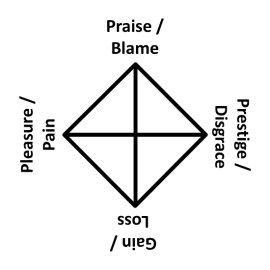 home, when we went out, my mother morphed into Glenda the Good Witch. Everyone would tell her what a good mother she was, and how she took good care of her children. Gain. Oh how my mother loved running after that. If she thought she could get more of anything—money, clothes, shoes, makeup furniture, appliances—she would. Mind you, her closets, vanities, and usually the houses were just about bulging with stuff, but she always wanted more stuff.
As I got older, I noticed that not one of the things my mother pursued made her happy. And she pursued a whole lot. As I grew up, I would ask myself how could that be? She got what she wanted, but it never worked. At about fifteen or sixteen, this truly puzzled me. The only conclusion I could draw was that my mother’s behavior wouldn’t, couldn’t lead to actual happiness.
So, when I went away to school and eventually went on with living my own life, I totally eschewed all the things I’d seen my mother pursue, and lived purely, seeking  happiness in something beyond worldly pleasures. I dedicated myself to the uplifting of humanity, and lived a simple life. You’d think so, wouldn’t you?
But that’s not how it worked out. I had internalized my mother’s wrong views, despite my own reflections on them. For years of my adult life, I was my mother’s daughter. I kept accumulating things, and I wanted  more things, and I wanted to be recognized, be a famous, super-famous writer like Stephen King. I wanted to be beautiful. In short, I was firmly caught in the net of suffering that is the eight worldly concerns.
I got caught in that net because I couldn’t recognize that what I had internalized was a diluted, contaminated doctrine of happiness.
Looking back, if I could have recognized sooner that the eight worldly concerns were an extraordinarily flawed way of seeking happiness, I would have avoided a great many psychological catastrophes in my life. I wouldn’t have traded a uselessly stressful job for a condo on the beach. I wouldn’t have devoted myself to satisfying the selfish needs of another person.
If I had had a true witness to even hint in the true direction of the cessation of suffering, I would have begun disentangling myself from Samsara a whole lot sooner.
Apply to an (ongoing) present situation (how does it matter today?)
A couple of years ago, I had to make a decision about changing jobs. I could have either gone into the same job in the same industry with the same stresses, or I could have chosen a lower paid job, had less stress, and have more bandwidth to pursue the Dharma.
 By this time in my life, I had been studying the Dharma with my Dharma Friend Tashi Nyima for a few years already. I understood about the eight worldly concerns. I understood about the importance of training the mind. I understood the idea of right livelihood.
Now, going on two years into my new job, I know I’ve made the right choice. My job is my field for cultivating compassion with each and every call. When I talk to people on the phones at work, I recognize how they believe all the lies that Samsara presents them, all the false promises Samsara holds out, all the diluted doctrines of happiness which, they believe, lie just beyond their grasp.
From this I learn an oh-so-valuable lesson: if we do not know the truth, we cannot recognize a lie. We will spend lifetime after lifetime chasing Samsara’s chimeras, a path that will ultimately trap us in the cycle of death and rebirth.
Apply to a potential situation (bringing it home to play)
When we first started studying the Fourth Council, I couldn’t understand why. After all, I’m not a Nihilist. None of the people in my sangha are Nihilists, or surely they wouldn’t  be there every Sunday in the Clubhouse Without a Fan. For the first couple of weeks, I really pondered this. I thought it would be quite rude to outright ask my teacher, “Yes, but why do we care at this late stage? Some of us have been studying with you for years.”
Whew! So glad I didn’t ask that, because if I had, right now I would feel like the tiniest, dimmest bulb on the string.
One of the hardest things for me to learn on my path has been the idea of emptiness. One of the first Dharma teachings I attended involved emptiness. There was a full glass of water. The question was, is the glass empty or full? This was very early on, and I thought, Dude, is this a trick question? And everyone was saying it’s empty. I just had to raise my hand and say, no, it’s full. And he asked me a question that I remember to this day as my true beginning on the path. He asked, if the glass were full, where would the water go? Yes. Of course. He was right. A ‘full’ glass would be a solid cylinder. Wow. That blew my mind for weeks. It made me rethink everything I had ever believed about anything.
In the same way, the discussion of functional nihilism has made me rethink the way I see the world. In Buddhism we understand that all phenoma (that which can be perceived by the senses) is empty. That is to say, they are impermanent, insubstantial, and dependent (on causes and conditions). However, Buddhism simultaneously recognizes that there is an Absolute realm that is empty of all but itself. That is to say, in this state exists true purity, true bliss, true being, true permanence. And no, there’s no train or plane to the Absolute. It’s a state of mind.
My teacher said something that rocked my world in this Dharma talk. Whenever we disregard the existence of the Absolute, he said, we fall into functional Nihilism. Most of us, he went on to say, are not philosophical Nihilists, but all of us are functional Nihilists.
When I heard that, I immediately thought, no, no, not me, I’m not a Nihilist, functional or otherwise. But sadly, we all are. The moment we fail to recognize the absolute the truth of  another being’s Buddha Nature, we have fallen into functional Nihilism. The moment we believe we matter more than another sentient being, we’ve fallen into functional Nihilism. The moment we believe our needs are so important, we’re willing to enslave and murder thousands of sentient beings just to eat their flesh, we’ve fallen into functional Nihilism.
Recognizing this, I want to bring it into the work place. As I work with this idea of the undiluted doctrine, I want to shift my focus to working with compassion not because it’s the right thing to do, but because recognizing another sentient being’s Buddha Nature demands this response.
Since I’m late writing this two weeks after the Dharma talk, I’ve had a chance to work with this. I’ve had phone calls where people were nearly unbearably obnoxious. And I really, really worked with seeing Buddha Nature in those moments.
I only managed to accomplish it once. I was very surprised at what happened. For a moment, barely a heartbeat, I had an actual recognition of Buddha Nature in a person I couldn’t even see! The second it happened, something shifted in me. The only response possible was compassion. There wasn’t room for anything else. It was pretty amazing.
The truth is, 98% of people are very nice when they call in. It’s just that two percent. Having experienced this glimpse of Buddha Nature in another, I’m very inspired to keep working with the Two Percenters. The shift I experienced in those few seconds was profound. This experience has left me convinced that by working this way, one Buddha at a time, we can attain the union of wisdom and compassion for all.

I currently study the Dharma with the Venerable Tashi Nyima.
 with it, you’ll be a success, and sublime happiness will be yours? I never found sublime happiness. Although, to be fair, I never stuck to the plan. It was hard. The plan kept changing. Year one’s goal was never year two’s goal, and by the time I got to year two, I’d changed, and I never knew if I should start a new plan or what.
 This is what I thought the Dharma was…a plan. A way of doing things. But now, after years of study, I see the Dharma for what it is: a principle. Gravity is a principle. It always sucks. No five year plan needed for getting old, it’s gonna happen. Aging, gravity – they’re principles that apply in a world of conditioned existence. The difference between a plan and a principle? A principle is unchanging. A principle doesn’t depend on causes and conditions. The Dhama’s like that. It’s a principle, a proposition, if you like: if we see reality as it is, we will permanently end our suffering.
 yes, but two and some thousand years is an awful long game of telephone. Mistakes, misunderstandings, misinterpretations are bound to slip in. When they do, the Dharma remains the same, but the doctrine that is transmitted can become woefully distant from the original principle. It can become a dreadful doctrine, a teaching that leads only to increased suffering, increased unhappiness, and delusions that veer off the Eight Fold Noble Path.
 When I first thought about this, for the life of me, I couldn’t think of how the idea of doctrine applied to my past. But then I thought…love—isn’t that a doctrine we’re taught from earliest childhood? Isn’t it something Hollywood lures us with: find love and you’ll find everlasting happiness. Never mind the crying babies, the mortgage, the love life you’re too damned tired to deal with, and the husband (wife) who just isn’t the fairy tale you’d hoped for. You found love. You’re happy, right? Right?
 arose from a dreadfully decayed doctrine of love that I had internalized wholly, and without question. My understanding of love was sophomoric, to be kind; delusional, to be truthful. I truly believed that if I loved someone, not only would they love me back, but they’d love me back just the way I wanted them to. As might be expected, this led to some hellish life lessons. My misunderstanding of the doctrine we call ‘love’ was a thing far removed from the actual meaning of love. Love is simply the desire that someone else be happy. My idea of love was all about me: I was supposed to be happy because I loved.
 These definitions were taken sequentially from the dictionary. So it’s safe to assume this is a snapshot of how the idea or doctrine of ‘neighbor ‘ has changed over time. So, a neighbor goes from being the guy/girl next door to Mother frikkin’ Teresa. That’s a heck of a game of telephone.

 In all honesty, I have to say being a good neighbor sometimes makes me long for a little arsenic and lace. They’re yelling, they’re asking why they have to pay out of pocket, they’re mad at you (because I run the company), they accuse you of ripping them off, and of course, they’re going to sue you.
 this lifetime and countless others. I hear the ‘if only’ mind, if only my car was fixed for free, then I’d be happy. I hear the lifetimes upon lifetimes they’ve taken rebirth, and have not yet found the path to the cessation of suffering. I hear that they’re caught up in the dreadful doctrine of happiness in Samsara. I hear that beneath it all, they believe there is no way out of their suffering.
 “To recognize smells as unborn is the crucial point of the completion stage;


 dharma pen