On Compassion . . .

On Compassion . . .

May all disease, famine, belligerence, wrong views,

impairments, transgressions, downfalls, harmful actions,

self-cherishing, obstacles, harmful influences and impediments,

all ripen on me and me alone!

Dilgo Khyentse Rinpoche, The Blissful Path to the Ocean of Bodhicitta

i. What does this mean to me?

I grew up in a religion where everything was my fault. Everything that I did wrong was due to my sinful nature, and I could only ever be saved by Grace. When I first read this verse of the prayer I thought, ‘Geez, I have enough of my own suffering, I’m not taking on anymore’.

In Buddhism there is no one to save you. ‘Buddha’ simply means ‘awakened one’. We all have the capacity to be awake because we all share the perfection of Buddha Nature. When we are fully awakened, it’s said that all afflictive emotions and wrong views fall away. Perhaps the most harmful wrong view that causes us suffering is the idea of separation or ‘me’ and ‘you’.

But as we move along the path of awakening we slowly come to realize that there is no true separation, no duality, as it appears in samsara. Once we come to this realization, the meaning of these lines becomes clear. We’re here in samsara because of our karma, our previous actions.

In these lines the writer is urging us to let go of the ideas of ‘you’ and ‘me’. If I were to shorten the verse to one sentence, it would be, ‘May I come to realize there is no ‘my suffering’ and ‘their suffering’, there is only suffering’. Putting it this way reveals an essential truth. It’s not so much that we pray in these lines to take on the suffering of others, but that we realize we are all in the swamp of suffering that is samsara.

II. How would I explain this to someone else?

I’d start by asking, ‘Can you fit an elephant inside your head?’ Besides the look of are you crazy, the answer would be ‘Of course not’.

The answer is patently obvious to anyone who gives the question even a passing thought. How then, do we know what an elephant is? Well, at some point we eight saw an actual elephant or an image of one on TV, YouTube, or any of the plethora of media we have available to us. When that happened, if we were paying attention, we created an internal mental representation and labeled it ‘elephant’.

How many minds are involved in this internal mental representation thing? Only one. Yours. This is true of all that we perceive. This being the case, does it make sense to separate our perceptions into yours and mine?

The writer goes all out in this verse. He names just about all there is on the spectrum of suffering from physical to psychological to shortcomings of the mind. Why do that? I think it’s to remind us again that everyone’s suffering is of the same nature. Since this is true, if we make just a drop of difference by decreasing suffering of any kind, we have dropped a drop of pure water into the swamps of samsara. This makes it better for all.

iii. How do I bring this into my life?

The Buddha taught that there is suffering, the cessation of suffering and a path to the cessation of suffering. When I think of bringing this this into my life, a recent teaching with my teacher the Venerable Tashi Nyima comes to mind. We were talking about including all in our compassion.

My question was, even Ted Bundy? Him too? Because I kind of feel like he was a bad person and did bad things. To sum up my teacher’s response, he said (a) why are you passing judgment on Ted Bundy; (b) who else isn’t good enough to be included in your compassion; and (c) Isn’t he among those deserving the most compassion because his actions, his karma, will bring him untold suffering.

Now, serial killers used to be a sort of hobby of mine. So immediately I started thinking. Wow, I thought to myself, that includes John Wayne Gacy, Jeffrey Dahmer, the Riverside Strangler, and yes, even Jim Jones. They are all most deserving of our compassion. But a tiny part of me still said, ‘but I would never do anything like that.’

Not two days later I was sitting at my desk working when I tiny fly went by. I swatted at it. Given our difference in size, I probably caused a hurricane for the insect. And it hit me, I am the Ted Bundy of the insect world. I try not to, but despite myself, I still swat at them, completely disturbing their world. Now I had to ask myself, am I less worthy of compassion for having done that countless times? Should I take my place next to the Ted Bundy of my mind who is worthy only of unending suffering?

That gave me pause. This writer is imploring us to let all suffering ripen, or mature, on us. If we did that, are we changing anything other than our perception and awareness? Aren’t we already in the swamp of suffering that is samsara? Can we avoid experiencing the miasma of the suffering that is samsara? No. We can’t. This prayer is simply reminding us to decrease suffering, whenever, wherever we can. There are no corners in a swamp. You can’t just decrease suffering in your corner of samsara. We have to realize the truth of interdependence. If one suffers, all suffer.

Having lived with this prayer for a week now. I bring it into my life by reminding myself of a quotation of the Dalai Lama, “Be kind whenever possible . . . it is always possible.” All week at work I really paused to ask myself, how can I be kinder in this interaction? I paused to remind myself to mind the suffering of the person at the other end of the email. This was quite the feat, since I work from home. It really struck me that these people were internal mental representations, actually faceless, since we’ve never met.

This week it occurred to me that true compassion is exactly that – faceless. We may not know every being in samsara, but we know the feel and flavor of suffering. I have to admit that just one week of living with this prayer isn’t enough. It feels like there is so much to do in samsara, and so little time. We can live with this illusion of futility by relying on our Buddha Nature. It is whole and perfect and lacks compassion for no one.


On Distraction…

On Distraction…

Now when the bardo of this life is dawning upon me,

I will abandon laziness for which life has no time,

enter, undistracted, the path of listening and hearing,

reflection and contemplation, and meditation,

making perceptions and mind the path,

and realize the “three kayas”: the enlightened mind.

Now that l have once attained a human body,

there is no time on the path for the mind to wander.

Guru Rinpoche Padmasambhava

i. What does this mean to me?

    We spend our whole day doing stuff. We urgently rush from one task to the next. When we get done with all that stuff, we turn to distraction to end our days. Whether it’s Netflix or video games or games on our phone, we are always distracting ourselves with so-called entertainment. Then we go to bed, wake up and start over doing stuff, rushing around and indulging in distraction.

    What are we distracting ourselves from? The suffering of living in samsara with the sure knowledge of disease, aging and death. In America, we’ve made an industry out of entertainment. We think nothing of it. For most of us, distraction is how we live our lives.

    There’s nothing wrong with entertainment in and of itself. But here’s the thing. We have very little time here. What we call ‘life’ is merely the gap or the bardo between birth and death. In our day-to-day lives, many of us bury this knowledge. The writer specifically tells us that having realized life is merely a bardo between birth and death, he will “…enter, undistracted the path of listening and hearing, reflection and contemplation and meditation…”. That’s a pretty long list but notice the writer says first, “undistracted”. Is it true that we have no time to waste on distractions? Well, nobody I know is getting younger with each passing day.

    To me, these lines are both an instruction and a warning. I don’t think we should all drop our lives and go live on top of a mountain and meditate and contemplate. Distraction is inevitable in samsara. But we have the capacity to limit distraction and turn our minds “undistracted” to meditating, and contemplating, and hearing, and listening to the Dharma. What we choose to do with our time and our mind is vitally important.

    ii. How would I explain this to someone else?

      I attended a two day retreat this past weekend. It was on Zoom. It was an inspiring experience. There were one to two hour gaps between each segment of the retreat and then of course overnight. At the beginning of the retreat we took a vow of Noble Silence. Among other things, that meant we would limit the distractions that entered our minds.

      Honestly, I had planned for some quality knitting and Netflix time in between segments. But no. Now there was Noble Silence. As it turned out, I got just as much from the in-between segments as I did from the retreat itself. The first in-between segment was two hours. No problem, I thought. And it wasn’t. Until it was time to do it. I had to actually sit a few moments and consider carefully what I was going to do to observe Noble Silence. I couldn’t watch YouTube – my go to distraction. No peeking in on Facebook at my knitting group. No catching a documentary on Netflix or Breaking Bad or Bridgerton. And definitely no listening to my favorite Murderbot series on Audible. It was daunting.

      It took me a good five minutes to decide to knit quietly and reflect “undistracted” on what we were learning in the retreat. It was eye opening. I had no idea there was so much distraction in my life.

      To explain this to someone else, I would ask them to observe a day of Noble Silence. I would ask that they go without their usual distractions for just one day. When we decrease our distractions, at first the mind is very noisy. Once you settle into an activity, the mind settles down. Thoughts come and go.

      After doing this exercise, it’s impossible not to notice your level of distraction. Although this was written long before Netflix or YouTube, or Audible, or video games, I’m sure there was still plenty to distract the mind. Even when we identify the distractions that cloud our mind, it’s not easy to enter “…undistracted, the path of listening and hearing, reflection and contemplation and meditation…”. The desire to distract the mind is very nearly addicting. But with practice and perseverance, we can learn to have, as my teacher the Venerable Tashi Nyima likes to say, more Dharma and less drama.

      iii. How do I bring this into my life?

        Just two days after the retreat ended, there were bad storms. I had no power or cable for just about two days. I felt as though the retreat had been in preparation for those two days. On Tuesday in particular, it was pretty much enforced Noble Silence. The only distraction I had was a Kindle, but I could only do that for a couple of hours at a time. There was no way to recharge it.

        While it’s true that I could have read some Pema Chodron, I chose instead to read Stephen King. Because of course I did. I want, I told myself, to be entertained and distracted from the awful discomfort of the heat. The Shining worked perfectly.

        I was a bit disappointed with myself because of course I felt that after the retreat, plus one whole day of practice, I should have been ready to engage in a day long meditation in unaccustomed heat and discomfort. The big difference between before and after the retreat is that now when I engage in distraction, I do it with awareness.

        It’s unrealistic that I would spend all my time studying the Dharma. For one thing, I have to go to work. I bring this into my life with new practices like stopping to take ten deep breaths ten times a day. And I use existing practices like meditation and contemplation. When I take the time in my day, whether it’s first thing in the morning or at random moments of the day, to study or practice the Dharma , my mind feels very aligned. It feels like I’m in harmony with something that I’ve forgotten but now I’m remembering.

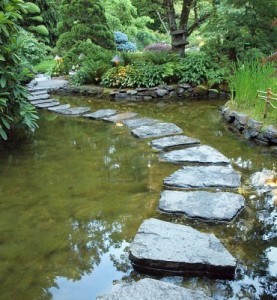
        As my teacher, the Venerable Tashi Nyima reminds us all the time, every moment is new. I think the writer here reminds us of this by calling it a path. He says I will “…enter, undistracted the path of listening and hearing…”. A path is a progression. No two steps are exactly the same. We are always arriving in the next brand new moment, much like stepping stones in a river.         

        Considering this, do we want to spend all our spare moments in distraction? Or do we want to spend our moments entering into a path of listening, hearing, meditating and contemplating the Dharma? Honestly it’s a question of balance for me. I would much rather spend more moments with the Dharma than not, as the Dharma is forever enduring.

        On the bardo…

        On the bardo…

        Now when the bardo of this life is dawning upon me,

        I will abandon laziness for which life has no time,

        enter, undistracted, the path of listening and hearing,

        reflection and contemplation, and meditation,

        making perceptions and mind the path,

        and realize the “three kayas”: the enlightened mind.

        Now that l have once attained a human body,

        there is no time on the path for the mind to wander.

        Guru Rinpoche Padmasambhava

        i. What does this mean to me?

        I can be the ultimate procrastinator. Why do today what you can do next week, or maybe the week after, is what I say to myself. Just the idea that we can do something tomorrow assumes a lot. For one thing, it assumes we’ll wake up the next day. What makes us so sure of that?

        The first line of this proverb says, “Now when the bardo of this life is dawning upon me. . .”. What’s a bardo? Our local friendly AI tells us that a bardo is a “gap, interval, intermediate state, transitional process, or in between…”. That’s a mouthful, isn’t it? A bardo is an interval that has a beginning and an end. Sleep, for instance, is a bardo. It’s an interval that begins when we fall asleep and ends when we wake up. Sleep is usually in between one day and the next. We take this bardo for granted. We assume we’ll awaken the next day.

        The writer talks about “…the bardo of this life…”. What does he mean? What is life between? Well, we’re born, we die, and in between there’s the bardo of life. The writer says that the bardo of this life is “…dawning upon me…”. Many times we go about our lives in a routine that’s day-to-day. We usually don’t pause to look at life itself, especially when we’re younger. It doesn’t dawn on us that life is a bardo. We can’t even be certain of our next breath, let alone our next day

        But samsara with its distractions, sucks us in. We enter a cycle that begins with struggle. When we struggle for something, there are only three possible outcomes. First, and most common, we don’t get it. Or, you get what you want, but it’s not what you thought it would be. And the least common outcome is you get what you want, it’s exactly what you thought it would be, but then you lose it because nothing lasts forever in samsara. When this happens, we are undeterred. We simply find something else to want, thinking this time I’ll get it. This time it will be what I want and it will last forever. We do this because we mistakenly believe that if we look hard enough, we’ll find something in samsara that will make us happy. Sadly, this isn’t so.

        The writer goes on to say that now with the bardo of this life “…dawning upon me, I will abandon laziness for which life has no time…”. Once we remember or once it dawns on us that life is just a bardo between birth and death, our perspective can change. We can start seeing that life itself is only a limited time and we have no time to waste.

        Does this mean we should all become monastics and pursue spiritual matters the rest of our lives? No. To me it means that this bardo of life that we take so much for granted is exactly that – a bardo. It’s going to end sooner than we think. So why waste time on the shiny distractions of samsara? How will that prepare us for the end of this bardo?

        ii. How would I explain this to someone else?

        Life is like a vacation from work. Why do I say that? When we go on a vacation, we make all sorts of plans so that everything goes just so. Some people even have very strict itineraries for vacation. Why is that? Because we recognize that, compared to the rest of our work-a-day life, vacation is very short.

        When we believe we have an entire lifetime yawning out before us, it’s easy to be lazy. It’s easy to watch Netflix instead of meditating or doing mantra or even contemplating the Dharma. If we believe that our lives will just go on and on, we live our lives with a complete lack of urgency.

        But the writer here uses strong language about life. He says he will “abandon” the habit of laziness. He’s not saying, ‘maybe I won’t be so lazy’. No, he says he’ll abandon laziness. To abandon is to “…give up completely…” according to our local dictionary. This is a pretty radical statement to make. The writer is not going to do his very best not to be lazy anymore. He is going to give up completely the habit of being lazy. Why is that? Because no one gets out of samsara alive.

        This may sound doom and gloom, but really it’s an encouragement. We’re all here in this realm of struggle and desire because of our karma. Does that mean we’ve been lazy in previous lifetimes? Hard to say. But once we are blessed with the perspective that life is a bardo, a short time between birth and death, that can really light a fire under us. And we can live our lives accordingly.

        iii. How do I bring this into my life?

        Like I said, I can be the ultimate procrastinator. I used to wait until the absolute last second to get something done. But like the writer I’m blessed to know the Dharma and understand that life is a bardo. It’s a very short time. Some turtles live to be hundreds of years old. Compared to that, the lifespan of the human species is a flash in the pan.

        I would like to say that having come to understand the truth of life as a bardo by studying the Dharma, I really lived life with a sense of urgency. But I didn’t. It’s only now as I have come into old age that I feel a sense of urgency. I have so few years left compared to what I’ve already lived. And now, I’m starting to wake up and truly realize that life is a bardo and there is no time for laziness.

        When is it time to study the Dharma? It’s always time to study the Dharma. It’s unavoidable. The truth of it rings out all around us every day. As I work to bring this teaching into my life, I find that it’s a matter of priority. Without ever leaving my house and with an internet connection, I quite literally have thousands of distractions at my fingertips. I also have the Dharma which is nothing more than an undistorted view of reality.

        When I first began studying the Dharma, my teacher the Venerable Tashi Nyima called it ‘mind training’. There was so much to learn. It seemed overwhelming. I thought I had to know all of it, chapter and verse. But gradually as I began  to study and meditate, I saw that no matter what ‘part’ of the Dharma you study, you’re studying all of it.

        Because the Dharma is seeing reality as it truly is, there’s no way to break down the Dharma and say, ‘I’m only going study this part’. Since studying the Dharma really is mind training, it doesn’t matter where you start. It’s said that there are 84,000 gates to the Dharma. No matter which gate works for you, you will encounter the entire Dharma. This is because studying the Dharma, after a short while, shifts your perspective. The minds starts to see things differently. The Dharma is a point of view.

        From this point of view we can understand that life really is a bardo, and there really is no moment to waste. This is the blessing for me of bringing these lines into my life. Once we see things as they truly are, samsara gradually loses its hold on us. We begin to see that the distractions of samsara are but a waste of our time. And our time here is very short.