
Currently I’m studying Heart Treasure of the Enlightened Ones with a Dharma friend, the Venerable Tashi Nyima.
This is my contemplation on the second line of verse 41 of the root text of Heart Treasure of the Enlightened Ones.

“By examining relative truth, establish absolute truth;
Within absolute truth, see how relative truth arises.
Where the two truths are inseparable, beyond intellect, is the state of simplicity;
In the view free of all elaboration, recite the six-syllable mantra.”
Full Disclosure:
Writing this contemplation felt whimsical, as though I were writing a Buddhist take on Peter Pan.
Written Sunday, October 5, 5:30 AM
Explain to someone else (making it my own)
I’ve always had a thing for stages. It’s always been interesting to me how a stage or a movie set is really just a lot of space. In fact, the defining characteristic of any stage or movie set is emptiness. I still like to watch ‘Bloopers’ and out takes from movies that I’ve seen. It’s fascinating to me to remember the moment as I saw it in the movie, and then see the actor say the line in the out take then say something like, “Damn. Sorry. Let’s do that again.” Seeing that mistake completely destroys the illusion of the story being acted out. It takes away the magic. In those out takes you see the lights, the cameras, the Coca Cola cans, and it completely wrecks the illusion of King Henry and his sixteenth century English court.
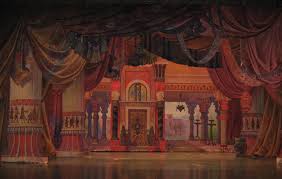 Particularly interesting to watch are time lapse segments that show an utterly dark and empty sound stage becoming the French king’s banqueting hall, complete with golden bejeweled goblets at the table settings. Maybe this has always intrigued me because there’s such similarity between how stages are dressed, how movies are made, and how we live our ordinary lives. If stage dressing is done just right, you don’t even notice it. You accept it as part of the story world. After all, how many times do we walk out of a movie and ask, “I wonder who the set designer was? They did a really good job.” No. We accept the set as part of the story.
In the same way, we accept conventional reality, what Patrul Rinpoche calls “relative truth” as though it were the entire story. But the truth is that samsara is the biggest, most convincing set ever built and we strut about the soundstage from the moment we’re born until the day we die. The problem is we’re so caught up in our own drama, we never notice that it’s just a story being played out on a vastly infinite stage: the ultimate reality of emptiness. Dilgo Khyentse puts it like this, “If the whole world—all its continents, all its mountains and forests—were to be destroyed and to completely disappear, only all-pervading empty space would be left. Something quite similar happens when you truly realize what relative phenomena are […] Once you realize ultimate truth, you will see what appears within—the whole, infinite display of relative phenomena—as no more than an illusion or a dream…”
Exactly so. The moment we can take a step back from our wrong views and afflicted emotions, conventional reality becomes less convincing. Our limitations can be seen for the illusions they are, and all around us lies the infinite vista of all possibilities: the absolute truth of emptiness.
***
Apply to a past situation (how would it have been different?)
Shakespeare told us, “All the world’s a stage”, right? Well, for many decades I had the starring role in a stage play I’d call The  Dream That Never Was. I used to live my life like this. First I’d see something someone had. And I’d think—that makes them happy. This would be quickly followed by I want that. It would make me happy too. Then by some weird quirk of my life I’d always be able to get…whatever…to make me happy. But then of course, it wouldn’t make me happy, then I’d get angry that I’d spent so much money or time or both on it, and I’d sulk through life for a while. Then I’d see something else that someone had…and it would start all over again. I’m embarrassed to say that I saw a happy looking nun one day. I went home and wrapped a towel around my head like a wimple, and decided that New York was just too hot to dress like that all the time, not to mention the long dress and those thick stockings.
On a more serious note, this constant inability to see beyond the relative truth of what would make me happy led to some disastrous, tragic times in my life.
Looking back on those times, I can notice that if I’d taken just a half step back, I may have noticed that I was playing out the same drama again and again, nearly word for word. If I’d been able to take a breath and allowed even a bare hint of peace and clarity to arise, I may have noticed that I was running away more than I was actually running toward anything.
I could always sense a certain yawning emptiness to my life, a terrible hollowness that threatened everything I believed—about who I was, about the life I lived. If I’d stopped and taken a breath, I may have noticed that my constant frenzy of all-consuming drama was driven by the fear of what would happen if I just stopped for a moment. I dreaded the emptiness that I could always sense underneath it all. Perhaps, had I been able to pause, I may have sensed that the emptiness was what I’d been seeking all along.
***
Apply to an (ongoing) present situation (how does it matter today?)
Tomorrow when I go to work, I will give my soon to be former manager my two weeks’ notice. Three weeks after that, I’ll begin a new job. This has been a turbulent time in my life, but not nearly so turbulent as I’d anticipated. At very odd moments, appropro of nothing, this wonderful peace arises in me. It isn’t a peace of knowing all will be well. It’s a peace of knowing all is well.
This peace is punctuated with many moments of high drama from my mind that go something like this: Are you crazy leaving a job you’ve had for almost twelve years?? You’re walking away from twenty-two thousand dollars!! That’s not a drop in salary, it’s a friggin’ nose dive! You know this won’t work, right? This is crazy! Don’t do it! Everything’s fine how it is. There’s BS on every corporate plantation. Don’t be an IDIOT! And on, and on.
But somehow when those moments of absolute peace arise, all these thoughts seem like the incoherent yammerings of a pissed off Chihuahua—utterly without meaning. Leaving this job is one of the easiest things I’ve ever done. Step 1: I decided I’d had enough. Step 2: I looked for a job. Step 3: I got an interview. Step 4: I got the job. No kidding. Just like that. My experience with the Dharma has taught me that things are only that easy when you are going as you’re meant to go. In comparison to leaving, staying was becoming a Herculean task.
 The experience of contrast between the moments of peace and the yammering of the Chihuahua mind has really given me an experience of how relative truth arises within absolute truth. The peace that arises within me is so complete, so whole that simply to experience it is to know that it is the truth of things. There is nothing beyond it or outside it because it is all there. It is an experience of non-obstruction. Within this peace fear arises, uncertainty, resistance. But they seem insubstantial, like shadows. The Chihuahua seems like a garishly made up starlet on a badly designed stage who doesn’t know her lines well enough to speak them convincingly.
I understand that the peace, or Serene Trust that I experience is only a glimpse of absolute truth, but that glimpse is more than enough to put the lie to relative truth in all its garish, overdone theatric pomp.
***
Apply to a potential situation (bringing it home to play)
So tomorrow when I go to work, the first thing I’ll do is type my resignation and email it to my soon to be former manager. She lives about six hours away from the work site. My preference would be to do it face to face. After I hit SEND, my whole life will change. That’s the storyline mind’s been running.
But I really have to stop here and ask, will my whole life actually change? Well, let’s see.
Will I still wake up and practice before going to work? Yes.
Will I still take a shower in the mornings? Ewwww… Of course. And get dressed? Not going out naked, so that’s a ‘yes’.
Will I still get in my car and drive to work? Well, I don’t plan on hitchhiking, so, yes.
Will I still answer emails? Yep.
Will I still practice the Dharma? Yes.
Will I still knit hats for cold little heads in Nepal? Yes.
Will I still bake and make up care packages for the homeless? Yes.
When I go to work will I still be full of the bile of frustration and resentment? Nope.
When I go to work will I still feel trapped and full of despair, certain that I’ll never have the courage to leave? Nope.
When I go to work, will I care that Salem is incompetent, manipulative, and a cheat? Not so much.
All told I’d say that I have very good, very positive changes coming my way after I hit that SEND button. On the level of relative truth, there is the undeniable finger-biting fear of leaving behind the unbearable comfort of the known. Sure, that’s there. But I have the wonderful gift of my practice and taking refuge in the Three Jewels. This has cultivated in my mind the capacity to be aware that these relative truths of fear and doubt are arising in the vast emptiness of absolute truth, a place from where all possibilities arise.
The best way I can describe that experience is this. Did you ever look up at the night sky on a very clear night? You know how you can see just thousands and thousands of stars all but crammed into the heavens? Then you have a sudden thought that to someone on one of those worlds orbiting those stars, you and all your dramas, your entire life, is just a pinprick of light in their night sky. In that moment of realization, all the ‘reality’ of problems and dramas dissolves and things simply are as they are. To me, this is what it feels like to see how relative truth arises and is informed by absolute truth.
I think once we glimpse the infinite constellations of our Buddha Nature, we can’t help but see the vastness of who we truly are shining through the mistaken delusion of who we believe ourselves to be.

 dharma pen