
Currently I’m studying Heart Treasure of the Enlightened Ones with a Dharma friend, the Venerable Tashi Nyima.
This is my contemplation on the second line of verse 31 of the root text of Heart Treasure of the Enlightened Ones.

“The mind cannot cope with all the many visualization practices;
To meditate on one Sugata is to meditate on them all.
Whatever appears, appearances are the form of the Great Compassionate One;
In the realm of the deity’s body, apparent yet void, recite the six-syllable mantra.”
Full Disclosure:
I found this verse very obscure to work with. Typically in my contemplations, the line or lines I want to write about will become apparent to me after I read over my notes from Tashi’s Dharma talk and then read Patrul Rinpoche’s commentary. But today was a little different. None of the lines spoke to me, so I started writing until one of them did. Watch out ahead for flying mind debris!
Explain to someone else (making it my own)
Sometimes when I study the Dharma, I feel like a girl exploring her grandmother’s attic, stuffed to the walls with really  cool-looking stuff and I can’t imagine what it all used to be for. Then I take my newly discovered Alien Artifact downstairs only to have my grandmother tell me it’s an old-fashioned waffle iron, and it makes far better waffles than that wretched Martha Stewart junk pile fodder you can order off the TV. And then I start remembering those amazing waffles grandma used to make when I was a kid.
Studying the Dharma is like that for me sometimes. When I learn a new teaching, there’s a feeling of rediscovering something wonderful that I knew a long time ago, but I’ve since forgotten. Today’s line, “To meditate on one Sugata is to meditate on them all” is like that.
We spend so much time and energy trying to solve all our problems, running from one problem to the next like actors in some never ending melodrama. In truth, we have only two problems: afflicted emotions and wrong views. If we would stop chasing after the shadow puppets the mind throws up against the seemingly solid walls of our delusions, we would see this clearly.
When we think of the Buddhas, our wrong view of duality makes us see many Buddhas. But this is not so. It’s more like there’s Buddha-ment (to coin a word) emanating through samsara at every moment. No matter which emanation we meditate on, we are meditating on all of them. The fragmentation is an illusion.
***
Apply to a past situation (how would it have been different?)
When I was in college, I wanted to be out, done. When I was done, I wanted to run my own business. When I started my own business, I wanted to be a court reporter. When I was a year into being a court reporter, I wanted to be a writer. When I couldn’t write the next Great American Novel in a couple of months, I wanted to get married.
For years, my life went on and on like that: always being dissatisfied with what I had, then being even more dissatisfied with what I’d get. In a sense, the Relationship From Hell helped with this issue because I eventually became so focused on my own survival that there wasn’t room for much else in my mind.
 Had I been able to take a step back from the mad dash through my life that eventually culminated in smashing into the shatteringly tough wall of surviving nearly ten years of a sociopath’s tender embrace, I may have noticed a few things.
What I thought I wanted was something I could settle into, something that would quell my restlessness. But what I actually needed to do was to spend some time working with my afflicted emotions and wrong views. They emanated through every imaginable aspect of my life. Had I been able to take a step back and just work with one (probably my afflicted emotions), I would have been able to make more skillful decisions about who to spend my life with. If I had been able to realize that the restless bustling of mind was like cloud cover against a clear blue sky, I may have begun to recover my Buddha Nature that much sooner.
***
Apply to an (ongoing) present situation (how does it matter today?)
When you first sit down to meditate, especially if the mind is agitated, the first thing you hear is noise. It’s a rush of thoughts that makes me think of New York’s Penn Station at 5:10 PM on a Friday afternoon: frantic, echoing chaos. In the new silence that I’m bringing into my life, mind seems suddenly very loud. By comparison, those first few minutes of meditation actually feel quieter.
I never realized how much I relied on noise to mask whatever unpleasantness was going on in my mind. After an agitated day at work, I’d come home and turn on tinkling “meditation bells” or ocean sounds. That doesn’t sound like much, but it was enough to draw attention away from mind’s discomfort and complaining after work.
Now, in the new silence that I’m cultivating, mind is much more apparent to me. I am beginning to see that, far from ‘complaining’ after work, mind is more like a freely flowing river that’s been dammed for most of the day. After that initial rush of thoughts and emotions (which I never used to allow), mind begins to settle into its own natural rhythms, which I find quite soothing. As a matter of fact, I’m starting to wonder if that rhythm isn’t just mind making its own white noise ‘music’. But that’s for another time.
Before I began cultivating silence in my life, it didn’t occur to me that by working with one thing in our lives, we are working with all things our lives. Maybe that’s why this line really resonates with me this morning. I’m beginning to understand that if we truly meditate on—I actually prefer the word ‘cultivate’ here—any one aspect of the Dharma, we are cultivating all of the Dharma and bringing all of it into our lives.
Since separation is a wrong view, any attempt we make, no matter how small is a little bit like looking at the sun through a prism. Even if you only see a single ray of light, it doesn’t matter because you’re getting to know the idea of ‘light’. Sooner or later you’ll realize the prism is just a skillful means to make sunlight visible. Once you know that, you’ll be able to perceive the incredible brilliance of the sun. Just so with our Buddha Nature. Even if we think we’re only cultivating one aspect of our Buddha Nature, to work with one aspect is to work with the entirety of the empty luminosity of who we truly are.
***
Apply to a potential situation (bringing it home to play)
As I work with cultivating silence in my life, there suddenly seems to be more space. I mean literally. Not only does my mind feel more spacious, but physical spaces feel bigger too. When I bake, my kitchen feels bigger. When I’m reading or writing, my living room or bedroom feels bigger somehow. It’s as though all the noise I was adding (to an already noisy world) was actually making my world smaller. Is that possible? I don’t know. I can only go by my experience.
I am beginning to notice, in this new cultivation of silence, a feeling of less separation in my world, less fragmentation. In my afflicted emotions this means that the sharply edged divide between “good” and “bad” emotions is wearing away. In the way I see people, this means I’m somehow able to see their suffering with more precision. In response compassion spontaneously arises and many times it leads to a precise kind of wisdom of how to best relieve the suffering I see, or at the very least, how to not add to it.
Cultivating silence has led to so much unexpected light in previously dark corners of my mind and of my life. Honestly, I don’t know what to expect next, or even what to plan on working with next in all the new space. But I do know one thing for certain. It has been absolutely true in my experience with silence that “To meditate on one sugata is to meditate on them all.”
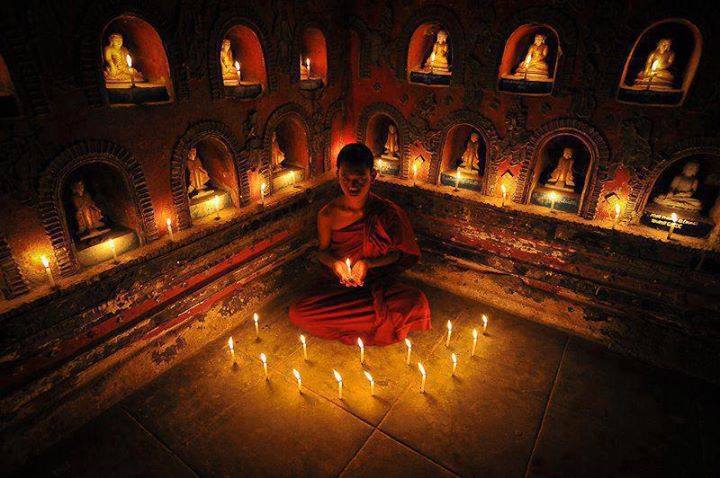 I thought I was taking silence for a test drive. But the experience is turning out to be that my Buddha Nature, through the vehicle of silence, is taking me for a test drive through my life. And what a ride it’s been so far. It’s like an all-inclusive tour through a life I’ve never taken the time to explore and now there are vistas of unknown hinterlands laid out before me.
So I think when I go to work today, I want to take this day to pay attention to how silence manifests in the workplace. Is the mind’s tendency to wander the known (and unknown) universe impacted? How? Am I able to see my Buddha Nature more clearly? What does that look like? And most importantly, I think, what is arising in all that new space, and what does it tell me about what my afflicted emotions and wrong views have been obscuring all this time?
Post Script:
I wrote this contemplation this morning, roughly twelve hours ago. During my day, I paid attention to the silence. What I noticed is something I’ve studied in the Dharma and heard about in teachings, but never really paid close attention to.
Yes. The world we experience is an internal representation. I thought I understood that. But I always thought this meant our world was defined by action, by what we do and what the perceived ‘other’ does. Today, for the first time, I was able to see that simply being still (silence) is the biggest ‘engine’ of making our world. This engine is infinite, unfathomable, and underlies every heartbeat, every breath, every moment.
When I shared my contemplation with my Dharma friend Tashi, he put it much more simply: “Silence = Emptiness = Space = All possibilities.”
Yes, indeed.
 dharma pen