On getting everything you want…

Currently I’m studying Heart Treasure of the Enlightened Ones with a Dharma friend, the Venerable Tashi Nyima.

This is my contemplation on the third line of verse 18 of the root text of Heart Treasure of the Enlightened Ones.

heart treasure

“Disgust, because there’s no one to be trusted,

Sadness, because there’s no meaning in anything,

Determination, because there’ll never be time to get everything you want;

If you always keep these three things in mind, some good will come of it.”


Explain to someone else (making it my own)

One day, I’ll die. I’ll be alone at the moment of my crossing into death. All that I know will be left behind. All that I have done will be left behind. All that I have wished for, even those secretly cherished dreams that I don’t dare speak aloud—of true love, of unending happiness, of an end to heartbreak—will be left behind. Knowing this, how am I to live my life?

grim reaperI tell myself I’m not afraid to die but…a couple of days ago I went to the doctor. When she walked in and looked at my EKG print out, her normally smiling, welcoming face was deadly serious. In those moments of stone silence, death’s cold draft blew through my life. I had regrets, anxieties, and so much fear. It was a routine test. But I was suddenly, unexpectedly face to face with my mortality. A brief thought ran through my mind…My god. I’ve been f**king around. Is it too late?

I finally managed to say to her, “What? What’s wrong?” As it turned out, nothing was wrong. “Just concentrating,” she said. She was having a busy day.

Ever since that moment, I’ve really thought of what this line says. There’ll never be time to do it all. And even if there was, how much of it is worth doing? It’s funny how that moment of utter terror left in its wake a gift of total clarity. For long moments on that day, I was able to realize that we are all like travelers on a short trip. It’s really a very short journey from birth to death.

In a couple of weeks, I will have journeyed around this world’s star fifty times. There’ll come a time when I don’t make the journey all the way around. When that time comes, I don’t want to leave this realm full of anxiety and regret. That’s where a life full of wishes for samsaric happiness leads: dying full of regret for what you could have done. Instead, we can choose to live so that our every step brings us closer to a death that will lead us to enlightenment and freedom from the suffering of the cycle of birth and death.

***

Apply to a past situation (how would it have been different?)

There was a time in my life, almost a decade ago now, when I wanted True Love. Yes. With the capital letters. Think Cinderella. Think Sleeping Beauty. Think Prince Charming. On steroids.cinderella

When Prince Charming came into my life, I was so swept off my feet, I breathed fairy dust. There was nothing in my life but roses and romance. And I thought, this is it. I found him. All that time looking, and here he is at last. Cinderella fitting into her glass slipper had nothing on me.

When Prince Charming’s glamour began to wear off, I refused to see it. I literally closed my eyes to anything that didn’t fit with my idea of True Love. Even though after a year I was living with all the classic signs of abuse—isolation, low self-esteem, fear for my safety—I still thought I could make things right. As nine years of my life crept by, I would think…I’m over forty. I won’t have time to find True Love again so I better stick with what I have.

Looking back on that situation in my life, I can notice how my own fear of my time running out to get what I wanted imprisoned me in misery. I can notice how I was willing to delude myself into believing I had what I’d wished for. All I had to do was make it right.

I could have taken a step back, breathed and noticed that the situation I found myself in was based on two afflicted emotions: hope and fear. Having noticed this, I might have asked myself…I got what I wanted, it wasn’t what I thought, did I want to spend the rest of my life chasing an illusion?

***

Apply to an (ongoing) present situation (how does it matter today?)

kitchen aidI want a Kitchen Aid stand mixer. I’ve looked at so many of them on E-bay, I get Kitchen Aid ads in my Gmail sidebar. I mean, really. I want one. Not the giant 7.5 quart Professional series. That’s around $700.00. No. I just want the classic. Well, the Artisan model, with the planetary motion (so I don’t have to scrape the bowl) would be nice. But it’s around a hundred bucks more than the classic. Or I could get a classic and upgrade to an Artisan later. I may even go to the Salvation Army and check out their appliances.

These thoughts go around in my head quite a bit lately. When I first started baking outside my bread machine, I had to have a cast iron Dutch Oven so that my breads would have a good crust. But…the bottom crust would burn; too much radiant heat on such a dark color. So, I wanted a ceramic Emile Henry pot. I got that. Works like a dream…except…the baking was still a little uneven because I have a cheap oven. What I really needed was a ceramic baking stone. It came in the mail yesterday. Wow. It’s sweet! I bake like a pro now; crispy top crusts, tender bottom crusts.

So now, all I need is…those artisan flours from the King Arthur Flour website. Just a few. And of course there’s the oblong clay baker, so I can make a real Italian loaf of bread and…there is no end to it.KA Flour

Working with my baking practice as I work with this line has really helped me to see how absolutely pointless it is to try and get everything we want. Our mind will never run out of things to want.

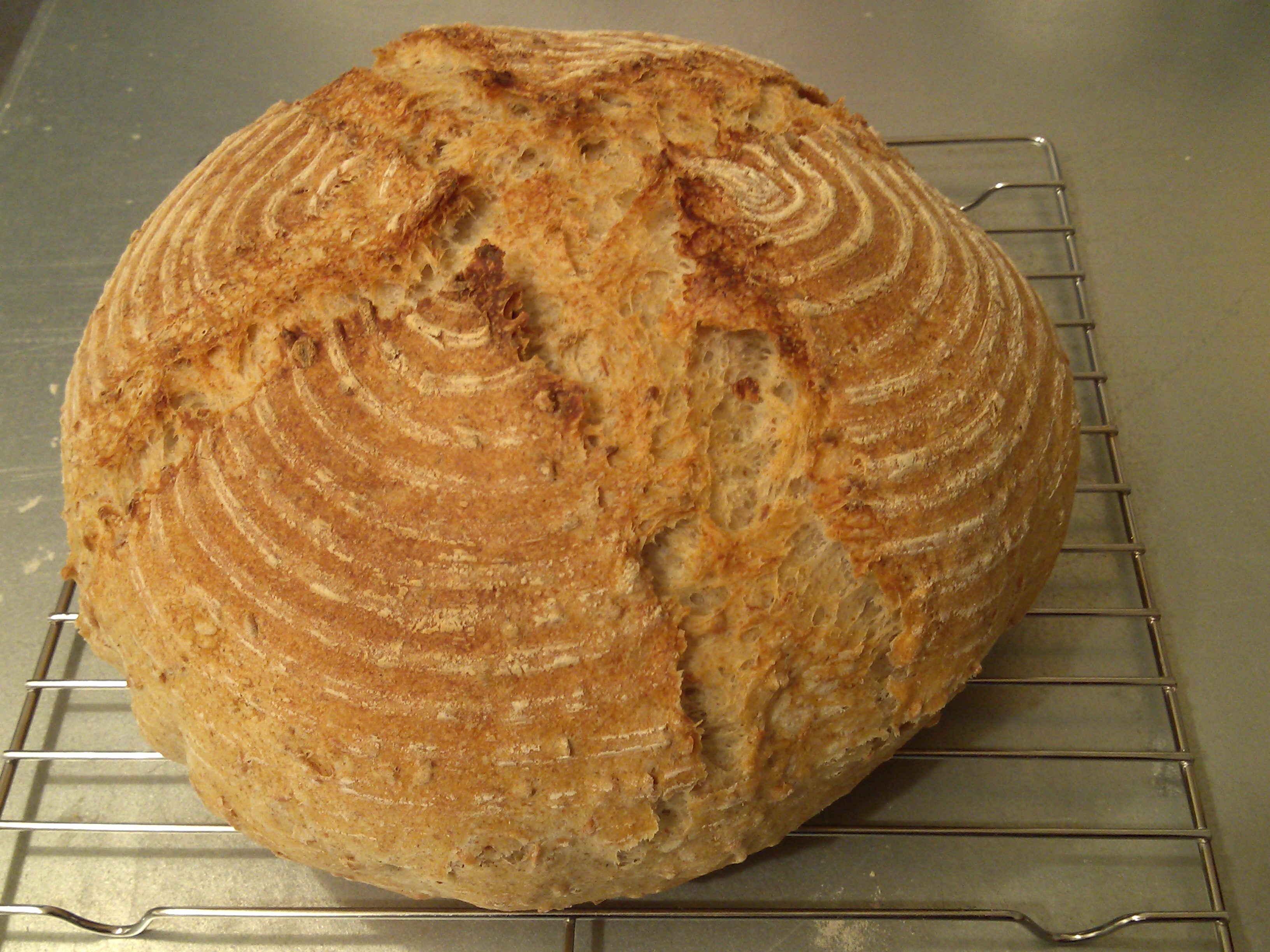
Having noticed this, I can take a step back and notice how every loaf of bread I make brings me a sort of ephemeral peace. It’s not the bread itself. It’s baking. Each loaf is a chance to perfect something, but then, you have to let it go. It won’t last. It’s not meant to. There’s something very satisfying in that arising of perfection, and the letting go of it.

I can notice that no thing in the phenomenal world can last because entropy rules the day in samsara. Having noticed this, I can turn my attention to ‘that which holds’—the Dharma. I can swiftly develop the mind of renunciation, and realize that any happiness that arises in samsara is fleeting, deceptive, illusory. There will never be time to get all I want, and even if I did, it wouldn’t be worth having.

***

Apply to a potential situation (bringing it home to play)

Today after sangha, I’ll be trying out a test bread. It was pretty bad the last time I made it, but I’ve got a pretty good idea of what went wrong. Typically when I bake, all sorts of thoughts go through my head: if I had that metal set of measuring cups and spoons from the King Arthur Flour website, I could just toss them in the dishwasher. I should get another banneton. A back up would be great. Wonder what this recipe would be like with an ancient grain flour. I really need a stone crock so I can try out sourdough….and on and on.

Today when I’m baking, I’m going to notice how those thoughts habitually get in the way of doing something I really enjoy. I’m going to notice how they lead to a dead end. I’m going to notice how I could fill an entire industrial-size kitchen with every baking implement I can think of or dream up, and still, it wouldn’t be enough.

I can notice how these thoughts aren’t about baking. They’re about dying. When we want something, we are fantasizing a future. And if there’s going to be a future, there’s going to be a ‘me’ to live it. Our thoughts of wanting things and chasing after them allow us to exit the discomfort of coming face to face with our own inevitable mortality.

Having noticed this, when those thoughts come up, I’ll breathe, do a quick mantra, and remind myself that there is only one way out of the suffering of samsara. It’s not the next Kitchen Aid, or the next clay baker, or the next bag of artisan flour. These are pleasant distractions. The only way out of the suffering of samsara is to study the Dharma and let it permeate and eventually dissolve our delusions and wrong views.

Having reminded myself of this, I can bake, finish that test bread and know that I have used the practice of baking to increase my peace and clarity by bringing baking to the path. Then I can dedicate the merit. The path is wherever you find your feet to be. My footsteps happen to be made in flour. SRL 03 08 14
On hiding your mind…

Currently I’m studying Heart Treasure of the Enlightened Ones with a Dharma friend, the Venerable Tashi Nyima.

This is my contemplation on the third line of verse 17 of the root text of Heart Treasure of the Enlightened Ones. 

I thought it was interesting to see how much of a HUGE part speech plays in our life. I also think that in this case “hide” can be read as “guard”, as in having vigilance. That’s the point of view in this contemplation.

heart treasure

“Hide your body by staying alone in a mountain wilderness;

Hide your speech by cutting off contact and saying very little;

Hide your mind by being continuously aware of your own faults alone.

This is what it means to be a hidden yogi.”


Explain to someone else (making it my own)

We’re always talking. There’s a twenty-four hour Weather Channel, a twenty-four hour CNN channel, a twenty-four hour cooking channel. If you’re willing to, you can spend twenty-four hours a day watching sports on ESPN. And that’s just television. There are twenty-four hour radio stations. We are inundated by seas of words constantly, whether it’s television, radio, or a text message on our cell phone that of course, can’t wait.

Where does all this talk come from? Is it anything more than pointless chatter? Sadly, probably about ninety-eight percent of what we say is utterly pointless and doesn’t need to be said.words tiles

If we think about how the mind works, all talk originates in our mind. Our own words begin with our thoughts. The words of others can only be understood when we take them into our mind, pass them through the filters of our prejudices, our likes and dislikes, our life experience, our mood, our tendencies, then finally arrive at ‘understanding’. This happens so lightning-fast, that most times we’re not aware of it.

Unfortunately for us, these filters work both ways. Every word we say is an impromptu autobiography. We continually reveal ourselves in our speech. If we know this to be true, then it’s a good idea to constantly, relentlessly examine our mind, and become aware of our faults. This awareness will lead us to a skillful discrimination in what faults we reveal, and what faults we choose not to reveal.

If we ask ourselves before we speak, “what is the state of my mind?”, we will find many times that we want to speak out of envy, jealousy, resentment, anger, fear, or some other afflicted emotion. If we hide (or guard) our mind by being continually aware of our faults, then monkey-mind has less of a chance to gibber pointlessly.

***

Apply to a past situation (how would it have been different?)

speech bubble 3There have been so many times when my speech has led to trouble in my life; it’s hard to point to just one situation.

I remember a fight I had with my mother when I was in my mid-twenties. I said something that made her cry and her tears infuriated me. Seeing her tears, I said something very like, “I don’t care if I make you cry. You’ve made me cry enough.” Then I stormed out the door to work.

Looking back at that unskillful speech, I can notice that I was so overwrought with emotion that it would have been better to super glue my tongue to the roof of my mouth than to utter a single word. I can notice that the state of my mind was frustration and anger. I can notice that my words were purposely chosen to inflict pain.

Having noticed this, I might have taken at least a half-step back, and before I spoke, I might have become aware of the faults of my mind in those moments. I could have breathed with the hot-prickly sensation of anger. Doing this would have given me a brief moment of clarity. In that moment I could have asked myself what choice I wanted to make. Did I want to continue my habitual actions, which would only lead to more suffering? Or did I want to guard my mind at that moment and move toward weakening my habitual tendency?

Having asked myself these questions, I could have taken another half-step back and breathed. Just one breath. The average rate of human speech is 225 words per minute. In that one breath, that one skillful act, I may have stopped my monkey-mind from pointlessly gibbering at least a hundred unskillful words, words that would have led to nothing but suffering.

***

Apply to an (ongoing) present situation (how does it matter today?)

Words are how I make a living. Throughout my work day, I resolve issues by answering questions either on the phone or via email. I process on average, about fifty email interactions a day. And every single email is a conversation in my mind. With over two hundred emails a week, sometimes over a thousand emails a month, my job could easily become monkey-mind’s playground. In fact, it has been exactly that in the past.

At times I catch monkey-mind up to its old tricks. Thoughts zing through my mind:

What a stupid question.

Seriously, are you telling me you have enough time in your day to sit down and type such a dumb question?

Good god lady, I told you that last week!

You need a friend. I’m not your pen pal.

Please. Go be stupid on your own time.

What I’ve noticed as I study the Dharma and get to know my mind, is that the emails don’t substantially change. It’s the same questions over and over, the same requests. What changes is my state of mind. These days when a thought like this comes up, I know I need to pause. I know I need to examine the state of my mind. And sure enough I’ll find I’m irritated because my back hurts, I have a headache, the test bread I baked over the weekend burned to charcoal on the bottom…whatever. The point is if I answer an email in that state of mind, I will show my faults. And since my faults of aggression and irritation and frustration are not unique to me, my faults will resonate with the person reading my words, and my email will in turn evoke their anger, their aggression, their frustration.

Instead, I choose to take a step back. I read most emails for tone before I send them out. This continuous awareness does not lead to a perfect work day, but shhhhit does lead me to do my job with a measure of compassion and empathy. Am I able to do it on every single email? Of course not. But, with awareness, by continually guarding my mind, continually being aware of my own faults, I keep monkey-mind’s gibbering to a minimum.

***

Apply to a potential situation (bringing it home to play)

The ongoing situation in my life is Salem. A few months ago, it felt like that situation was completely unworkable. I remember thinking something like ‘working with my mind is one thing, but I ain’t a freakin’ saint’. The situation with Salem remains unchanged. What has changed is the state of my mind.

In working with what I felt was an external ‘enemy’, it became clear to me that the ‘enemy’ was an internal representation that had very little to do with the person sitting next to me. After months and months of hard work, I can finally examine the state of my mind before I interact with Salem.

As this happens, I’m finding that I want to progress beyond simply not disliking her. I’m not sure what the next step is. On Thursday, she shared a recipe book with me. That felt really good, as if all my hard work had paid off.

This situation has gone from being very closed in, with both of us locked into adversarial roles to being very open-ended. But now, I feel like I’m at a stalemate. Salem is a drama-junkie. This isn’t maligning her. It’s based on observation. I don’t want to become part of that. It would just lead back to afflicted emotions.

truceOn Tuesday when I go to work, perhaps I can bring her a King Arthur Flour recipe. Baking has become a big part of my life and doing that would be like reaching across a great divide. This is definitely an experiment with state of mind. I have never before gone from adversarial to truce with anyone in my life. In the past, it’s always reached an unbearable crisis where the only option was to walk away. This time I find that the only way to work with this is to be continually aware of my faults, lest monkey-mind spews words that will lead away from the Dharma, away from peace and clarity. With relentless vigilance, monkey-mind doesn’t get to be in charge. I have a choice.

On being a fraud…

Currently I’m studying Heart Treasure of the Enlightened Ones with a Dharma friend, the Venerable Tashi Nyima.

In the last teaching that Tashi gave, he talked about indifference being the worst of the three poisons, and how it was the biggest obstacle to spiritual cultivation. This took me by surprise, and haunted me. I began to ask myself how indifferent I was, and what that meant to my journey on the road of Dharma. This is my contemplation on the first line of verse 15 of the root text of Heart Treasure of the Enlightened Ones.

heart treasure

Whoever you see isn’t human, but a fraud;

Whatever people say isn’t right, but just lies.

So since these days there’s no one you can trust,

You’d better live alone and stay free.”

Explain to someone else (making it my own)

Having grown up Christian, I’ve always had the belief that being human is kind of like a default. Before studying the Dharma, even though I didn’t practice Christianity, there was the underlying belief that I (and the other people I meet) are human beings because we were made that way. Somewhere in the distant past a girl and a boy (also human, of course) shared chromosomes and genes, I gestated inside a womb, then voila! I was born human, part of a species.

But reading this line forces me to reconsider what it means to be human. What do we all have in common? It’s not our bodies. We all look totally different, not to mention the whole gender thing. It’s not where we live. It’s not even our genes and chromosomes. So where do we look for ‘human’?

The Dharma teaches that we are all naturally perfect, that we all have Buddha Nature. Our natural perfection is obscured by our karmic formations, like a diamond encrusted with mud. If we take that to be true, then the measure of our humanity seems to be our capacity to uncover who we truly are.

Our Buddha Nature is like a prisoner inside our karmic formations, but once in a while, the prisoner breaks free. In those moments we experience tremendous spontaneous compassion, love, and at the same time a kind of yearning to be closer to the source of compassion.

It seems then that being human is our capacity and willingness to live our everyday lives with a measure of compassion.

Well, compassion is a nice word, but when you get out of bed in the morning, what the heck does it mean?

It means not having bacon and eggs for breakfast because you recognize that sentient beings were slaughtered brutally for your pleasure. It means not pretending you don’t see that homeless man pushing a shopping cart with all he owns through thirty degree weather as you drive by in your comfortably warm car. It means in a word, giving up indifference.

Apply to a past situation (how would it have been different?)

I grew up in the Bronx, just about forty minutes from Manhattan by subway. My favorite places to go in Manhattan were Barnes & Noble on Fifth Avenue, the New York Public Library, and Steuben Glass. In Manhattan, the homeless are everywhere. They are unavoidable. In winter they shuffle along in too-thin coats, walking up to you and asking for money. In summer, they sit on the boiling hot sidewalks with signs: BLIND. PLEASE HELP. And nearly without exception, they are ignored, given a wide berth, as though being homeless were a deadly plague that could be caught. Even when people give money, it’s done with averted eyes, and from a prudent distance.


At sixteen or seventeen, the homeless were just another feature of New York’s streets. They were part of the landscape. I had a vague idea that they hadn’t started out that way, but it wasn’t important enough to think about.

Looking back on those trips into Manhattan, I might notice how I had utter indifference to the suffering of the homeless. I can notice that seeing a homeless man curled up on a bench in Penn Station with newspaper for a blanket was a distasteful mess that I averted my eyes from. In my mind, they weren’t quite human, and they certainly had nothing in common with me.

Having noticed my indifference, on the spot, I could have breathed, paused and really looked at a homeless person. I could have done what Pema Chodron calls Just Like Me. I could have realized that just like me, the homeless man sleeping on the bench wanted to be free of suffering; just like me, he wanted to be comfortable; just like me, he wanted to be loved. I could have realized that my indifference was blinding me to my own suffering by building a kind of armor around my heart. I could have noticed that even a moment of compassion for the man sleeping on the bench would have softened my armor of indifference. This softening would have been my first tentative steps on the way to being enlightened.

Apply to an (ongoing) present situation (how does it matter today?)

The ongoing situation in my life is looking for a job. The hardest part for me is the rejection. It feels so personal, so heartless, so much like a betrayal. I think without my practice, it would have made me very bitter by now.people in line

I haven’t looked for a job for years. Even though there have been layoffs all around me, whittling down the department I’m in from sixteen to two, I’ve had complete indifference to people who are unemployed. I never even noticed my indifference.

Now, with March and First Quarter looming, the threat of layoff is in the air again. Every previous quarter, I’ve focused on my own suffering, my own fear. While I want to be free of my job, I don’t want to be unemployed.

This time, as I work with these fears, I also spare a few thoughts for the millions (in this country alone) that are unemployed. I spare a thought for their fear, their desolation, their sense of betrayal. My indifference before this was a soothing balm…oh well, they’ll find a job. I chose to be indifferent because I didn’t (and don’t) want to suffer.

But now as I look around with what feels like newly opened eyes, I see that everyone at work is afraid and suffering terribly. In some way I don’t understand, this awakening to the suffering of others feels like re-claiming or maybe remembering my true nature.

Indifference, I think, locks us into the wrong view of separation: they’re suffering, but I’m okay. This is a miserable way to live because life becomes an epic struggle to hold onto “I’m okay”, and there’s a terrible sense of betrayal when some tragedy crashes through your delusion and exposes your fraud of being human.

I used to believe that renunciation was the first step on the spiritual journey. But now I’m starting to see that before you get to renunciation, you have to let go of indifference and wake up to the suffering of samsara. I wonder if that ‘awakening’ is what we experience as compassion?

Apply to a potential situation (bringing it home to play)

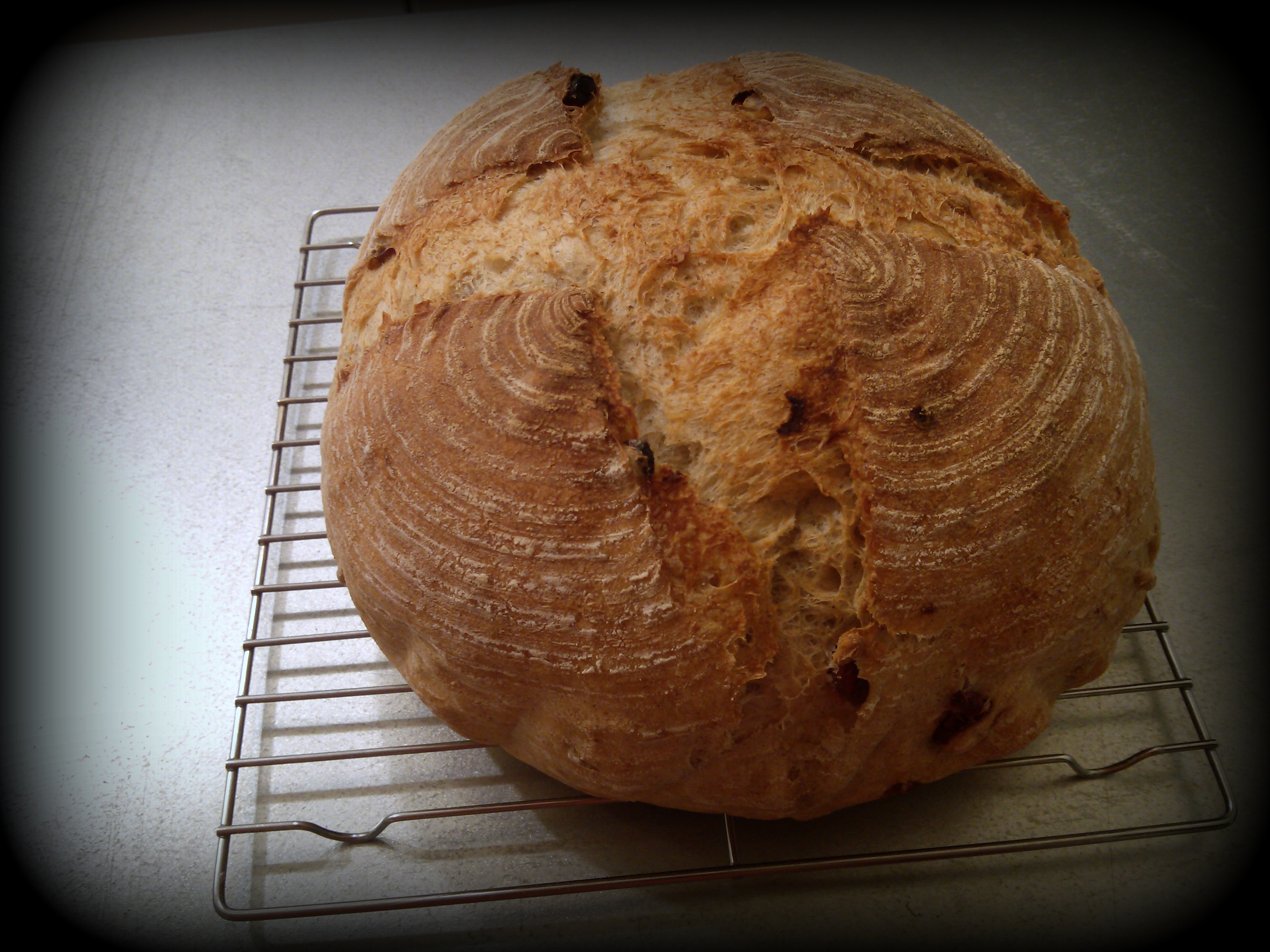
I have a long weekend coming up. No work on Monday. I’ll be baking. One of the most enjoyable parts of baking for me is giving away what I make. The harder the bread was to make, the more challenges I ran into with the recipe, the more enjoyable it is to give it away.

This weekend when I bake, I’ll be baking a bread to be donated as part of a meal for the homeless. Last weekend when I did it, I didn’t really give much thought to the people who would be eating the bread. The fun part for me was giving it away.

This weekend when I bake, I’ll make a conscious effort to work with my indifference to the plight of the homeless people who will eat the bread. I’ll work with the Just Like Me exercise. I’ll work with understanding how indifference is probably the absolute worst of the three poisons, and how it makes spiritual cultivation all but impossible.

I’m not sure how well I’ll be able to do this since growing up in the U. S. is like getting a Ph.D. in Indifference. But it is my intention that I will use baking that bread as an opportunity to soften my armor of indifference, to re-claim who I truly am, to be more in touch with my Buddha Nature of compassion.

On echoing words…

Currently I’m studying Heart Treasure of the Enlightened Ones with a Dharma friend, the Venerable Tashi Nyima.

This is my contemplation on the last two lines of verse 14 of the root text of Heart Treasure of the Enlightened Ones.

heart treasure

“All talk is like an echo,” said the Buddhas,

But these days it’s more like the re-echo of an echo.

What the echoes say and what they mean are not the same,

So don’t take any notice of these insidious echo-words.


       Explain to someone else (making it my own)

The heart sutra reminds us of the nature of samsaric existence, “All phenomena are merely empty…”. Sometimes I ask myself how that can possibly be true. Right now, I’m holding a pen. I’m sitting on a chair. My notebook’s on a table. I’m putting words on paper. None of it feels empty. And it certainly doesn’t feel like an echo of anything. It feels like the thing itself.molecules

But if you stop to think about it, a ‘pen’ is really just a conglomeration of atoms and molecules with mostly empty space between them. That’s true of my hand, the notebook, the table, my chair, even the floor that seems to be supporting me. Looked at this way, it means ‘pen’ is actually a thought about a chaotic arrangement of molecules and atoms barely held together by very strong bonds.

All right then. So, thoughts must be real, right? No. Meditation has taught me that thoughts are perhaps the most ephemeral, the most empty of our samsaric experience. If our thoughts are merely imputing meaning, and they reference unknown objects, then what is it in our samsaric experience that is not an echo? Nothing.

Samsara depends on talk—either our thoughts or our speech—to exist. And “all talk is like an echo”. It’s the nature of echoes to distort the source that gave rise to them. If we go about in the samsaric world never realizing that all we experience is a distorted echo of the reality of emptiness, we will impute reality to the echoes. We will believe, as we are constantly told, that if we just look hard enough, permanent happiness can be found in samsara. The corollary of course is that if you can’t find it, then there’s something wrong with you. You’re to blame. We live caught in this blame and shame, and Madison Avenue is the pied piper whose melody leads only to despair and disillusion.

Apply to a past situation (how would it have been different?)

A few years ago, before I had a Kindle, I went to the annual Friends of the Library sale. This is where libraries donate books they no longer want on their shelves. It’s a massive room with table after table of books. The books were priced anywhere from twenty-five cents to two or three dollars. When I went, I sought out every book Stephen King had ever written. Even though I’d already read every single one of his books, I wanted them so I could read them again. I also picked up maybe a dozen books by writers I’d always wanted to read, but never had. I had so many books I needed the suitcase I’d brought to get them to my car. I’d gone prepared.

memories4What I wasn’t prepared for was what happened once I got the books home. After spending hours combing through the tables for hardcover copies of Stephen King’s cannon, I stacked them against a wall of my living room in order by series, then time. Then I went about my life. I never read even a single one of the books I bought that day. In perhaps the ultimate irony, I ended up boxing them up and donating them to my local library.

Looking back on this, I can notice that when I went to the book sale, I was acting on an echo from my past. I was doing something “I’d always wanted to do” in the belief that it would bring me happiness. In retrospect, I can notice that Stephen King’s books had once been a source of temporary happiness in a very unhappy life. But once I was here in Texas, I was free to seek different ways to be happy, instead of relying on an echo of what had once brought very temporary release from suffering.

Having noticed that, I could have breathed, taken a step back, and taken a look at my motive for going to the book sale. I could have asked myself what I was setting out to accomplish by buying books I’d already read. The answer would have been that I had had so little freedom in my prior relationship that such a thing would have been unthinkable. Once I’d noticed this, I might have taken yet another step back and assessed my needs in my new life, and then turned my search for happiness in a direction that wasn’t a re-echo of my past.

Apply to an (ongoing) present situation (how does it matter today?)

The ongoing situation in my life right now continues to be Salem [a co-worker]. That’s becoming a really interesting place of learning the Dharma for me. These days, what once felt like a tornado of anger, resentment, and frustration has slowed down to a mild breeze with intermittent high gusts that can sometimes still knock me over.

I worked with that situation by purposely injecting the Dharma into my workday every day, on the hour. Every hour there’s a reminder that pops up on my computer that says ‘breathe’. Every time it comes up, I stop (even in if I’m typing and I’m in mid-word). I silently recite ‘om amideva rhi’ ten times, then shuffle through my Dharma Brigade stack of index cards and silently recite whatever lines of prayer come up. Then I go back to work. On my desk is a sign that says “Less Drama, More Dharma”, and a little yellow Post-It that says, “Give iless dramampermanence a chance to prove itself.” These signs are positioned in such a way that whenever I talk to Salem, they are within my peripheral vision.

I did all of this out of desperation. Honestly, I didn’t think it would work. What’s interesting is that the situation hasn’t changed at all. Salem is still Salem. She always will be.

What’s changed are the “insidious echo-words” of my thoughts. Doing this daily practice, on the spot, in the midst of the storm so to speak, has helped me to see that my thoughts were rampaging through my mind in a constant emotional hurricane. This was blinding me, deceiving me into believing I had to be a helpless victim to the constant repeating echoes. Now, the echoes still happen, but they’re quickly followed by a snippet of prayer. This has been tremendously powerful.

When the Dharma goes through my mind right on the heels of an echo-thought, it’s so easy to experience the distortion as exactly that—distortion, untruth. In contrast, the Dharma resonates in a way that is beyond language, beyond thought. It simply is. For that moment there is utter clarity and the echo simply dissolves. Of course, the echo-thoughts return, but they are easy to recognize for the distortions they are.

Apply to a potential situation (bringing it home to play)

I turn fifty next month. Yesterday in meditation the idea of a pilgrimage arose. It was very attractive. I feel somehow that this is the right time in my life to do that. Since both Mecca and Tibet (not to mention Jerusalem) are beyond my budget, I had to come up with something else. It had to be something I could do while living my ordinary life that would make me feel that I was taking a journey I’d never taken before.

pilgrimage4The idea that I’ve come up with is what I now call The Pilgrimage of 62. It would be a commitment to meditate/pray twice a day for the 31 days of March and journal for ten minutes afterward.

Oh! The echoes that came with that. The insidious echo-words were flying. “I can’t do that!” “I NEVER meditate twice Saturdays.” “What if I start, get almost all the way through, then miss one day at the very end?” “What if I get laid off?” And the ultimate trump card, “What if I get sick and die?”

In meditation, I listened quietly to monkey-mind pinging thoughts around. I really noticed how much they sounded like echoes in a giant cave. After a few seconds (and a few hundred thoughts whizzing by), I noticed something. No matter what the actual ‘words’ of the thoughts were, they were all echoes arising from one afflicted emotion: fear. The thought underlying all the echo-words was: I’m afraid I can’t do this. And it’s so important to me.

It was interesting to notice how compelling each thought was, how convincing, how utterly persuasive. From this I learned that one way to read Dilgo Khentse when he says, “What the echoes say and what they mean are not the same…” is to realize that our echo-thoughts all arise from some deeply rooted karmic formation.

I wonder if all our ‘echoes’ rise from one inescapable fear, a fear which has become so covered over and so twisted that it’s a monstrous karmic formation, eons old: One day, I’m going to die.